Deep in the rugged terrain of northern Mongolia, a prehistoric mystery has finally been solved after seven decades of uncertainty. For years, paleontologists had heard whispers of a site where giants once walked, but without precise maps or detailed records, the location remained a ghost. Now, an international team of researchers has not only rediscovered this “lost” tracksite but has uncovered proof that massive dinosaurs claimed the far northern reaches of Mongolia during a pivotal chapter in Earth’s history.
The rediscovery, announced by experts from the Institute of Paleontology at the Mongolian Academy of Sciences (IP-MAS) and the Okayama University of Science (OUS), marks a turning point for Asian paleontology. By identifying a total of 31 dinosaur footprints etched into the earth, the team has provided the first definitive evidence that the colossal titans of the Early Cretaceous—predators and herbivores alike—were thriving in regions previously thought to be inhabited only by their smaller relatives.
Resurrecting a Cold Case from the Early Cretaceous
The story of the Saijrakh tracksite began roughly 70 years ago when a Mongolian geographer published a brief, two-page report mentioning the discovery of dinosaur footprints. It was a tantalizing lead, but it lacked the scientific rigor required to pin it to a map. Without a precise locality or a thorough description, the site faded into obscurity, effectively becoming a legend rather than a verified scientific resource.
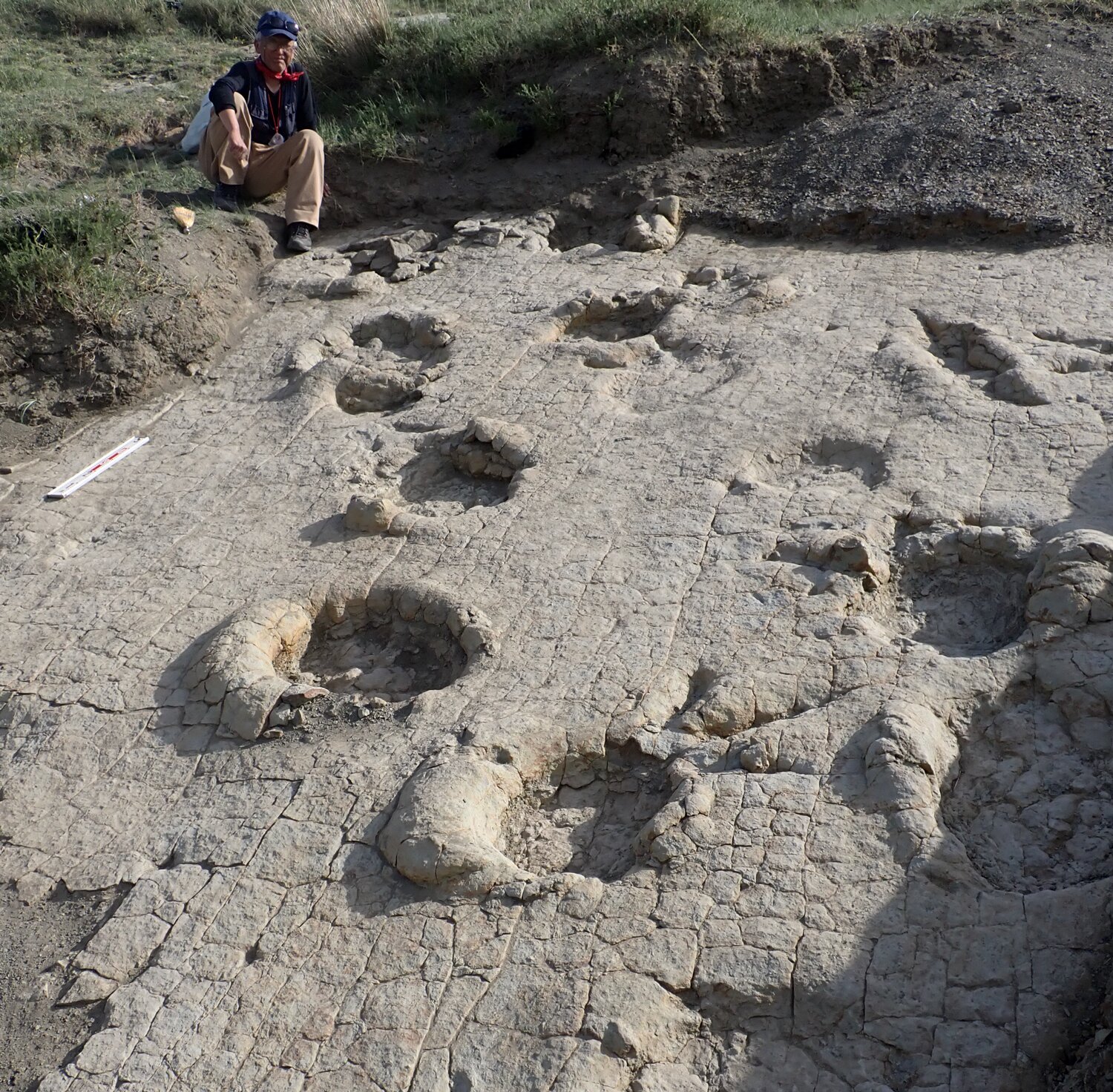
That changed in 2024 when a joint expedition set out to find the site once more. Guided by the accounts of local residents who knew the land best, the researchers finally relocated the ancient bedding surface. A follow-up, comprehensive study in 2025 allowed the team to document the site in high resolution, revealing a world frozen in time. The tracks are preserved within the Shinekhudag Formation, a geological layer representing a massive lake environment from 120 million years ago.
Scientists believe the footprints were captured during a period of environmental flux. The lake floor was primarily composed of fine black clay, but occasional thin layers of sand would settle when the water levels dropped. It was on these exposed sandy surfaces that the dinosaurs walked, leaving deep impressions that were later buried and fossilized as the lake waters returned.
Walking in the Shadow of Giants
The findings at Saijrakh are particularly significant because they fill a major gap in the fossil record. While Mongolia is famous for its Late Cretaceous fossils, remains from the Early Cretaceous are rare and typically belong to small- or medium-sized dinosaurs like Harpymimus or Psittacosaurus. The Saijrakh tracks tell a different story—one of immense scale.
The team identified the trackways of two large sauropods, the long-necked herbivores that are among the largest animals to ever walk the Earth. These specific individuals were estimated to exceed 15 meters in length. Their hind footprints, measuring approximately 70 cm long, revealed a “wide gauge” stance, suggesting a broad and stable way of moving.
Interestingly, the sauropod tracks showed a behavior remarkably similar to modern animals. The two trackways largely overlap, indicating that one dinosaur walked a specific path and a second followed nearly the same trail at a slightly slower pace. Researchers noted that this “follow-the-leader” behavior is a trait observed today in modern elephants, providing a rare glimpse into the social dynamics of the titanosauriform group.
Predators in the North
The herbivores were not alone. The survey also uncovered five distinct trackways from large theropods—the bipedal carnivores that ruled the food chain. The largest of these footprints reached 57 cm in length, belonging to a predator estimated to be more than 8 meters long.
Unlike the sauropods, the theropods showed no signs of social or gregarious behavior. Their tracks moved in random directions with toes widely splayed, suggesting solitary hunters patrolling the lake’s edge. While evidence of large predators from this era had been found previously in China and Japan, their presence in northern Mongolia and eastern Russia was largely unconfirmed until now. This discovery confirms that these apex predators had successfully expanded their range into the Mongolian north.
Connecting the Global Prehistoric Map
The implications of the Saijrakh discovery extend far beyond the borders of Mongolia. Around 120 million years ago, the planet was in the midst of a dramatic transformation. The climate was warming, and the rapid diversification of flowering plants was rewriting the rules of the ecosystem. This was also the era when dinosaurs began dispersing from Asia into North America, using Mongolia as a critical land bridge.
Because Early Cretaceous fossils are so scarce in the region, scientists have struggled to understand how animal populations transitioned between East Asia and North America. By proving that large-bodied dinosaurs inhabited this northern corridor, the research team has provided a vital link in the evolutionary chain. These tracks offer a new data point for comparing faunal assemblages across China, South Korea, Japan, and the Western United States.
Why This Matters
The rediscovery of the Saijrakh tracksite is more than just a successful trek through the desert; it is a fundamental shift in our understanding of dinosaur geography. It proves that the “empty” spaces in the fossil record are often just waiting to be found with the right documentation and local knowledge.
By confirming the existence of 15-meter-long herbivores and 8-meter-long carnivores in northern Mongolia 120 million years ago, scientists can now build more accurate models of how these animals migrated and adapted to changing climates. Furthermore, the presence of gravel-bearing sand layers near the tracks suggests that skeletal remains may be buried nearby. If found, these bones could provide the first physical look at the species that left these impressions, potentially revealing entirely new branches of the dinosaur family tree.
Study Details
Buuvei Mainbayar et al, A dinosaur ichnofauna from the Lower Cretaceous Shinekhudag Formation, Mongolia, Ichnos (2026). DOI: 10.1080/10420940.2026.2645024