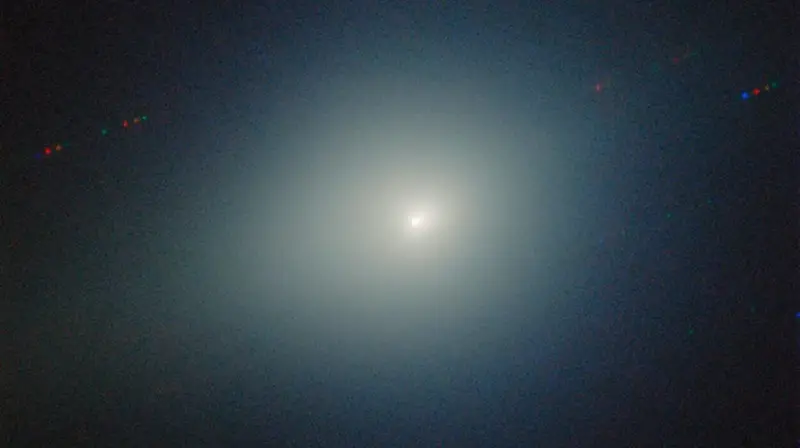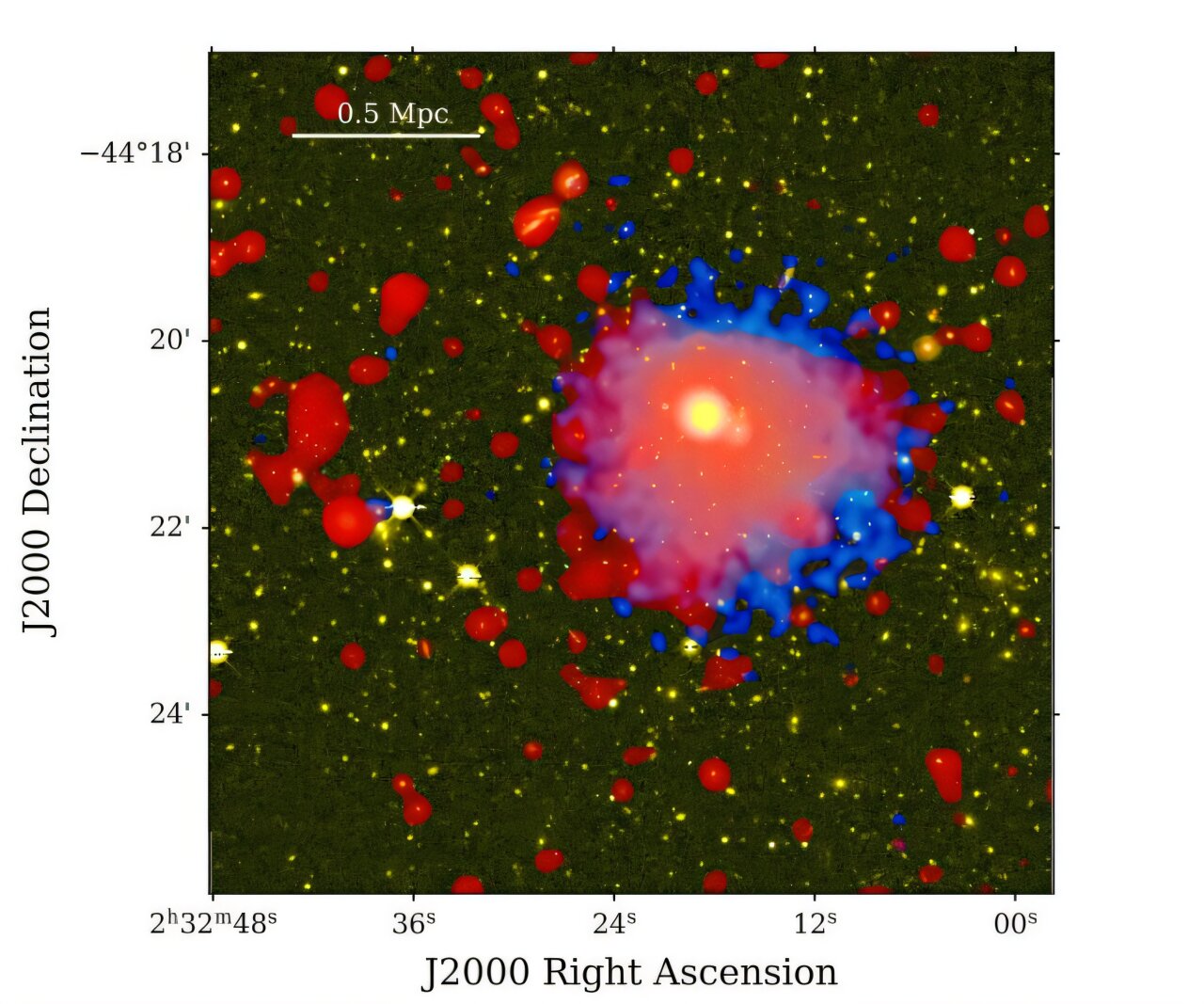
New radio observations of the galaxy cluster RXCJ0232–4420 confirm that its central diffuse emission spans more than 3.3 million light years, establishing it as a true giant radio halo system. Researchers also identified an eastern radio relic nearly 1 million light years across and found evidence that particle re-acceleration may be occurring throughout the cluster. The results strengthen the case that RXCJ0232–4420 is an unusual “in-between” cluster with both a cool core and signs of dynamical activity.
Astronomers have taken a fresh look at a galaxy cluster that has puzzled researchers for years—and the new data finally clarifies what they’re seeing. Using two powerful radio telescopes, they confirmed that RXCJ0232–4420 hosts a truly massive radio structure, one that stretches across millions of light years.
The findings, published April 29 on the arXiv pre-print server, come from observations made with the upgraded Giant Metrewave Radio Telescope (uGMRT) and South Africa’s MeerKAT radio telescope.
Why Galaxy Clusters Are Important Targets
Galaxy clusters can contain up to thousands of galaxies bound together by gravity. They are not static systems—clusters grow over time through mergers and by pulling in smaller sub-clusters.
Because of this, they provide astronomers with valuable environments for investigating how galaxies evolve and how the universe’s largest structures form.
RXCJ0232–4420 has become particularly interesting because it may help researchers understand how different types of large-scale radio structures develop inside clusters.
A Cluster With Confusing Radio Signals
RXCJ0232–4420 is a massive galaxy cluster located at a redshift of about 0.066 and was first discovered in 2002. It is described as a relaxed cool-core cluster, but with an unusual feature: it contains two brightest cluster galaxies, known as BCG-A and BCG-B, separated by roughly 330,000 light years.
Earlier studies produced conflicting interpretations of the cluster’s radio emission. Some observations found diffuse emission centered on BCG-A that resembled a typical radio mini-halo. Other work suggested the radio emission extended out to around 3.6 million light years, implying something much larger—closer to the scale of a giant radio halo.
Researchers also reported two possible radio relics to the east and south of the main emission region.
This mix of signals made RXCJ0232–4420 a standout case. If it hosted a structure larger and more powerful than a mini-halo, but not quite matching the usual behavior of a giant halo system, it could offer a rare look at how small radio features might grow into massive cluster-wide structures.
That uncertainty motivated a team led by Pralay Biswas of the National Center for Radio Astrophysics in Pune, India, to observe the cluster in more detail.
uGMRT and MeerKAT Confirm a Giant Radio Halo
The new observations provided a decisive result: the central diffuse radio emission in RXCJ0232–4420 extends beyond 3.3 million light years at all observed frequencies.
This confirms that the cluster hosts a giant radio halo, rather than only a mini-halo.
The researchers also identified an eastern radio relic with a linear size of approximately 980,000 light years, supporting earlier suggestions that relic-like structures may be present in the system.
Together, these features reinforce the idea that RXCJ0232–4420 is not a typical cool-core cluster with only small-scale radio emission.
Spectral Clues Reveal How the Emission Behaves
The study measured spectral indices—values that describe how radio brightness changes with frequency—for both the halo and the eastern relic.
The radio halo showed a spectral index of −1.17, while the candidate eastern relic had a spectral index of −0.85.
One key result was that the halo’s e-folding radius showed no significant variation with frequency. This indicates there is no strong radial spectral steepening across different frequencies, a detail that helps clarify how the emission is distributed throughout the cluster.
Evidence for Particle Re-Acceleration Across the Cluster
The spectral index maps revealed only minimal variation across the cluster region. Most pixels had spectral indices between −1.0 and −1.3.
Importantly, the researchers noted that these values are not extremely steep for a radio halo located in a cluster that contains a cool core.
This pattern suggests that in-situ re-acceleration of charged particles is occurring on small scales throughout the cluster. In other words, the particles responsible for producing the radio emission may be getting energized repeatedly across the cluster region, rather than only in one central area.
Radio and X-Ray Signals Move Together
The team also performed a point-to-point comparison between radio and X-ray surface brightness.
Their analysis found a strong positive correlation between the cluster’s non-thermal radio emission and the thermal X-ray emission from its intracluster medium. This indicates a close connection between the energetic processes producing radio waves and the hot gas traced by X-rays.
X-Ray Structure Suggests an Intermediate Dynamical State
Although RXCJ0232–4420 is considered a cool-core cluster, the study reports that its X-ray morphology and thermodynamic properties show it is not perfectly relaxed.
Instead, the results indicate it is an intermediate dynamical system. It still hosts a cool core, but it also shows evidence for mild substructure—suggesting some level of disturbance or past interaction.
This combination fits with the unusual radio properties observed in the cluster.
Why This Matters
RXCJ0232–4420 stands out because it combines characteristics that are not usually found together: a cool core alongside a confirmed giant radio halo spanning more than 3.3 million light years.
By confirming the halo’s true size and mapping its spectral behavior, astronomers now have stronger evidence that particle re-acceleration can occur throughout a cluster environment—even in systems that are not undergoing extreme disruption. The detection of an eastern relic nearly 1 million light years wide adds another key piece to the puzzle.
Taken together, these results make RXCJ0232–4420 an important system for understanding how large-scale radio structures form and evolve inside galaxy clusters, offering a clearer picture of how thermal and non-thermal processes interact across some of the largest structures in the universe.
Study Details
Pralay Biswas et al, uGMRT and MeerKAT observation of RXCJ0232-4420: a quiet cluster with a giant radio halo, arXiv (2026). DOI: 10.48550/arxiv.2604.27123