A newly discovered supernova in the galaxy NGC 1433 is giving astronomers an unusually early look at the destruction of a white dwarf star. Located about 50 million light-years from Earth, the explosion, designated SN 2026ahvu, is already brightening rapidly. Because astronomers detected it before it reaches peak brightness, they have a valuable opportunity to track how the explosion develops and investigate the physics behind one of the universe’s most useful cosmic distance markers.
The explosion was first detected on Nov. 2, 2026, by the Asteroid Terrestrial-impact Last Alert System (ATLAS). Initially cataloged as AT 2026ahvu, the object was later identified through spectroscopy as a young Type Ia supernova and given its official designation, SN 2026ahvu.
Observations show how quickly its brightness has changed. At discovery, the supernova had an apparent magnitude of approximately 17. Within just a few days, it had brightened to magnitude 13.5. Astronomers expect it to reach maximum brightness, between magnitude 10.5 and 12.1, sometime between Nov. 18 and 23.
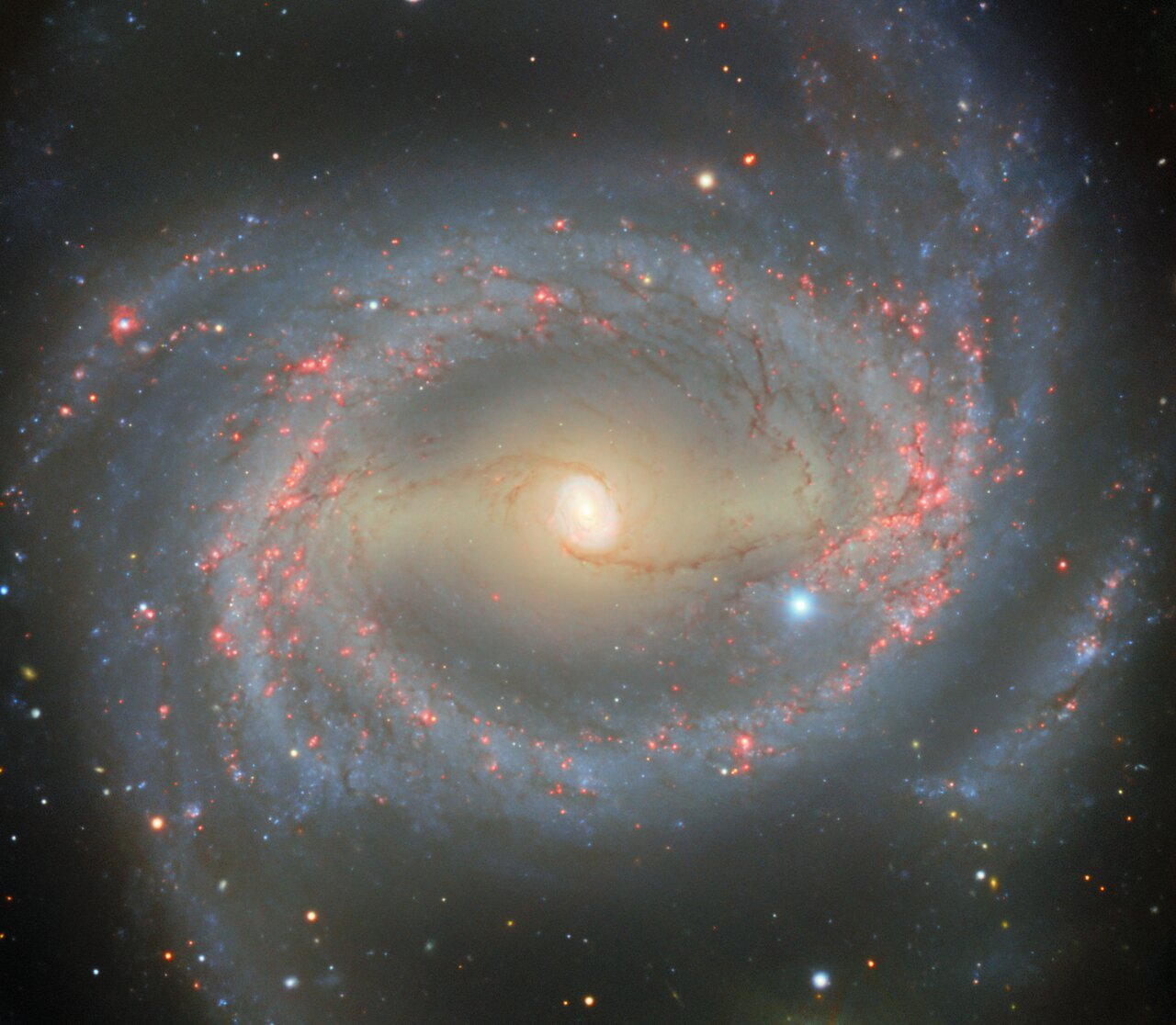
The explosion appears just below and to the right of the center of NGC 1433 in new images captured by the Dark Energy Camera (DECam) and the Gemini South telescope in Chile.
What makes this event particularly valuable is not simply its brightness or location. Its early detection gives astronomers access to stages of a Type Ia supernova that are difficult to observe and may reveal clues that disappear as the explosion develops.
Why the first days of a supernova matter
Type Ia supernovae occur when white dwarfs undergo thermonuclear explosions. White dwarfs are extremely dense stellar remnants left behind by stars similar to our Sun.
In the scenario associated with SN 2026ahvu, a white dwarf has accumulated matter from a nearby companion star before exploding. However, astronomers still have important questions about the systems that produce Type Ia supernovae and the precise conditions that trigger their destruction.
Observations made shortly after an explosion can help researchers investigate these uncertainties. They can look for evidence of interaction between the exploding white dwarf and its companion, as well as signs of material surrounding the star before the explosion.
Such clues can become harder to detect as the expanding debris changes and spreads out.
SN 2026ahvu is also one of the nearest Type Ia supernovae observed since SN 2011fe, which was discovered in the Pinwheel Galaxy, also known as Messier 101, in 2011. Its relatively close distance and discovery before peak brightness make it an especially useful target for detailed observations.
Comparing the galaxy before and after the explosion
Astronomers have an additional advantage when studying SN 2026ahvu: they already have images of its host galaxy from before the star exploded.
DECam previously photographed NGC 1433 during the Dark Energy Survey, a project conducted between 2013 and 2019 under the leadership of the U.S. Department of Energy’s Fermi National Accelerator Laboratory. The survey was designed to investigate the nature of dark energy.
Those earlier images give researchers a record of the galaxy before the supernova appeared. By comparing them with new observations, astronomers can examine the explosion’s surroundings and distinguish the newly emerged supernova from the galaxy’s pre-existing features.
The latest observations also combine two different imaging capabilities. DECam is mounted on the Víctor M. Blanco 4-meter Telescope at Cerro Tololo Inter-American Observatory in Chile, while Gemini South provides sharper images that allow a closer examination of the system.
Together, the observations help astronomers study both the supernova and its environment.
Following the explosion as it changes
The National Science Foundation’s NOIRLab is coordinating follow-up observations using Blanco/DECam, Gemini, and the Southern Astrophysical Research (SOAR) Telescope, also located in Chile.
Each type of observation contributes different information.
Repeated images allow astronomers to measure changes in the supernova’s brightness and color over time. Spectroscopy, which examines the light emitted by an object at different wavelengths, helps identify the elements in the expanding material and determine how quickly that material is moving.
Combining these measurements can help researchers reconstruct the explosion’s development, investigate the stellar system that existed beforehand, and test explanations for how Type Ia supernovae occur.
These explosions are particularly important because astronomers use them to estimate distances across the universe. Studying their underlying physics can help improve their reliability as distance-measuring tools.
Observatories around the world, including facilities operating at different wavelengths, can contribute additional observations. Coordinated monitoring across different locations and time zones also increases the chances of recording short-lived changes that an individual telescope might miss.
Amateur astronomers can also follow the supernova
SN 2026ahvu is not exclusively a target for professional observatories. At its reported brightness, the supernova is already within reach of small to moderately sized amateur telescopes under favorable observing conditions.
Observers in southern locations have a particularly good opportunity because NGC 1433 rises relatively high in their skies. Through an amateur telescope, the supernova appears as a faint point of light within its distant host galaxy.
As the explosion approaches its expected peak brightness, continued observations by both professional and amateur astronomers could help build a more complete record of its evolution.
For researchers, the most valuable information may come from following SN 2026ahvu from these early stages through its brightest phase and eventual decline. Each observation adds another measurement of an explosion whose changing light can reveal details about how white dwarfs die and how astronomers use these events to measure the expanding universe.