Ancient plant remains buried alongside a young girl sacrificed on Llullaillaco volcano have helped researchers narrow the timing of one of the most famous Inca rituals to between 1462 and 1507 CE, with 1489 CE emerging as the most likely year. The refined timeline suggests the ceremony may have served not only religious goals but also broader political ambitions during the reigns of powerful Inca rulers.
For more than two decades, the frozen mummies discovered high atop Llullaillaco volcano have fascinated archaeologists and the public alike. Preserved by the extreme conditions at an elevation of 6,715 meters (22,031 feet), the remains offered an extraordinary glimpse into the world of the Inca Empire. Yet one crucial question remained unresolved: exactly when did this ritual take place?
Now, researchers have used an unusual source of evidence—plants left as offerings beside one of the children—to provide the clearest answer yet.
In a recent study published in Archaeometry, researchers analyzed coca leaves, manioc seeds, and maize grains recovered from the burial site, allowing them to significantly refine the timing of the ritual.
A Famous Discovery High in the Andes
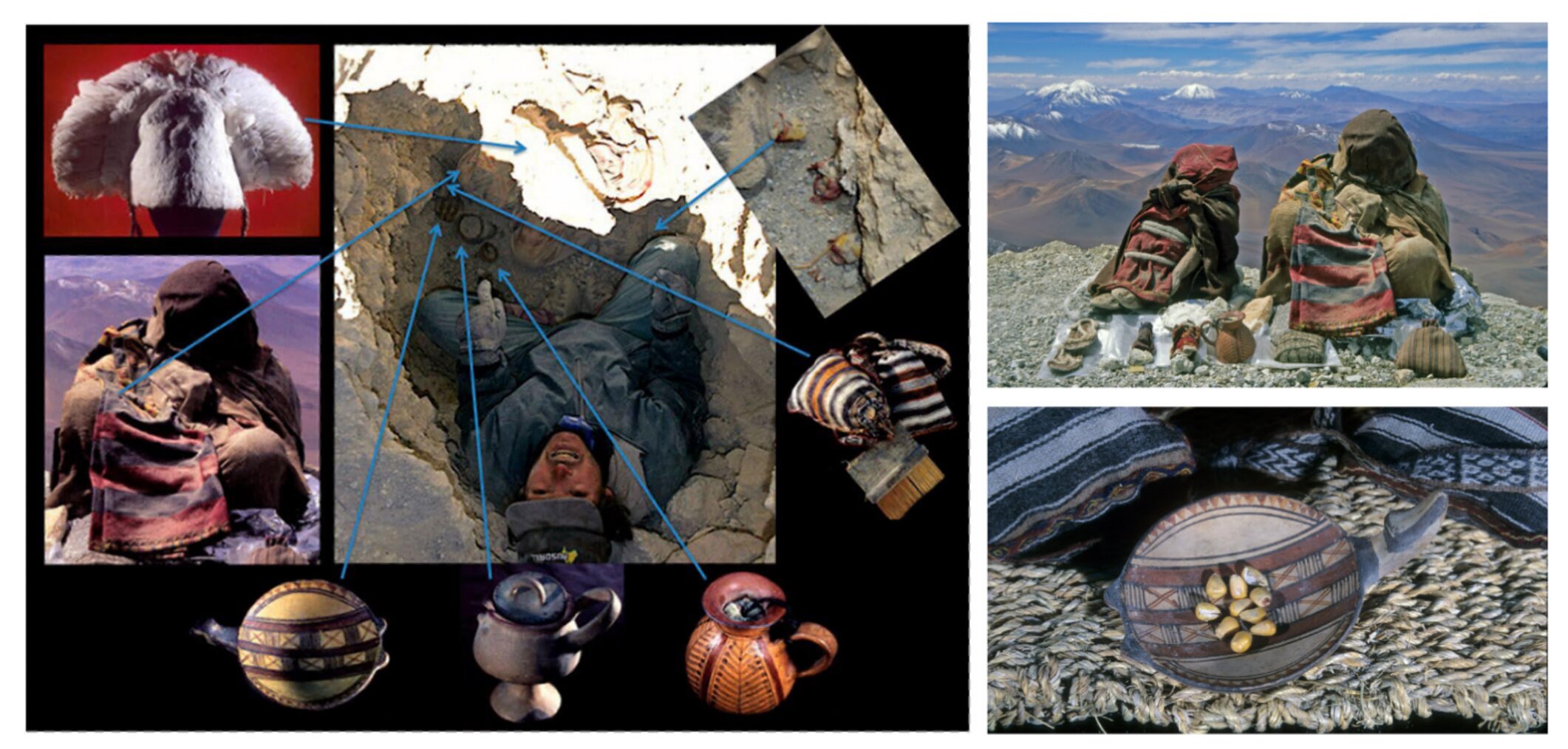
The story begins in 1999, when researchers working on the summit of Llullaillaco volcano, located on the border between Argentina and Chile, uncovered a remarkable burial site. The find included the mummified remains of three children: a 14-year-old girl known as the Maiden, a 6-year-old girl, and a 7-year-old boy.
The children were buried with a variety of offerings, and the site was linked to the Inca Capacocha ritual, a ceremonial practice involving the sacrifice of children and young women.
The discovery quickly became one of the most significant archaeological finds related to the Inca civilization. However, previous scientific dating methods could only place the burial somewhere between 1430 and 1520 CE, leaving a nearly century-long period of uncertainty.
That broad timeframe made it difficult to understand the historical circumstances surrounding the ceremony.
Looking to Ancient Plants for Answers
To achieve greater precision, researchers shifted their attention away from the human remains and toward the offerings placed beside the Maiden.
Among the objects recovered were coca leaves, manioc seeds, and maize grains. Because these plants are short-lived, they absorb carbon during a single growing season, making them especially useful for radiocarbon dating.
The team combined radiocarbon dating with stable isotope analysis, examining carbon, nitrogen, and oxygen isotopes preserved within the plant remains.
These isotopes provided clues not only about when the plants grew but also about the environmental conditions and regions where they likely originated.
The approach offered researchers a much sharper chronological snapshot than earlier analyses.
Overcoming a Complex Dating Challenge
Dating materials from the Inca Empire is not straightforward.
The empire stretched across a vast territory that included regions influenced by air masses from both the Northern and Southern Hemispheres. Because atmospheric conditions affect radiocarbon dating calculations, researchers had to account for this unusual mixing.
To improve accuracy, they employed a sophisticated mixed-calibration model tailored to the environmental realities of the region.
This careful methodology allowed them to significantly reduce uncertainty in the dating results.
A Narrower Timeline Emerges
The analysis narrowed the timing of the Llullaillaco ritual to a 45-year window between 1462 and 1507 CE.
Statistical modeling identified 1489 CE as the most likely date.
This refined chronology places the event during the reigns of two major Inca emperors, Topa Inca and his son Huayna Capac.
The new dating also carries an important implication. The sacrifice appears to have occurred decades after the Incas had already established control over the region. As a result, researchers argue that the ceremony was unlikely to have been a simple celebration of a recent military conquest.
Instead, the findings point toward more complex motivations.
Religion and Politics May Have Worked Together
The Inca Empire grew from a relatively small ethnic group into a vast political system spanning diverse landscapes, from the Pacific coast to the Amazon rainforest.
Maintaining unity across such a large and varied territory would have required more than military power alone.
With the ritual now linked to a more specific historical period, researchers suggest that Capacocha ceremonies may have played a role in reinforcing imperial authority while promoting shared religious beliefs throughout the empire.
Rather than marking a single victory over an enemy, the sacrifice may have been part of a broader strategy aimed at strengthening social cohesion and maintaining control over distant regions.
The evidence does not eliminate the ritual’s religious significance. On the contrary, honoring mountain deities likely remained a central purpose. But the new timeline suggests that political and spiritual goals may have been closely intertwined.
Not a Response to Disaster
The revised chronology also helps rule out another possible explanation.
Researchers found that the burial does not coincide with any known major volcanic eruption or extreme climate event. This weakens the idea that the ceremony was conducted primarily as a response to a natural catastrophe.
Instead, the timing points toward motivations rooted in the social, religious, and political realities of the Inca Empire itself.
That distinction is important because it shifts attention away from short-term crises and toward the larger mechanisms through which the empire governed its people.
Why This Matters
The Inca Empire left behind relatively few written records of its own, and much of what is known today comes from accounts produced after Spanish conquest. As a result, archaeologists and historians rely heavily on physical evidence to reconstruct the empire’s history.
By narrowing the date of the Llullaillaco Capacocha ritual to 1462–1507 CE, and identifying 1489 CE as the most probable year, researchers have provided a firmer historical framework for interpreting one of the most iconic Inca archaeological sites.
The findings offer a clearer understanding of how ritual sacrifice may have functioned within imperial governance, helping scholars move beyond colonial-era narratives. They also give museums and heritage institutions a more precise story to tell—one that connects religion, politics, and power in a civilization that ruled a vast and diverse landscape for centuries.