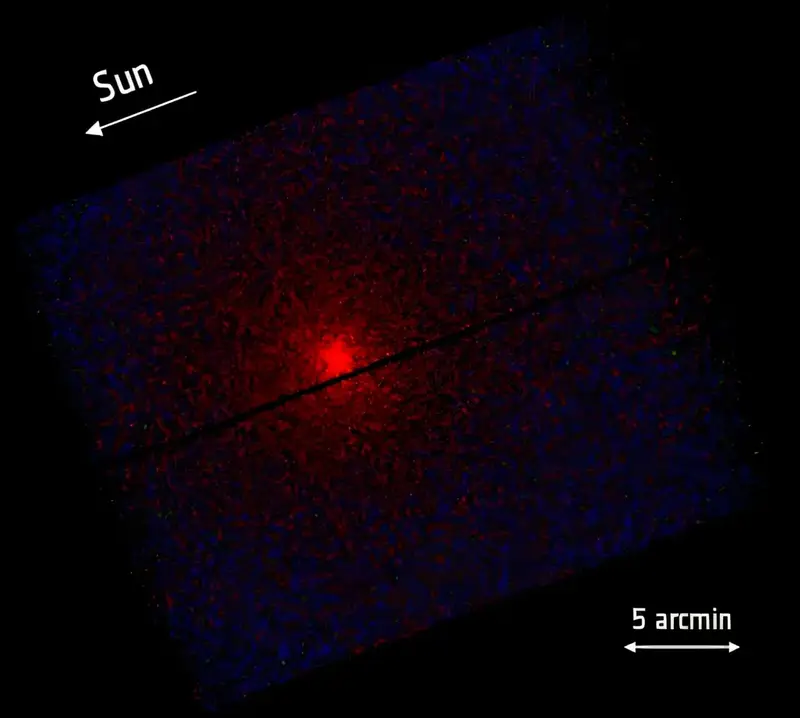
On a quiet stretch of December space, something rare drifted past the instruments of human curiosity. Interstellar comet 3I/ATLAS, a traveler from beyond our solar system, passed through a region where the European Space Agency’s X-ray observatory XMM-Newton was watching. On 3 December, the spacecraft turned its attention toward this visitor and stayed with it for around 20 hours, patiently collecting light that human eyes can never see.
At that time, the comet was far away, about 282 to 285 million kilometers from the spacecraft. Distance did not dull the moment. Instead, it sharpened it. Here was an object not born around our Sun, glowing faintly in X-rays as it crossed a realm where planets, dust, and solar wind meet. The observation was not just a technical achievement. It was a quiet encounter between humanity and something truly alien.
The Telescope That Sees the Invisible
XMM-Newton made this observation using its European Photon Imaging Camera EPIC-pn, the most sensitive X-ray camera onboard the spacecraft. This camera does not see light the way our eyes do. It records energetic signals that pass straight through darkness, revealing processes hidden from optical view.
When astronomers looked at the resulting image, they saw a subtle but unmistakable glow. In the picture, blue marks empty space with very few X-rays, while red highlights the comet’s X-ray emission. The comet did not shine like a star. It whispered instead, its presence traced by faint energy released through invisible collisions.
This glow did not come as a surprise. Astronomers expected it. They knew that when gas molecules streaming from a comet collide with the solar wind, X-rays are produced. Yet expectation does not erase wonder. Seeing theory written directly into the sky still carries emotional weight, especially when the object involved comes from beyond the solar system itself.
When Solar Wind Meets Alien Gas
The X-rays detected by XMM-Newton are born in motion. Gas molecules flow outward from the comet and encounter the solar wind, a stream of charged particles flowing through space. When they collide, energy is exchanged, and X-rays are released.
These X-rays can come from interactions with gases such as water vapor, carbon dioxide, or carbon monoxide. Those gases have already been detected by other observatories, including the NASA ESA CSA James Webb Space Telescope and NASA’s SPHEREx. But X-ray observations do something different. They are uniquely sensitive to gases like hydrogen and nitrogen.
Hydrogen and nitrogen are especially difficult to detect. They are almost invisible to optical and ultraviolet instruments. Cameras on the NASA ESA Hubble Space Telescope or ESA’s JUICE can easily miss them. X-rays, however, can reveal their presence through the energetic fingerprints they leave behind.
This is where XMM-Newton’s observation becomes more than a beautiful image. It becomes a powerful scientific tool, capable of uncovering what other instruments cannot.
A New Way to Read a Cosmic Traveler
Because X-ray observations can detect gases that are otherwise hidden, they allow scientists to study the composition of objects in a new way. This is especially important for interstellar visitors. These objects formed around other stars, under conditions that may be very different from those that shaped our own solar system.
Several groups of scientists think that the first detected interstellar object, 1I/’Oumuamua, which was found in 2017, may have been made of exotic ice like nitrogen or hydrogen. Those ideas remain difficult to test directly. 1I/’Oumuamua is now too far away for detailed study.
But 3I/ATLAS is here now, and it is close enough to observe. X-ray light offers a rare chance to probe its nature. If hydrogen or nitrogen plays a role in its behavior, XMM-Newton’s data could help reveal that story, complementing observations made at other wavelengths.
This approach does not replace optical, ultraviolet, or infrared observations. Instead, it adds a new layer. Each wavelength tells part of the story. X-rays speak for the gases that rarely show themselves.
Watching Space Write Its Own Signature
The image from XMM-Newton is simple in appearance but profound in meaning. A faint red glow marks the place where an interstellar comet interacts with our Sun’s influence. It is a record of chemistry and motion, written directly into space.
Nothing about the observation is rushed. Twenty hours of careful watching allowed scientists to gather enough data to see the glow clearly. At hundreds of millions of kilometers away, the comet was not a dramatic spectacle. It was subtle, distant, and quiet. Yet it carried with it information from another star system, encoded in its gases and revealed through X-rays.
This is how modern astronomy often works. It is not about dramatic explosions or bright flashes, but about patient listening. Instruments like XMM-Newton extend human senses into realms where nature speaks softly.
An Opportunity That Will Not Last
Interstellar objects do not wait. They pass through, briefly intersecting with our solar neighborhood before continuing on their long journeys. Each one offers only a narrow window for study.
While 1I/’Oumuamua has already slipped beyond reach, 3I/ATLAS remains accessible for now. Observations in X-ray light will work alongside data from other telescopes to help scientists figure out what this object is made of. Together, these observations may help clarify whether exotic ices like hydrogen or nitrogen are present, or whether more familiar materials dominate.
This opportunity is precious precisely because it is temporary. The comet will move on. The chance to study it up close, with a full range of instruments, will end.
Why This Discovery Matters
This research matters because it opens a door. X-ray observations of interstellar objects allow scientists to study gases that are otherwise almost invisible. They provide a way to test ideas about exotic materials that may exist in objects formed around other stars.
By observing 3I/ATLAS in X-rays, scientists gain a new perspective on what interstellar objects are made of and how they interact with the solar wind. These insights help place our own solar system in a broader cosmic context. They remind us that the materials and processes we see here are part of a much larger story unfolding across the galaxy.
Most of all, this observation matters because it shows how much can be learned from faint signals. A distant comet, a soft X-ray glow, and a patient spacecraft together reveal something extraordinary. Even in the emptiest reaches of space, there are stories waiting to be told, if we learn how to listen.
More information: For the latest updates and FAQs related to comet 3I/ATLAS, see esa.int/3IATLAS.