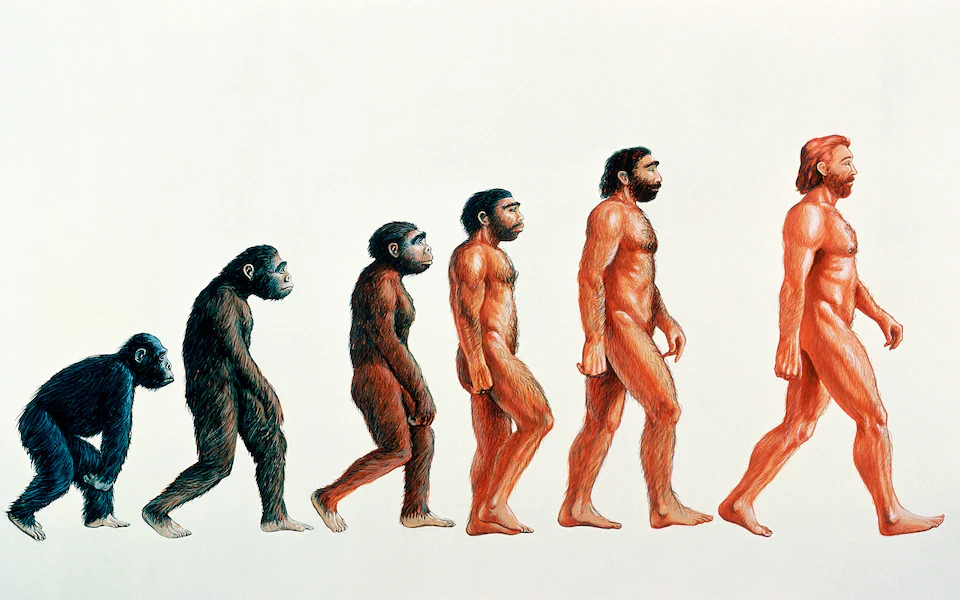
The story of human evolution is often imagined as a neat, linear procession: ape-like ancestors gradually standing upright, growing larger brains, crafting tools, and eventually becoming modern humans. In reality, evolution is far messier, branching like a tangled tree rather than climbing a straight ladder. Fossils appear, vanish, and reappear in unexpected places. Entire populations emerge, adapt, and go extinct, sometimes leaving behind only fragments of bone or stone tools as evidence of their existence.
The term “missing link” is frequently misunderstood. It does not refer to a single, half-ape, half-human creature waiting to be discovered, but to transitional populations that connect major stages in our evolutionary history. Some of these links are known only from partial remains, others are inferred from genetic or archaeological clues, and some represent periods where evidence is sparse or ambiguous. Together, they form gaps not because evolution stopped, but because fossilization is rare and discovery is uneven.
This article explores seven of the most important missing links in human evolution—key transitions where evidence is incomplete, debated, or still emerging. These moments are scientifically grounded yet emotionally powerful, because they represent turning points when our ancestors were becoming something new: more upright, more social, more inventive, and more human.
1. The Transition from Arboreal Apes to Habitual Bipeds
One of the most profound changes in human evolution was the shift from life primarily in trees to habitual walking on two legs. Bipedalism defines the human lineage more clearly than brain size or tool use, yet the exact evolutionary pathway leading to efficient upright walking remains one of the most significant missing links.
Modern apes are superb climbers, and their skeletal structure reflects this. Their hips, spines, and limbs are adapted for swinging, grasping, and climbing rather than long-distance walking. Humans, by contrast, possess a bowl-shaped pelvis, an S-shaped spine, elongated legs, and arched feet designed to support body weight during upright locomotion. The transformation between these two forms was gradual, not sudden, and likely involved multiple intermediate stages.
Fossils such as Sahelanthropus tchadensis and Orrorin tugenensis, dating back roughly six to seven million years, offer tantalizing hints. These species show skull and femur features that suggest some degree of upright posture, yet they also retain ape-like traits suited for climbing. The missing link lies in understanding how these early hominins balanced life in trees with increasing time on the ground, and why bipedalism became advantageous in the first place.
Environmental change likely played a role. As African forests fragmented and grasslands expanded, individuals capable of moving efficiently between scattered trees may have had an advantage. Standing upright also freed the hands for carrying food, infants, or tools. Still, the precise anatomical and behavioral steps that turned occasional upright posture into habitual bipedalism remain incomplete. This missing link represents the moment when our ancestors began to experience the world from a new vertical perspective, reshaping anatomy, perception, and social interaction.
2. The Gap Between Early Australopithecines and the Genus Homo
Australopithecines occupy a central place in human evolution. Species such as Australopithecus afarensis, famously represented by the fossil “Lucy,” walked upright yet retained small brains and many ape-like features. They lived between about four and two million years ago and clearly belong to the human lineage. What remains uncertain is how, and through which populations, these australopithecines gave rise to the genus Homo.
The emergence of Homo marks a critical evolutionary threshold. Members of this genus generally show larger brains, smaller teeth, flatter faces, and a greater reliance on tools. Fossils attributed to early Homo, such as Homo habilis, appear around 2.4 million years ago. Yet the transition from australopithecine body plans to the more human-like form of Homo is not cleanly documented.
Some fossils blur the boundary. Certain australopithecines display traits once thought exclusive to Homo, while some early Homo specimens retain primitive features. This overlap raises questions about whether Homo habilis represents a true evolutionary leap or simply one branch among several experimenting with new adaptations.
The missing link here is not just a fossil, but clarity about evolutionary relationships. Did a single australopithecine species give rise to Homo, or did multiple populations independently develop human-like traits? Was tool use the driving force behind brain expansion, or did dietary changes and social complexity play a larger role?
This gap matters deeply because it represents the origin of our own genus. It marks the beginning of a lineage increasingly defined by learning, cooperation, and technological dependence. Understanding this transition helps explain why humans became so distinct from other primates, even while remaining biologically connected to them.
3. The Origin of Stone Tool Technology and Cognitive Shift
Stone tools are often treated as a clear dividing line between human ancestors and other animals. The oldest widely accepted stone tools date back about 2.6 million years, associated with what archaeologists call the Oldowan industry. These tools are simple—flakes struck from a core—but they represent a radical cognitive shift.
The missing link lies in identifying who made these tools and how tool-making emerged from earlier behaviors. Tool use is not unique to humans; modern chimpanzees use sticks to extract termites and stones to crack nuts. What distinguishes early human tool-making is the intentional shaping of stone to produce sharp edges, requiring foresight, precision, and learned technique.
Some australopithecine fossils are found alongside stone tools, suggesting that tool-making may have begun before the appearance of Homo. However, direct association between specific species and tools is rare, leaving room for debate. The cognitive leap required for systematic tool production—planning a strike, anticipating fracture patterns, and teaching the skill to others—is difficult to pinpoint in the fossil record.
This missing link is as much psychological as anatomical. It represents the moment when our ancestors began externalizing thought into objects, embedding intelligence into tools that extended their physical capabilities. Stone tools changed how early humans interacted with their environment, allowing access to new food sources and altering social dynamics around sharing and cooperation.
The emotional power of this transition lies in its familiarity. Every modern human lives in a world shaped by tools. To glimpse the origin of that dependence is to witness the first sparks of technological humanity.
4. The Evolution from Homo habilis to Homo erectus
The appearance of Homo erectus marks one of the most dramatic transformations in human evolution. Compared to earlier hominins, Homo erectus had a larger brain, a more human-like body proportion, and an ability to travel long distances efficiently. This species was also the first to leave Africa, spreading across Asia and possibly Europe.
The missing link here involves the evolutionary steps connecting Homo habilis and Homo erectus. While fossils of both species exist, the transition between them is poorly resolved. Homo habilis retains relatively long arms and a smaller body, while Homo erectus displays a tall, long-legged physique adapted for endurance walking and running.
This change suggests a shift in lifestyle. Homo erectus likely relied more heavily on hunting and scavenging across open landscapes, requiring greater mobility and cooperation. Control of fire, though debated in its timing, may also have played a role by enabling cooking, warmth, and protection.
The gap between these species raises questions about the pace of evolutionary change. Did Homo erectus arise rapidly in response to environmental pressures, or did it gradually emerge through intermediate populations now lost to time? Fossils such as Homo ergaster may represent transitional forms, but classification remains contested.
This missing link reflects a moment when our ancestors became truly global, capable of adapting to diverse environments. It marks the beginning of humanity as a planetary species, long before spaceflight, through sheer biological resilience and ingenuity.
5. The Ancestral Relationship Between Homo erectus and Later Humans
Once Homo erectus spread across the Old World, it persisted for over a million years. During this immense span of time, it gave rise to multiple descendant populations. The missing link lies in understanding how these populations evolved into later forms such as Homo heidelbergensis, Neanderthals, Denisovans, and ultimately modern humans.
Fossils from this middle period of human evolution are often fragmentary and difficult to classify. Homo heidelbergensis, for example, is thought to represent a common ancestor of both Neanderthals and modern humans, yet its defining traits vary widely across regions. Some specimens appear more archaic, others more advanced.
Genetic evidence has added new layers of complexity. DNA extracted from Neanderthal and Denisovan remains reveals interbreeding with modern humans, indicating that evolutionary relationships were not strictly linear. Instead, populations diverged, met again, exchanged genes, and diverged once more.
The missing link here is not a single species, but a clear map of how these populations interacted and evolved. It challenges the traditional image of evolution as a branching tree and replaces it with a braided stream, where genetic currents merge and separate over time.
This complexity underscores an emotional truth about human history: we are not the product of a single, isolated lineage, but of encounters, exchanges, and shared survival. Our ancestry is collective, not solitary.
6. The Transition from Archaic Humans to Anatomically Modern Humans
Anatomically modern humans, classified as Homo sapiens, appear in the fossil record around 300,000 years ago. They possess a high, rounded skull, a reduced brow ridge, and a lighter skeletal frame compared to earlier humans. While these features define our species anatomically, the behavioral transition is far less clear.
The missing link lies in understanding when and how modern human behavior emerged. Traits such as symbolic thought, complex language, art, and long-distance trade do not appear suddenly with the first Homo sapiens fossils. Instead, they seem to develop gradually and unevenly across different regions.
Some early modern humans display advanced tools and symbolic artifacts, while others appear technologically similar to Neanderthals living at the same time. This overlap complicates the idea of a sharp behavioral divide between species.
The gap here is deeply human. It asks when our ancestors began to think in ways recognizably like us—telling stories, assigning meaning, and imagining futures beyond immediate survival. Fossils can show skull shape, but they cannot directly reveal inner experience.
This missing link reminds us that being human is not just a matter of anatomy, but of culture, communication, and shared imagination.
7. The Disappearance of Other Human Species
Perhaps the most haunting missing link in human evolution is the disappearance of other human species. Neanderthals, Denisovans, and other archaic humans lived alongside Homo sapiens for thousands of years. They hunted, adapted, and thrived in harsh environments, yet they eventually vanished.
The reasons for their extinction remain debated. Climate change, competition for resources, population size, and interbreeding all likely played roles. Genetic evidence shows that Neanderthals and Denisovans did not disappear entirely; parts of their DNA live on in modern human populations.
The missing link lies in understanding the balance between replacement and integration. Did modern humans outcompete other species, absorb them through interbreeding, or both? Were these encounters peaceful, violent, or varied depending on time and place?
This final gap is emotionally charged because it confronts us with the fragility of existence. Other humans were not inferior experiments; they were successful, intelligent beings who adapted to their worlds. Their disappearance is a reminder that survival is contingent, not guaranteed.
In recognizing these lost relatives, we gain perspective on our own survival. Modern humans are not the inevitable outcome of evolution, but the remaining branch of a once-diverse human family.
Conclusion: Missing Links as Windows into Humanity
The missing links in human evolution are not failures of science, but invitations to deeper inquiry. Each gap represents a moment when our ancestors were changing—anatomically, cognitively, socially—into something new. Fossils, tools, and genes offer clues, but the full story remains incomplete, shaped by chance preservation and ongoing discovery.
What makes these missing links so compelling is not just what they reveal about the past, but what they say about us. Human evolution is a story of adaptation, cooperation, and uncertainty. It is a reminder that our species emerged through countless transitions, each fragile and contingent.
In exploring these gaps, we do more than reconstruct ancient history. We confront the reality that being human is an ongoing process, rooted in deep time yet unfolding into the future.