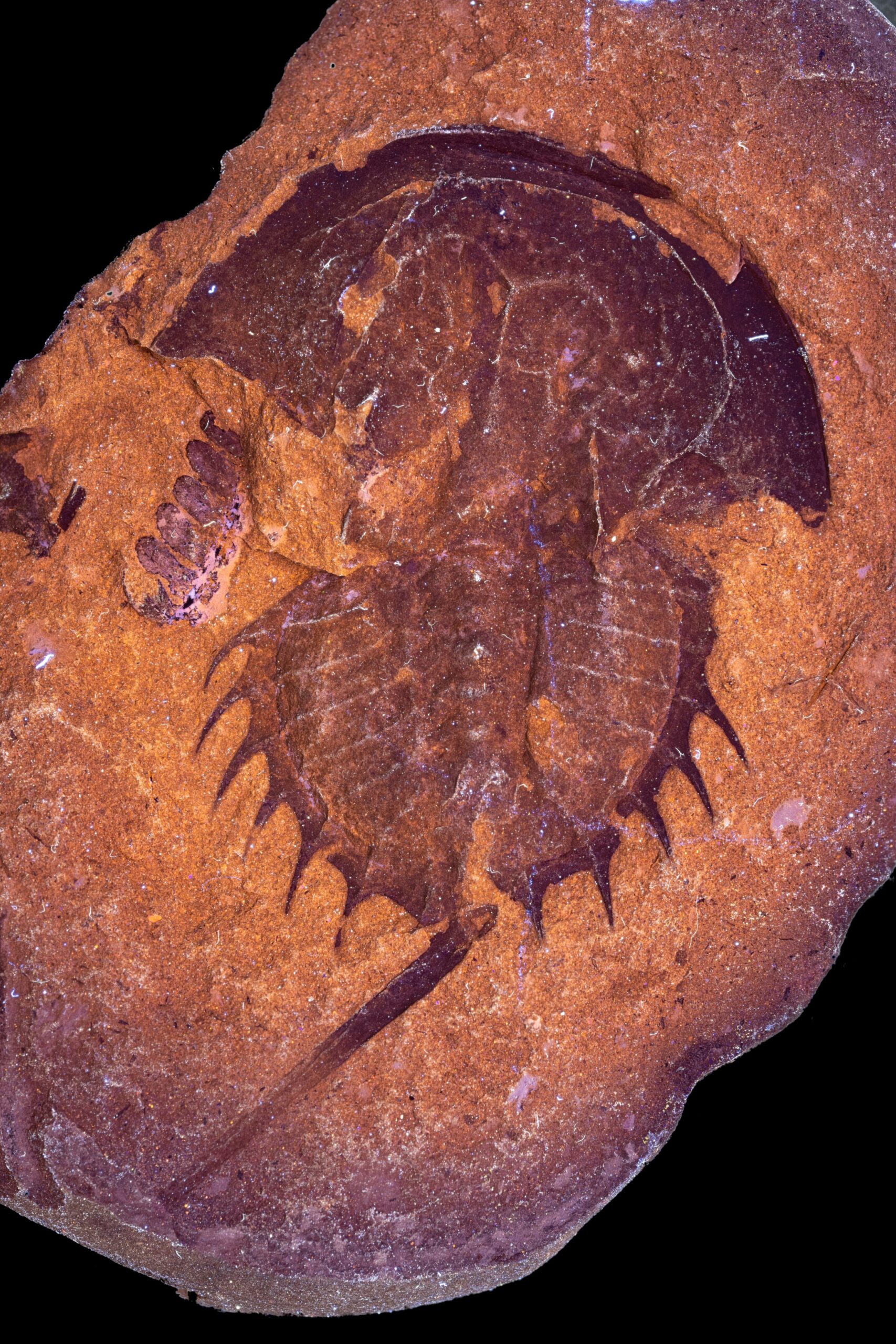
When scientists split open a smooth ironstone nodule from the Mazon Creek beds of Illinois, they did not expect to find a drama still etched in the shell of a creature that lived long before dinosaurs walked the Earth. Yet there it was. A single horseshoe crab, perfectly preserved and covered with more than one hundred tiny pits that hinted at a struggle older than any forest of conifers or any soaring pterosaur. It had lived and died in the Late Carboniferous, more than 300 million years ago, in a swamp world thick with oxygen, tangled with vast forests, and ruled by amphibians and the earliest reptile ancestors.
The fossil belonged to Euproops danae, an ancient relative of today’s horseshoe crabs. But what made this specimen extraordinary was not its shape or its age. It was its wounds. Those pits across the front of its shell offered one of the earliest known records of animal disease, a story of microbial or algal infestation that swept across a group of these ancient arthropods and left a quiet signature of suffering in stone.
A Silent Record of Battle Beneath the Shell
The research, led by Dr. Russell Bicknell of Flinders University in South Australia, set out to understand exactly what those pits meant. The fossil came not from an ordinary deposit but from the famous Mazon Creek Lagerstätte, a place where rapid burial and unusual chemistry often sealed organisms in vivid detail inside ironstone concretions. The horseshoe crab inside this one seemed frozen at a moment of crisis. Something had attacked its shell, leaving behind rows of small, rounded depressions that would have weakened the animal at its most vulnerable point.
Dr. Bicknell emphasizes that this was no isolated incident. “Ancient arthropods faced many of the same ecological pressures that modern species experience today, including microbial attacks and environmental stress,” he explains. The pits were not random marks or marks created long after burial. Their distribution and form pointed toward an infestation that had taken hold during the creature’s life, likely involving microbes or algae attaching to the shell and slowly overwhelming it.
What made the discovery even more compelling was the evolutionary context. “This fossil links a specific biological event—likely microbial or algal infestation—to a broader evolutionary picture, showing that interactions between animals and microbes were already well established long before dinosaurs evolved,” Dr. Bicknell says. He notes that the finding pushes back clear evidence of such infestations in horseshoe crabs by more than 300 million years.
The World That Preserved a Moment of Ancient Illness
Understanding what happened to this animal requires stepping into the world it once knew. The Late Carboniferous was a time of dramatic environmental change. Forests stretched across continents. Oxygen levels soared. Land vertebrates were diversifying. And among the low-lying swamps of what is now North America, conditions fluctuated constantly. Tides and storms washed fresh and salt water back and forth, creating a nutrient-rich environment that encouraged explosive microbial growth.
These same conditions made Mazon Creek an extraordinary place for fossil preservation. “The Late Carboniferous nutrient-rich environment at Mazon Creek, with its regular flooding and fluctuating salinity, would have promoted microbial growth and rapid burial,” Dr. Bicknell notes. The result was a natural factory for ironstone concretions, each one capable of sealing away an organism with remarkable clarity. Because of this, scientists can still see the subtle marks left on the horseshoe crab’s shell more than three hundred million years later.
The animal itself offers another clue. Fossil horseshoe crabs regularly shed their shells as they grow. Heavy fouling like the pits seen here suggests one crucial fact. “Heavy fouling indicates the specimen had stopped molting and reached maturity,” Dr. Bicknell explains. Whatever attacked the shell did so when the animal could no longer escape by shedding the damaged exoskeleton. Once the infestation took hold, the creature’s fate was likely sealed.
A Window Into Ancient Ecological Pressures
The significance of this discovery goes far beyond a single fossil. It reveals that ancient marine arthropods lived in complex ecological networks where microbial life played an active and sometimes harmful role. The infestation recorded on this horseshoe crab’s shell highlights how even early organisms had to navigate pressures that shaped their bodies, their behaviors, and ultimately their evolution.
“This fossil adds to a new piece of the ecological puzzle, highlighting the pressures shaping ancient marine arthropods and their evolutionary responses to infestation,” Dr. Bicknell says. In a world where life was expanding into new forms and ecosystems, diseases and microbial interactions were already influencing the fate of species. These pressures helped shape the path of evolution long before the rise of dinosaurs, long before the break of the first mammalian dawn.
The story also connects past to present. Modern horseshoe crabs, which are more closely related to spiders and scorpions than to true crabs, still encounter microbial threats in their environments today. The ancient pits on the fossil shell show that this struggle is not new. It is a battle that has echoed across deep time, changing its players but not its rules.
Why This Discovery Matters
This fossil offers something rare—a direct glimpse of disease in one of Earth’s early complex ecosystems. It reveals that microbial attacks were not a minor nuisance but a force powerful enough to shape survival. It demonstrates that ancient arthropods, despite their armored bodies and resilient lifestyles, were vulnerable to the same kinds of pressures that influence modern species.
The discovery also underscores the importance of sites like Mazon Creek, where delicate details of ancient life are preserved with exceptional fidelity. Without such fossil beds, the record of early disease would be far more fragmentary and far less revealing.
Most importantly, this research shows that the connections between animals and microbes stretch back through hundreds of millions of years of life’s history. Understanding those connections helps scientists trace the long arc of evolution, illuminating how organisms adapt, respond, and sometimes fall to the pressures of their environments.
The tiny pits on the shell of one long-dead horseshoe crab may seem small, but they carry a message from the Carboniferous world. They remind us that life has always been a negotiation between growth and threat, between flourishing and decay. They show that even in the shadows of ancient forests and beneath the surface of primeval swamps, the dance between animals and microbes was already shaping the path of evolution.
More information: Unique, dimple-like exoskeletal structures suggest syn-vivo infestations in Late Carboniferous horseshoe crabs, Biology Letters (2025). DOI: 10.1098/rsbl.2025.0565