Violent encounter from roughly 160 million years ago has been reconstructed from a remarkable fossil discovered in a museum drawer. Researchers found direct evidence that a massive marine predator likely attacked an ichthyosaur with such force that the tip of its tooth snapped off and became lodged inside the victim’s vertebra, preserving a rare moment of prehistoric life and death.
Some fossils reveal what ancient creatures looked like. Others reveal how they lived. This one appears to capture the instant when one giant marine reptile met a brutal end.
Researchers studying a curious fossil in the Yale Peabody Museum’s collection uncovered what may be one of the clearest examples yet of a predator-prey interaction among the colossal marine reptiles that inhabited the seas during the Late Jurassic. The fossil consists of an ichthyosaur vertebra pierced directly through its center by the broken tip of a tooth.
The discovery, described in the Bulletin of the Peabody Museum of Natural History, allowed scientists to reconstruct a dramatic encounter that likely unfolded in a sea near what is now Peterborough, England, around 160 million years ago.
A Tooth Broken in the Heat of the Attack
During the Age of Dinosaurs, ichthyosaurs were among the ocean’s most successful predators. Shaped somewhat like dolphins, they were fast swimmers that hunted prey such as squid and ammonites.
But according to the researchers’ interpretation, one ichthyosaur became prey itself.
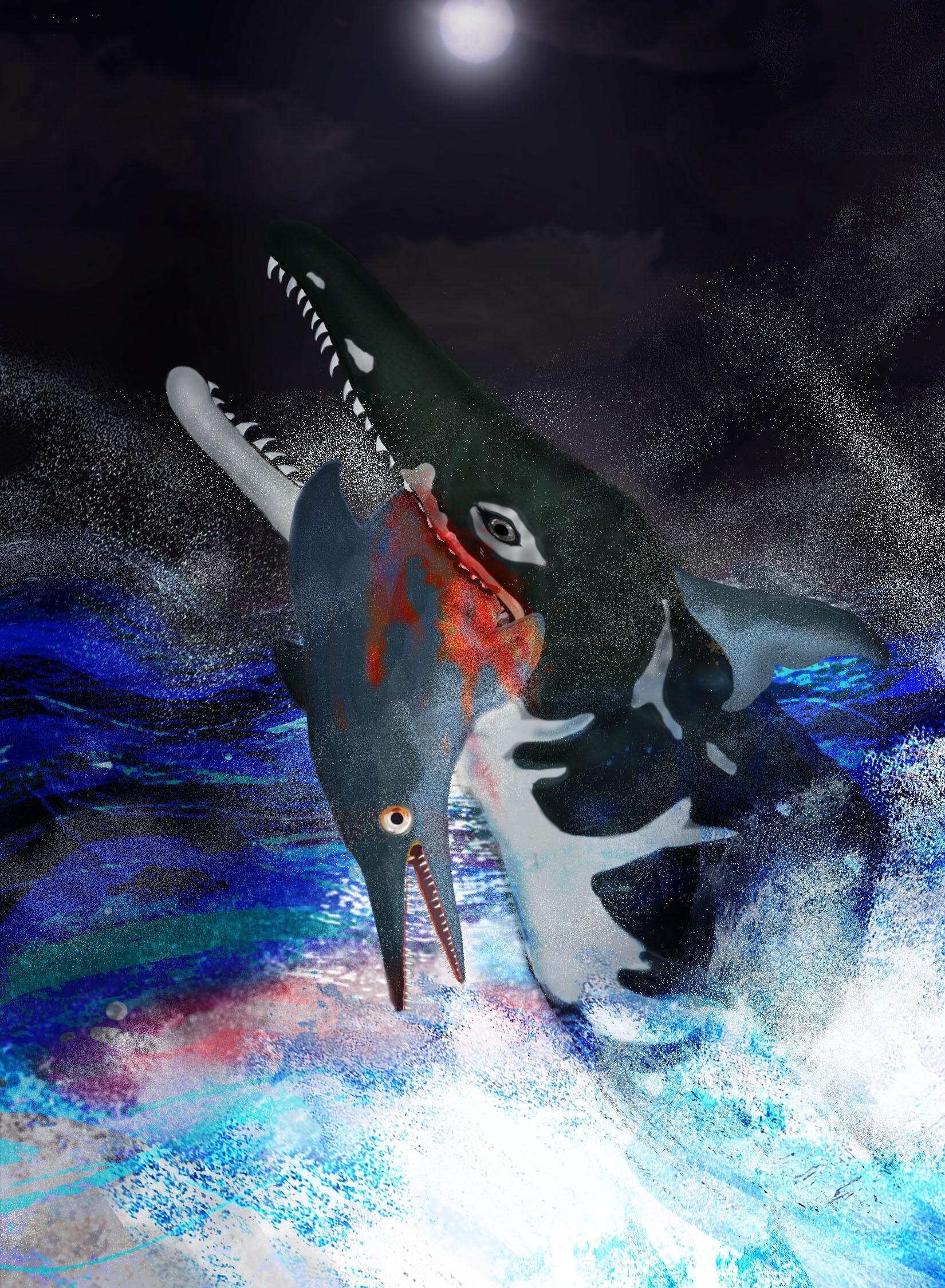
The team believes a massive pliosaur—an even larger marine reptile armed with 5-inch-long (13-centimeter-long) dagger-like teeth—attacked from below. During the struggle, one of the predator’s teeth drove through the weakest part of the ichthyosaur’s vertebra with extraordinary force.
The impact was so powerful that the tooth tip snapped off and remained embedded in the bone.
Caleb Gordon, who first became fascinated by the fossil while a Ph.D. student at Yale and now works as a postdoctoral researcher at the Florida Museum of Natural History, said the specimen immediately suggested an intense and violent event.
According to Gordon, the tooth penetrated the vertebra’s fragile center with enough force to break itself, preserving evidence of the encounter in a way that is exceptionally rare in the fossil record.
Predation or Scavenging?
The fossil does not provide a complete account of what happened.
Researchers favor the idea that the pliosaur actively hunted the ichthyosaur in an ambush-style attack. However, they acknowledge another possibility: the predator may have bitten into an animal that was already dead.
Even so, the location of the tooth and the nature of the damage make the specimen remarkable.
Giovanni Serafini of the University of Modena and Reggio Emilia, an expert on ichthyosaur carcasses, was immediately struck by the unusual placement of the tooth.
He identified the fossil as belonging to an ichthyosaur and determined that the bite occurred just above the animal’s tail. Whether the interaction represents predation or scavenging, the fossil captures a direct interaction between two prehistoric animals—something paleontologists rarely encounter.
Gordon noted that such evidence is “vanishingly rare” because fossils typically preserve bones rather than behavior.
Discovery Began in a Museum Drawer
The story behind the fossil is nearly as intriguing as the ancient attack itself.
In September 2024, Gordon was examining a drawer containing assorted ichthyosaur fossils when he noticed a vertebra with a pointed object protruding from its center.
The specimen came with only a brief label that offered little information. To uncover its identity, Gordon teamed up with Daniel Brinkman, the longtime museum assistant in Vertebrate Paleontology at Yale’s Peabody Museum.
What followed was a detailed investigation through historical archives.
The researchers traced specimen records, studied old labels, examined estate maps, and worked through difficult-to-read nineteenth-century correspondence. Their effort revealed that understanding the fossil required understanding the people who had collected, exchanged, and cataloged it over more than a century.
Following a Trail Back to the Nineteenth Century
The archival research indicated that the fossil was probably acquired by O.C. Marsh, Yale’s first professor of paleontology and founder of the Peabody Museum, sometime between 1863 and 1899.
Evidence suggests the specimen was collected around 1888 by Alfred Nicholson Leeds, a collector and farmer whose discoveries from the Oxford Clay deposits near Peterborough became famous among paleontologists.
Correspondence between Leeds and Marsh helped researchers piece together the fossil’s history and place of origin, information that proved essential for identifying both the predator and its victim.
Despite being acquired in the nineteenth century, the fossil was not formally cataloged until 1927. For decades afterward, it remained largely overlooked.
A revised label created sometime in the 1980s linked the specimen to Leeds, but the fossil eventually returned to storage, where it sat unnoticed until Gordon encountered it in 2024.
Direct Evidence for a Long-Held Idea
Before this discovery, scientists had inferred from indirect evidence that pliosaurs likely preyed on ichthyosaurs.
The newly studied vertebra provides something stronger: direct physical evidence connecting the two animals.
The embedded tooth offers tangible proof that these giant marine predators interacted in exactly the way researchers had long suspected.
For Gordon, that confirmation is significant because it validates earlier scientific interpretations that were based on careful reasoning but lacked direct fossil evidence.
The specimen therefore serves not only as a dramatic record of ancient life but also as support for hypotheses that had remained untested for decades.
Why This Matters
This unusual fossil demonstrates how a single overlooked specimen can transform scientific understanding.
Beyond documenting a likely predator-prey interaction from 160 million years ago, the discovery highlights the value of museum collections and historical archives. The fossil’s scientific importance only became clear after researchers combined paleontology with detective work, tracing records that stretched back more than a century.
Most importantly, the vertebra preserves a fleeting moment that would normally vanish without a trace. Whether it records a deadly ambush or a scavenging event, it offers an extraordinarily direct glimpse into the lives of the giant marine reptiles that once dominated Jurassic seas—a rare window into behavior, not just anatomy, from a world long gone.