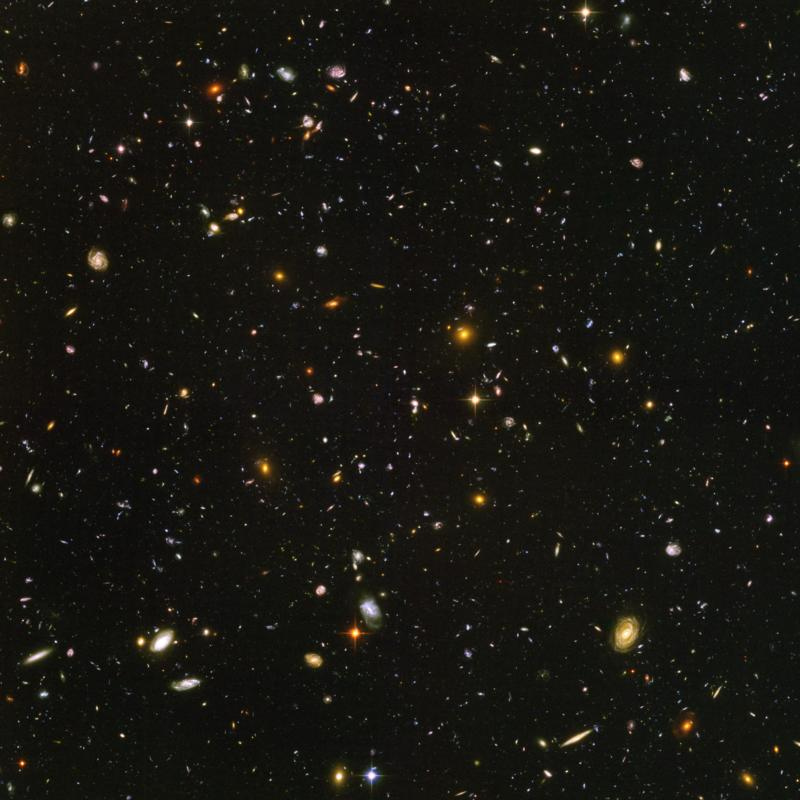
For most of human history, the universe seemed eternal and unchanging. The stars moved across the sky in predictable patterns, and the cosmos appeared stable and permanent. But the 20th century transformed that perception forever. Astronomers discovered that the universe is expanding—galaxies are moving away from one another, and space itself is stretching.
This discovery alone was revolutionary. Yet an even deeper shock arrived in the late 1990s. Scientists studying distant exploding stars found that the expansion of the universe is not slowing down as expected. Instead, it is accelerating.
This result defied decades of assumptions about gravity and cosmic evolution. Gravity, after all, pulls matter together. With billions of galaxies attracting each other across cosmic distances, the expansion should gradually slow. Instead, the opposite is happening.
The universe is expanding faster than it should.
This mystery is one of the greatest puzzles in modern cosmology. Astronomers, physicists, and mathematicians are working tirelessly to understand what force—or what misunderstanding—is driving the cosmos to accelerate.
Below are ten scientifically grounded explanations scientists are investigating to understand why the universe is expanding faster than expected.
1. Dark Energy Is Dominating the Cosmos
The most widely accepted explanation for the accelerating expansion of the universe is the existence of dark energy.
Dark energy is an unknown form of energy that permeates all of space. Unlike ordinary matter, which pulls things together through gravity, dark energy appears to have a repulsive gravitational effect. Instead of slowing expansion, it pushes galaxies apart.
Observations suggest that dark energy makes up about 68 percent of the total energy content of the universe. In contrast, ordinary matter—the atoms that form stars, planets, and people—accounts for only about five percent.
If dark energy truly fills space uniformly, then as the universe expands and more space is created, more dark energy effectively appears. This means the repulsive effect grows stronger over time.
In such a universe, gravity can never fully halt expansion. Instead, galaxies drift farther apart at increasing speeds.
While dark energy provides the simplest explanation, scientists still do not know what it actually is. It may represent a fundamental property of empty space itself.
2. The Cosmological Constant May Be Real
One of the earliest theoretical ideas related to cosmic acceleration came from Albert Einstein. When he developed the equations of general relativity in 1915, Einstein initially believed the universe was static. To allow this, he introduced a term called the cosmological constant.
This constant represented a repulsive force that could counteract gravity and maintain a stable universe.
When astronomers later discovered cosmic expansion, Einstein reportedly abandoned the cosmological constant, calling it his “greatest blunder.” But modern observations suggest he may have been closer to the truth than he realized.
The cosmological constant can be interpreted as the energy of empty space, often called vacuum energy. Even in a perfect vacuum, quantum physics predicts that tiny fluctuations constantly occur.
If vacuum energy has a small but positive value, it could produce a repulsive gravitational effect that accelerates cosmic expansion.
The problem is that theoretical predictions of vacuum energy are enormously larger than the value observed in cosmology—by a factor of up to 10¹²⁰. This mismatch is one of the greatest unsolved problems in physics.
3. The Hubble Tension May Indicate Unknown Physics
Modern cosmology measures the expansion rate of the universe using a parameter called the Hubble constant. However, two major measurement techniques produce slightly different results.
One method analyzes the cosmic microwave background—the ancient radiation left over from the early universe. Another method measures distances and velocities of nearby galaxies using supernovae and variable stars.
These two approaches disagree by several percent, a discrepancy known as the Hubble tension.
This difference may seem small, but in precision cosmology it is significant. If the measurements are both correct, then our current model of the universe might be incomplete.
Some scientists suspect that new physics—perhaps involving dark energy, dark matter, or early-universe processes—may be responsible.
The Hubble tension hints that the expansion of the universe may be more complex than we currently understand.
4. Dark Energy May Be Changing Over Time
Many cosmological models assume that dark energy is constant throughout the history of the universe. But this assumption may not be correct.
Some theories suggest that dark energy evolves with time. Instead of being a fixed property of space, it could be a dynamic field that changes strength as the universe expands.
One proposed version is known as quintessence. In this model, dark energy is produced by a slowly evolving scalar field permeating space. The energy density of this field may vary across cosmic time.
If dark energy is dynamic rather than constant, it could explain why the expansion rate has accelerated in recent billions of years.
Testing this idea requires extremely precise measurements of distant galaxies and supernovae. Future telescopes may reveal whether dark energy truly changes over time.
5. Gravity May Behave Differently on Cosmic Scales
General relativity has passed every experimental test conducted within the solar system and nearby stars. However, the universe spans distances far larger than anything we can test directly.
Some scientists propose that gravity itself may behave differently across vast cosmic distances.
Modified gravity theories attempt to adjust Einstein’s equations in ways that reproduce cosmic acceleration without requiring dark energy. In these models, gravity becomes weaker or behaves differently when objects are separated by enormous distances.
One example is f(R) gravity, where the equations governing spacetime curvature are altered. Other models involve extra fields or additional forces that become significant only on cosmological scales.
If gravity works differently across the universe than it does locally, it could explain why cosmic expansion accelerates.
This possibility challenges our deepest understanding of spacetime itself.
6. Hidden Dimensions Could Influence Cosmic Expansion
Some theoretical frameworks, particularly those inspired by string theory, suggest that the universe may contain more than the familiar three spatial dimensions.
These extra dimensions might be extremely small or hidden from direct observation. However, they could influence gravitational behavior on large scales.
In certain models, gravity can “leak” into extra dimensions. This leakage would weaken gravitational attraction between distant galaxies, allowing expansion to accelerate.
While such theories remain speculative, they provide intriguing mathematical frameworks that could potentially explain cosmic acceleration without invoking dark energy.
If extra dimensions truly exist, they would fundamentally alter our understanding of the universe’s structure.
7. Early Universe Physics May Have Left Hidden Effects
The universe’s first moments were extraordinarily energetic. Within fractions of a second after the Big Bang, rapid expansion known as cosmic inflation may have occurred.
This inflationary period smoothed and stretched the fabric of spacetime. However, it may also have left subtle imprints on the universe that influence expansion today.
Some theories suggest that fields or particles created during the early universe may still affect cosmic dynamics billions of years later.
These relic fields could behave like dark energy or interact with spacetime in unexpected ways, driving acceleration long after their original formation.
Understanding the universe’s earliest moments remains one of the most challenging tasks in cosmology, but it may hold the key to explaining present-day expansion.
8. Large-Scale Cosmic Structures May Influence Expansion
The universe is not perfectly uniform. Galaxies cluster into vast filaments, sheets, and voids forming a structure known as the cosmic web.
In theory, these large-scale structures could influence how expansion behaves locally versus globally. Some researchers propose that uneven distributions of matter might produce subtle effects that mimic cosmic acceleration.
This idea suggests that we may be misinterpreting observations because of how light travels through complex cosmic structures.
While most cosmologists believe these effects are too small to fully explain acceleration, ongoing research continues to explore whether cosmic structure contributes to the phenomenon.
Understanding the large-scale geometry of the universe is crucial for interpreting expansion measurements accurately.
9. Exotic Forms of Energy Could Exist
Dark energy might not be the only exotic energy component in the universe. Theoretical physics allows for other unusual forms of energy with strange properties.
Some models propose phantom energy, a hypothetical substance whose energy density increases as the universe expands. Such energy would cause acceleration to grow stronger over time.
In extreme scenarios, phantom energy could eventually tear apart galaxies, stars, planets, and even atoms in a hypothetical event called the Big Rip.
Other exotic possibilities include vacuum phase transitions or unknown quantum effects in spacetime.
While these ideas remain speculative, they illustrate how much remains unknown about the energy content of the universe.
10. Our Cosmological Model May Be Incomplete
Perhaps the most unsettling possibility is that our current cosmological model—the Lambda Cold Dark Matter model—simply does not capture the full complexity of reality.
This model has been remarkably successful in explaining many observations, from galaxy formation to cosmic microwave background patterns. Yet the discovery of cosmic acceleration revealed that a huge component of the universe—dark energy—remains mysterious.
Future discoveries may reveal new particles, new forces, or new aspects of spacetime that reshape our understanding entirely.
Scientific history shows that breakthroughs often occur when existing models encounter anomalies they cannot explain.
The accelerating universe may be pointing toward a deeper theory waiting to be discovered.
The Mystery Driving Modern Cosmology
The discovery that the universe is expanding faster than expected reshaped modern physics. It forced scientists to confront the possibility that most of the cosmos consists of unknown forms of energy and matter.
Today, telescopes scan distant galaxies, satellites measure ancient radiation, and particle physicists explore fundamental forces—all in pursuit of a clearer understanding of cosmic expansion.
New observatories, including next-generation space telescopes and deep-sky surveys, promise to refine measurements of the universe’s expansion history. These observations may reveal whether dark energy changes over time, whether gravity behaves differently across vast distances, or whether entirely new physics awaits discovery.
The accelerating universe reminds us that even our most successful scientific theories are only approximations of reality.
Beyond the galaxies drifting apart lies a deeper truth about the structure of space, time, and energy.
One day we may uncover the force that drives the cosmos outward.
Until then, the universe continues to expand—faster and faster—carrying galaxies away from one another into the deep, mysterious darkness of space.