Every moment of our lives unfolds in a world that appears simple and familiar. We move left and right, forward and backward, up and down. Everything we see and touch seems to exist within three directions of space. Length, width, and height form the stage on which all physical objects exist. Our homes, mountains, oceans, and even the distant planets all appear to follow this rule.
But physics tells a deeper story.
Modern science suggests that the universe is not limited to just three dimensions. In fact, reality may contain additional dimensions that we cannot directly perceive. Among these, the fourth dimension is the most fascinating and widely discussed. Sometimes it refers to time itself, forming the concept of spacetime. In other contexts, it refers to an additional spatial dimension beyond our perception.
To truly understand the universe—from the motion of galaxies to the strange behavior of particles—physicists must consider dimensions beyond the ones we experience daily. The fourth dimension challenges our intuition, stretches our imagination, and opens a window into a reality far more complex than it appears.
Understanding it does not require advanced mathematics at first. What it requires is curiosity and a willingness to imagine worlds slightly different from our own.
Below are ten profound secrets of the fourth dimension explained in a simple and engaging way.
1. The Fourth Dimension Is Often Time
One of the most important ideas in modern physics is that time is not separate from space. Instead, time acts as a fourth dimension that works together with the three dimensions of space.
This concept became widely accepted after the work of Albert Einstein and the development of the theory of relativity. In everyday life we treat time as something that simply passes, independent of where we are. But relativity revealed something surprising: space and time are deeply connected.
Together they form a unified structure called spacetime.
Imagine plotting your position in the universe. To describe exactly where you are, three numbers are not enough. You also need a moment in time. Your position on Earth at noon is different from your position at midnight, even if you stand in the same place.
In this way, time functions just like another dimension. Every event in the universe can be described using four coordinates: three for space and one for time.
This means that the path of an object through the universe is not simply a movement through space but a trajectory through spacetime.
Your life itself can be imagined as a long line stretching through this four-dimensional structure—from the moment you were born to every moment you will ever experience.
2. Spacetime Can Bend and Curve
If time is part of a four-dimensional spacetime, something remarkable follows: spacetime itself can bend.
According to Einstein’s theory of general relativity, massive objects like stars and planets distort the fabric of spacetime around them. This curvature is what we perceive as gravity.
Before Einstein, gravity was thought of as a force pulling objects together. But in the relativistic view, gravity emerges because objects move along curved paths in spacetime.
Imagine placing a heavy bowling ball on a stretched rubber sheet. The sheet dips under the weight, and smaller balls placed nearby roll toward it. They are not being pulled directly; they are following the curved surface.
Spacetime behaves in a similar way.
The Sun curves the spacetime around it, and Earth moves along that curved path. This motion appears to us as an orbit.
This idea reveals that the fourth dimension is not static. It interacts with mass and energy, shaping the structure of the cosmos itself.
3. Objects Leave Four-Dimensional Trails
In everyday life we think of objects as existing in the present moment. But in four-dimensional spacetime, an object is not just where it is now. It is a continuous path through time.
Physicists call this path a worldline.
Imagine watching a car drive down a road. At any given moment the car occupies one location. But if you consider its motion through time, the car traces a long path.
In spacetime, the car is not just a single object in one place. It is an extended structure stretching through the fourth dimension.
The same is true for every object, including you.
Your body right now is just one slice of your full existence in spacetime. Your childhood, your present moment, and your future all form different points along a continuous four-dimensional trajectory.
From a four-dimensional perspective, your entire life exists as a long curve within spacetime.
4. Time Can Flow at Different Speeds
One of the most surprising consequences of the fourth dimension is that time does not pass at the same rate everywhere.
According to relativity, time slows down when objects move very fast or when they are near massive gravitational fields.
This phenomenon is called time dilation.
Astronauts traveling at extremely high speeds experience time slightly more slowly than people on Earth. Similarly, clocks near massive objects like neutron stars tick more slowly compared to clocks far away.
These effects are usually tiny in everyday conditions, but they have been confirmed by precise experiments. Even satellites used in global positioning systems must account for time dilation to maintain accuracy.
The existence of time dilation means that the fourth dimension is flexible. It stretches and compresses depending on motion and gravity.
In a sense, time behaves more like space than we once imagined.
5. The Fourth Dimension Allows Strange Geometry
Geometry in three dimensions already includes fascinating shapes such as spheres, cubes, and pyramids. But if a fourth spatial dimension exists, entirely new geometrical structures become possible.
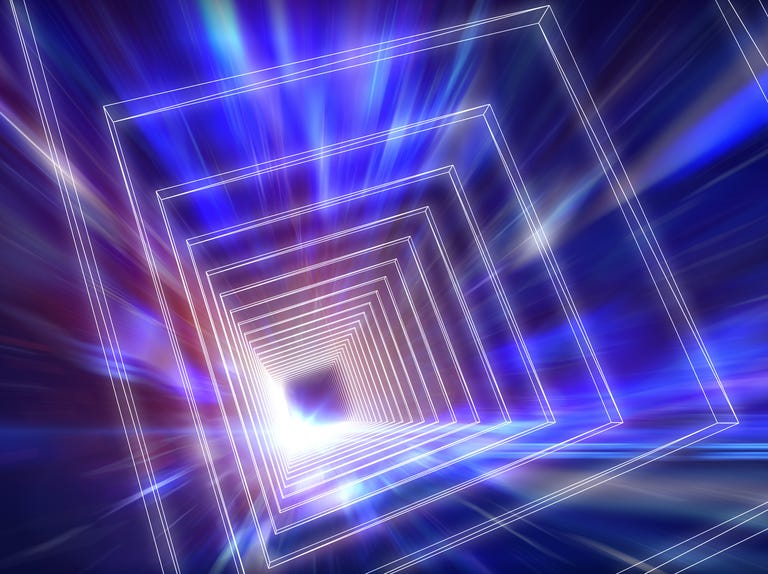
A four-dimensional cube, for example, is known as a tesseract.
Just as a cube is built from squares, a tesseract is built from cubes. It is a structure that cannot fully exist within our three-dimensional world.
We can only see projections of it, much like a shadow.
When mathematicians visualize a tesseract, they often draw a smaller cube inside a larger cube connected by edges. This diagram is only a representation of a shape that truly exists in four spatial dimensions.
If such a structure existed physically in higher-dimensional space, it would appear almost magical to us.
Objects could seemingly appear or disappear as they passed through our three-dimensional world.
6. Higher Dimensions May Exist in Physics
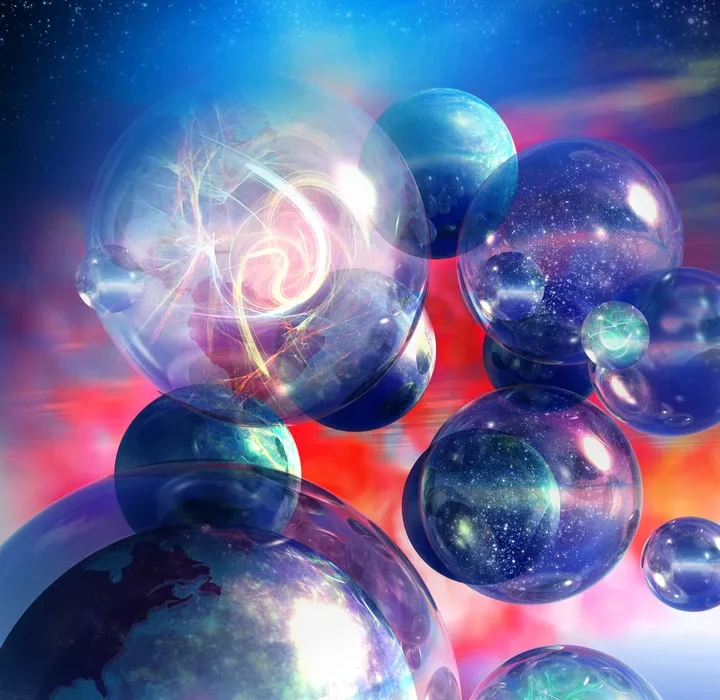
The idea of additional dimensions beyond the fourth is not merely speculation. Some modern theories of physics propose that the universe contains many hidden dimensions.
String theory, for example, suggests that reality may have ten or even eleven dimensions.
Most of these dimensions would be extremely small—curled up at scales far smaller than atoms. Because they are so tiny, we cannot perceive them directly.
Yet their existence could influence the behavior of fundamental particles and forces.
In these theories, gravity, electromagnetism, and other forces might arise from the geometry of higher-dimensional space.
If this is true, the universe is far more complex than the three-dimensional world we experience.
Our perception would represent only a thin slice of a much richer multidimensional reality.
7. A Four-Dimensional Being Would See Everything at Once
Imagining life in four spatial dimensions leads to fascinating thought experiments.
A being that exists in four dimensions could perceive our three-dimensional world in ways we cannot comprehend.
To understand this idea, consider a two-dimensional world like a flat sheet of paper. Creatures living in that world would only see length and width. Height would be invisible to them.
If a three-dimensional object passed through their world, they would see strange shapes appearing and disappearing as slices of the object intersected their plane.
Similarly, if a four-dimensional object entered our world, we would only see three-dimensional slices of it.
A four-dimensional being might be able to see the inside of closed objects, just as we can see the inside of a two-dimensional drawing.
Even more astonishing, such a being might see our entire timeline at once—past, present, and future existing simultaneously in spacetime.
8. The Fourth Dimension Shapes the Universe
Cosmic events are deeply connected to the geometry of spacetime.
Black holes, for example, are regions where spacetime is curved so intensely that nothing—not even light—can escape.
Near a black hole, the fourth dimension behaves in dramatic ways. Time slows drastically compared to distant observers.
For someone falling toward the event horizon, time would appear normal. But to someone watching from far away, the falling object would seem to slow and freeze.
This strange behavior arises from the structure of spacetime itself.
Similarly, gravitational waves—ripples in spacetime—travel across the universe when massive objects collide. These waves are distortions not only of space but also of time.
The fourth dimension is not merely an abstract idea. It plays a central role in the dynamics of the cosmos.
9. The Fourth Dimension Challenges Our Perception of Reality
Our brains evolved to navigate a three-dimensional environment. As a result, thinking about higher dimensions feels unnatural.
Yet mathematics allows us to describe spaces with any number of dimensions.
By extending geometric ideas, mathematicians can explore shapes and relationships in four, five, or even infinitely many dimensions.
These mathematical spaces often reveal patterns that help physicists understand the real universe.
For example, complex quantum systems are often described using multidimensional mathematical spaces called Hilbert spaces.
Although we cannot visualize these spaces directly, their mathematical structure provides powerful tools for understanding nature.
The limits of human perception do not define the limits of reality.
10. The Fourth Dimension May Hold the Key to Unified Physics
One of the greatest goals in physics is the unification of all fundamental forces.
Currently, gravity is described by general relativity, while the other forces are described by quantum mechanics. These two frameworks are incredibly successful but difficult to combine.
Some proposed solutions involve higher-dimensional models of spacetime.
In certain theories, the extra dimensions allow gravity and quantum forces to emerge from a single underlying structure.
If such a theory is confirmed, the fourth dimension—and possibly additional ones—could play a crucial role in revealing the ultimate laws of the universe.
Understanding higher dimensions may one day allow us to explain phenomena that currently remain mysterious, from dark matter to the origin of the cosmos itself.
The Universe Beyond Our Senses
The fourth dimension challenges the boundaries of human understanding. It forces us to rethink time, space, motion, and existence itself.
What once seemed like science fiction is now central to modern physics. Time as a dimension, spacetime curvature, black holes, and gravitational waves are all consequences of this deeper structure.
Yet our exploration of dimensions is still in its early stages. The universe may contain hidden layers of reality beyond anything we can directly observe.
Perhaps future discoveries will reveal that the cosmos is woven from many dimensions interacting in ways we are only beginning to grasp.
When we imagine the fourth dimension, we step outside the narrow limits of everyday experience and glimpse a universe that is richer, stranger, and more beautiful than we ever expected.
And that realization—that reality is deeper than our senses can perceive—is one of the most profound discoveries humanity has ever made.