There are places in the universe where the rules we trust collapse.
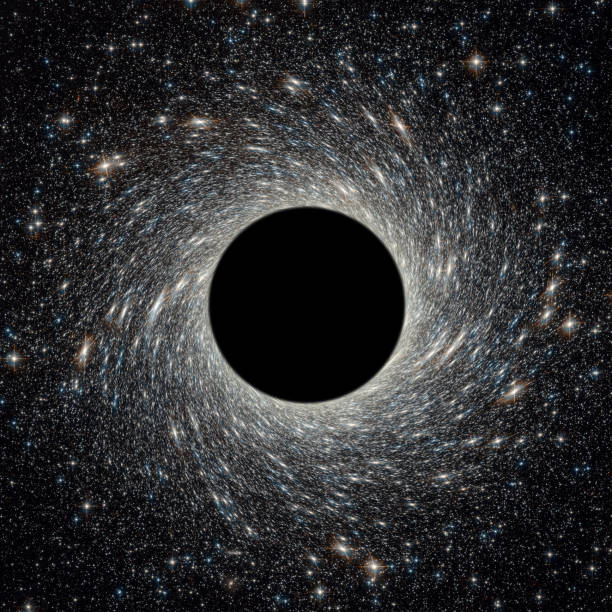
Places where space twists in on itself, where time stretches and snaps, where gravity becomes so overwhelming that even light—the fastest thing in existence—cannot escape. These are black holes: not holes in space, but regions where spacetime is curved into an abyss.
They are born in violence. When massive stars exhaust their nuclear fuel, their cores collapse under gravity. If the remaining mass is sufficient, no known force can halt the implosion. The result is a region so dense and compact that it warps spacetime beyond recognition.
Black holes are not science fiction. They are predicted by Einstein’s theory of general relativity and confirmed by astronomical observation. We have detected gravitational waves from merging black holes. We have imaged the shadow of supermassive black holes at galactic centers.
And yet, what happens inside a black hole remains one of the most terrifying and profound mysteries in physics.
Here are ten scientifically grounded, deeply unsettling facts about what occurs within these cosmic abysses.
1. Crossing the Event Horizon Is a One-Way Journey
At the boundary of every black hole lies the event horizon.
The event horizon is not a physical surface. It is a mathematical boundary in spacetime. It marks the point beyond which nothing—not light, not particles, not information—can escape back to the external universe.
For a non-rotating black hole described by the Schwarzschild solution to general relativity, the radius of this boundary is called the Schwarzschild radius. It depends solely on the black hole’s mass. For a black hole with the mass of our Sun, that radius would be about three kilometers. For supermassive black holes containing millions or billions of solar masses, the event horizon spans millions of kilometers.
If you were to approach a sufficiently large black hole, you might not notice the moment you crossed the event horizon. There would be no wall, no sudden jolt. Locally, physics would seem normal. But globally, your fate would be sealed.
Inside the horizon, all future-directed paths through spacetime lead inward. Escape would require moving faster than light—an impossibility according to relativity.
Terrifyingly, once you cross, the singularity is not just somewhere in space ahead of you. In a deep sense, it is in your future. Just as tomorrow cannot be avoided in ordinary life, the singularity cannot be avoided once you are inside.
The event horizon is a cosmic point of no return.
2. Time Slows to a Crawl—From the Outside
Black holes distort not only space but time.
According to general relativity, gravity affects the flow of time. The stronger the gravitational field, the slower time passes relative to distant observers. This phenomenon, known as gravitational time dilation, has been measured even on Earth using atomic clocks at different altitudes.
Near a black hole, this effect becomes extreme.
If you were to fall toward a black hole while a distant observer watched through a powerful telescope, that observer would see your clock tick more and more slowly. Your signals would become increasingly redshifted, stretched to longer wavelengths by the intense gravity.
From the outside perspective, you would appear to freeze at the event horizon, fading and reddening until your light disappears.
But from your own perspective, time would pass normally. You would cross the horizon in finite time, unaware that, to the rest of the universe, you seem suspended at the brink forever.
This duality is one of the strangest features of black hole physics. Two observers, each correct in their own frame of reference, would describe radically different realities.
Time itself fractures under gravity’s pressure.
3. Spaghettification Is Not a Metaphor
As you fall deeper into a black hole, gravity’s pull on your feet becomes stronger than its pull on your head. This difference in gravitational force across your body is called a tidal force.
On Earth, tidal forces from the Moon stretch our oceans, producing tides. Near a black hole, tidal forces can stretch matter into thin strands.
This process is colloquially known as spaghettification.
For small black holes—those formed from collapsing stars—tidal forces near the event horizon are extreme. A human approaching such a black hole would be stretched vertically and compressed horizontally long before crossing the horizon. Molecules would be pulled apart. Atoms would eventually disintegrate.
For supermassive black holes, tidal forces at the event horizon can be weaker. In principle, you could cross the horizon intact. But as you continue inward, tidal forces grow relentlessly.
There is no structural integrity that can withstand infinite curvature. Every object, from spacecraft to stars, is ultimately shredded by gravitational gradients.
Inside a black hole, shape becomes irrelevant. All matter is drawn into a narrowing funnel toward destruction.
4. The Singularity Is a Place Where Physics Breaks
At the center of a classical black hole lies the singularity.
In general relativity, a singularity is a point where curvature becomes infinite and density becomes infinite. It is not merely a very small, very dense object. It is a breakdown in the mathematical description of spacetime.
Infinite quantities in physics usually signal that a theory is incomplete.
The singularity predicted by general relativity is hidden within the event horizon. This is consistent with the cosmic censorship conjecture, which suggests that singularities are always concealed from external observers.
But what truly exists at the center?
Most physicists believe that quantum effects become dominant near the singularity, and that a full theory of quantum gravity would replace the classical singularity with something finite and physically meaningful.
Perhaps spacetime becomes quantized. Perhaps there is a core of extreme but finite density. Perhaps new physics emerges entirely.
What is terrifying is not just the singularity itself, but the realization that our best theory of gravity fails there.
Inside a black hole, we reach the limits of knowledge.
5. Information May Never Truly Disappear
In the 1970s, physicist Stephen Hawking discovered that black holes are not entirely black. Quantum effects near the event horizon cause them to emit radiation—now known as Hawking radiation.
This radiation arises because quantum fields in curved spacetime can produce particle-antiparticle pairs. One falls into the black hole; the other escapes. To an external observer, the black hole slowly loses mass.
Over immense timescales, a black hole could evaporate completely.
But here lies the paradox.
Quantum mechanics insists that information is conserved. The complete description of a system at one time determines its description at any later time. But Hawking radiation, as originally calculated, appeared to be purely thermal—carrying no information about what fell into the black hole.
If a black hole evaporates and the information about its contents is lost, quantum mechanics would be violated.
This is the black hole information paradox.
Decades of debate have followed. Modern theoretical developments suggest that information may be encoded in subtle correlations within Hawking radiation, possibly through mechanisms related to holography.
The prevailing view today is that information is not destroyed. But how it escapes remains deeply subtle.
Inside a black hole, information seems to vanish. Yet at a fundamental level, nature may refuse to forget.
6. Spacetime Inside May Be Radically Different
In a non-rotating black hole, the singularity is often described as a point. But in more realistic rotating black holes, described by the Kerr solution, the internal structure is more complex.
Instead of a point singularity, the mathematics predicts a ring singularity. Surrounding it are regions where spacetime behaves in bizarre ways.
Some solutions of Einstein’s equations even suggest the theoretical possibility of wormhole-like structures or paths to other regions of spacetime.
However, these exotic features are highly unstable. Even tiny perturbations would likely destroy such structures. Most physicists believe realistic black holes do not permit safe passage to other universes.
Still, the equations reveal that spacetime inside a rotating black hole is not simply a straight descent to a point. It may involve horizons within horizons, regions where time and space swap roles, and areas where predictability fails.
The interior is not just dark. It is geometrically alien.
7. You Cannot See What Is Ahead of You
Outside a black hole, light travels outward in all directions. Inside the event horizon, all light paths curve inward.
Even if you carried a powerful flashlight, its beam would not illuminate what lies ahead. The light would bend toward the singularity along with you.
This means that inside the event horizon, the concept of “forward” becomes distorted. Every direction you move leads deeper.
In normal space, you can choose a direction and potentially reverse course. Inside a black hole, spacetime geometry itself denies that freedom.
The inability to see what is ahead is not merely metaphorical. It is a geometric inevitability.
Darkness is not the absence of light. It is the inescapable curvature of spacetime itself.
8. The Interior May Be Holographically Encoded on the Surface
One of the most profound ideas to emerge from black hole physics is the holographic principle.
Studies of black hole entropy—particularly by physicists like Jacob Bekenstein—revealed that the entropy of a black hole is proportional not to its volume, but to the area of its event horizon.
This was astonishing. In ordinary systems, entropy scales with volume. But for black holes, the information content appears to be encoded on a two-dimensional surface.
This led to the conjecture that the information about everything that falls into a black hole may be stored on its horizon, much like a hologram.
In some interpretations, the entire three-dimensional interior could be described by data encoded on a two-dimensional boundary.
If true, this idea has implications far beyond black holes. Some physicists speculate that our entire universe may operate holographically.
Inside a black hole, reality may not be what it seems. Depth itself could be an emergent illusion.
9. The Journey to the Singularity Is Finite
It may feel eternal, but the fall toward the singularity is not infinite in duration.
For an object crossing the event horizon of a Schwarzschild black hole, the proper time—the time measured by a falling clock—until reaching the singularity is finite.
For a stellar-mass black hole, this time could be fractions of a second.
For supermassive black holes, it might be longer—minutes or hours, depending on the mass and initial conditions. But it is never infinite.
Once inside, there is no indefinite wandering. The geometry ensures that the singularity lies in your future, and that future arrives.
The fall is inevitable.
Gravity does not simply pull. It rewrites destiny into the structure of spacetime.
10. Black Holes May Outlive Everything
Black holes are not merely destroyers. They are among the most durable objects in the universe.
Stars exhaust their fuel and fade. Galaxies collide and transform. Even protons may eventually decay over unimaginably long timescales.
But supermassive black holes at galactic centers can persist for trillions upon trillions of years.
Hawking radiation causes black holes to evaporate, but the timescale for a supermassive black hole to disappear is staggeringly long—far exceeding the current age of the universe by many orders of magnitude.
In the distant future, after stars have burned out and galaxies have dimmed, black holes may dominate the cosmos.
Only after incomprehensible expanses of time will they slowly evaporate into a thin bath of radiation.
Inside them, for most of cosmic history, matter and information remain locked away.
Black holes are both tombs and time capsules.
They represent not just an end, but a long, dark endurance.
The Abyss and the Frontier
Black holes are terrifying because they confront us with limits.
Limits of escape. Limits of light. Limits of matter. Limits of knowledge.
They expose the seams in our theories and force us to grapple with the unification of gravity and quantum mechanics. They challenge our intuitions about time and space. They hint that reality may be holographic, that information is fundamental, that spacetime itself may be emergent.
And yet, they are not monsters lurking in the dark. They are natural consequences of gravity obeying Einstein’s equations.
The same laws that keep planets in orbit and galaxies bound together also give rise to these cosmic abysses.
Inside a black hole, the familiar dissolves. But in that dissolution lies one of the greatest frontiers of physics.
To understand what happens within is to push against the boundary of human comprehension.
And perhaps that is the most terrifying fact of all: that beyond the event horizon, the universe keeps its deepest secrets—waiting for a theory not yet written.