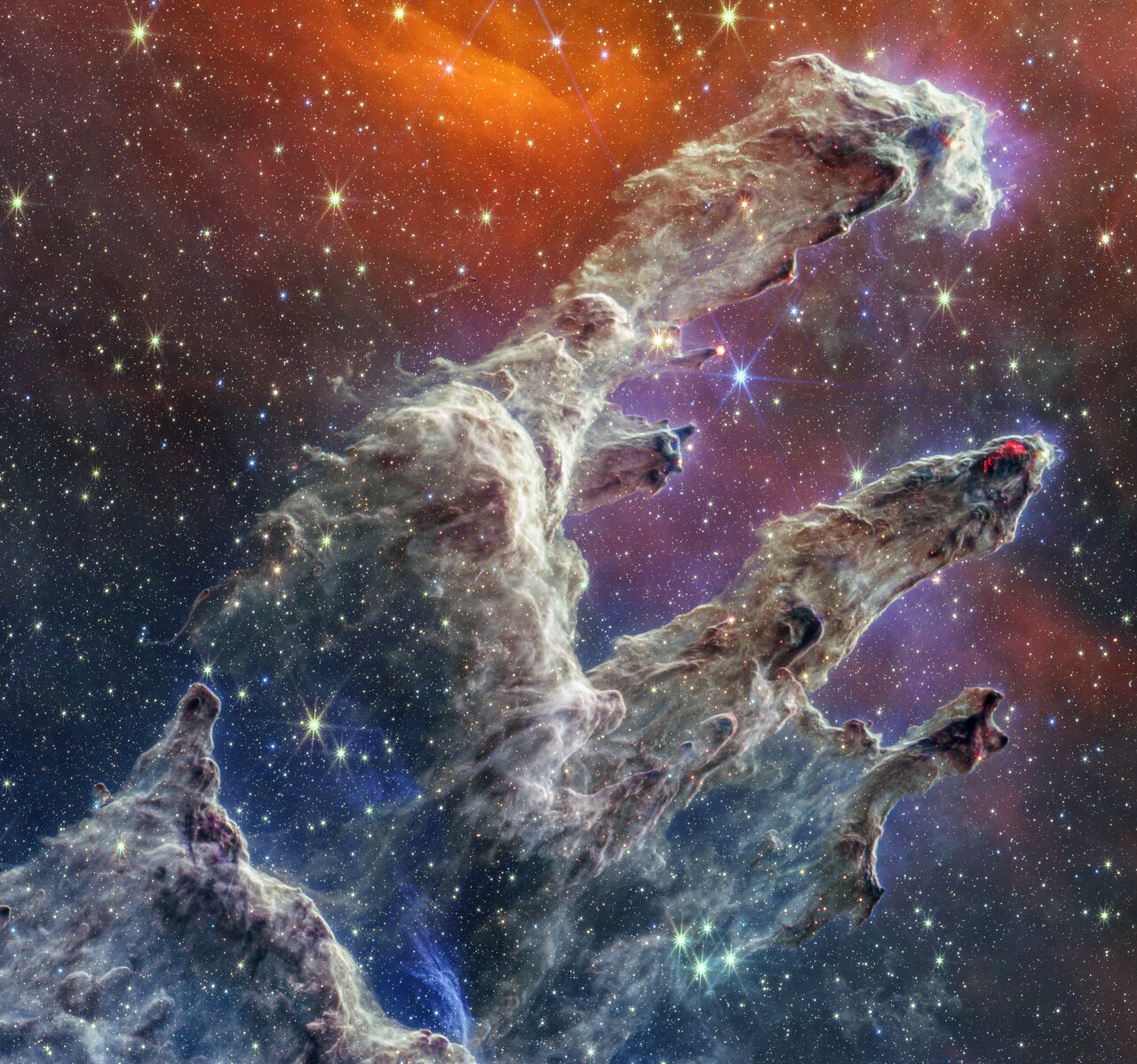
The Pillars of Creation are among the most recognizable and emotionally powerful images ever produced by astronomy. Rising like ghostly spires from a luminous cloud of gas and dust, they appear at once ancient and alive, sculpted by forces that operate on scales of time and energy far beyond ordinary human experience. First made famous by the Hubble Space Telescope in 1995, the Pillars of Creation are located within the Eagle Nebula, a vast star-forming region in our Milky Way galaxy, roughly 6,500 light-years from Earth.
At a glance, the Pillars seem serene, even majestic. Yet they are sites of intense physical processes: stellar birth, violent radiation, gravitational collapse, and cosmic erosion unfolding simultaneously. What we see in the iconic images is not merely a beautiful structure, but a dynamic moment in an ongoing story of creation and destruction. Over the decades, astronomers have returned to these pillars with ever more powerful instruments, uncovering details that are often overshadowed by the image’s fame.
This article explores ten scientifically grounded facts about the Pillars of Creation that go beyond the familiar photograph. Each fact reveals a deeper layer of meaning, showing how these structures challenge intuition, illuminate the physics of star formation, and remind us that the universe is both fragile and immense.
1. The Pillars Are Not Solid Structures, but Vast Clouds of Gas and Dust
The name “Pillars of Creation” evokes the image of monumental, stone-like columns standing firm against the cosmos. In reality, the pillars are anything but solid. They are composed primarily of cold molecular hydrogen gas mixed with microscopic dust grains made of carbon, silicates, and ices. These materials are the raw ingredients from which stars and planets form.
Each pillar stretches several light-years in length, meaning that light itself takes years to travel from one end to the other. Despite their enormous size, their density is extremely low by Earthly standards. Even the densest regions within the pillars would be considered a near-perfect vacuum on our planet. What gives them their dramatic appearance is not solidity, but contrast: dense regions of gas and dust silhouetted against a glowing background of ionized gas.
This structure arises because ultraviolet radiation from nearby massive stars strips electrons from surrounding hydrogen gas, causing it to glow. The denser regions resist this erosion longer, creating towering shapes that appear sculpted. The pillars are thus transient features, shaped by the balance between gravity pulling material inward and radiation pushing it outward.
2. The Pillars Are Actively Forming New Stars Within Their Dark Interiors
Despite appearing dark and opaque in visible-light images, the interiors of the Pillars of Creation are sites of active star formation. Embedded within the densest knots of gas and dust are protostars, young stellar objects still in the process of accumulating mass. These newborn stars are hidden from optical view, but their presence is revealed through infrared observations.
As gravity causes pockets of gas to collapse, temperature and pressure rise at the core, eventually igniting nuclear fusion. This process transforms a cold, diffuse cloud into a shining star. In the Pillars, many of these protostars are only tens or hundreds of thousands of years old, making them extremely young by cosmic standards.
The discovery of star formation within the pillars was crucial in overturning the idea that they were merely passive remnants being destroyed by nearby stars. Instead, they are both cradles and casualties of stellar evolution. The same radiation that erodes their surfaces also compresses gas in certain regions, triggering the collapse that leads to new stars. Creation and destruction are inseparably linked within these structures.
3. The Pillars Are Being Slowly Destroyed by Nearby Massive Stars
While the Pillars of Creation are famous for their role in star birth, they are also in the process of being destroyed. The Eagle Nebula contains a cluster of massive, hot stars that emit intense ultraviolet radiation and powerful stellar winds. These forces gradually strip away the outer layers of the pillars, a process known as photoevaporation.
As ultraviolet photons strike the surface of the pillars, they heat the gas and cause it to flow away into space. Over time, this erosion reshapes the pillars, carving out ridges, fingers, and cavities. Astronomers estimate that the pillars are losing mass at a significant rate and will likely be completely dispersed within a few million years.
This destruction is not sudden or catastrophic, but slow and relentless. On human timescales, the Pillars appear eternal. On cosmic timescales, they are fleeting. Their eventual disappearance will leave behind newly formed stars, scattered into the surrounding nebula, carrying the chemical legacy of their birthplace.
4. What We See Is a Snapshot from the Distant Past
Because the Pillars of Creation are approximately 6,500 light-years away, the light captured in telescopic images began its journey thousands of years ago. This means that every image of the pillars shows them as they were in the distant past, not as they are “now” in any absolute sense.
This fact has led to speculation about whether the pillars might already have been destroyed by a supernova explosion. Some studies suggest that a supernova shock wave may have passed through the region several thousand years ago, potentially dispersing the structures. If this is the case, the pillars may no longer exist in their iconic form, and humanity is witnessing their memory rather than their present reality.
Whether or not the pillars have already been destroyed remains a topic of scientific investigation. What is certain is that astronomy always involves looking back in time. The Pillars of Creation serve as a vivid reminder that the universe we observe is a historical record, written in light that has traveled across vast distances to reach us.
5. Infrared Observations Reveal a Completely Different View of the Pillars
The iconic 1995 image of the Pillars of Creation was captured in visible light, emphasizing dust silhouettes and glowing gas. However, when astronomers observe the same region in infrared wavelengths, an entirely different picture emerges. Infrared light can penetrate dust more effectively, revealing stars hidden within and behind the pillars.
Infrared images show a rich population of young stars embedded throughout the region, many of which are invisible in optical images. These observations demonstrate that the pillars are not isolated structures, but part of a complex, three-dimensional environment filled with stellar activity.
The contrast between visible and infrared views underscores the importance of multi-wavelength astronomy. No single type of light tells the whole story. By combining observations across the electromagnetic spectrum, astronomers can reconstruct the physical conditions, composition, and evolution of regions like the Pillars of Creation with far greater accuracy.
6. The Pillars Are Much Larger and More Complex Than the Famous Image Suggests
The familiar image of the Pillars of Creation shows three prominent columns, but this view captures only a small fraction of the Eagle Nebula. In reality, the region contains numerous filaments, clumps, and cavities formed by the interplay of gravity, radiation, and turbulence.
The pillars themselves are not uniform structures. They contain multiple layers of gas with varying temperatures and densities, shaped by internal motions and external forces. Some regions are collapsing to form stars, while others are being blown apart. This complexity challenges simple interpretations and requires sophisticated computer simulations to understand.
The apparent simplicity of the image is partly an illusion created by projection. We see a three-dimensional structure flattened into two dimensions, with overlapping features that may be separated by significant distances along the line of sight. The true architecture of the pillars is far more intricate than it appears at first glance.
7. The Pillars Contain Clues to How Planetary Systems May Form
The processes occurring within the Pillars of Creation are directly relevant to understanding how planetary systems like our own come into being. The dust grains within these clouds are the seeds from which planets eventually form. As stars emerge from collapsing gas, disks of material often surround them, providing the raw material for planet formation.
By studying the physical conditions within star-forming regions like the pillars, astronomers can infer how radiation, turbulence, and magnetic fields influence the early stages of planetary system development. The harsh environment near massive stars may strip away outer disk material, affecting the types of planets that can form.
These insights suggest that the environment in which a star is born plays a crucial role in shaping its planetary system. The Pillars of Creation, therefore, are not just visually striking objects, but natural laboratories for studying the origins of worlds.
8. The Name “Pillars of Creation” Reflects Human Interpretation, Not Scientific Terminology
The evocative name “Pillars of Creation” was not chosen as a formal scientific designation, but as a poetic description that captures the imagination. It reflects the human tendency to find meaning and symbolism in natural phenomena. Scientifically, the pillars are simply dense regions within a molecular cloud undergoing star formation.
This naming highlights an important aspect of astronomy: while the science is grounded in data and theory, communication and interpretation often rely on metaphor. Such names help convey complex ideas to a broader audience, fostering public engagement and wonder.
At the same time, the name can be misleading if taken too literally. Creation in astronomy is not a singular event, but a continuous process governed by physical laws. The pillars are part of an ongoing cycle in which matter is recycled through generations of stars.
9. The Pillars Are Shaped by a Delicate Balance of Forces
The existence of the Pillars of Creation depends on a delicate balance between competing forces. Gravity works to pull gas and dust together, promoting collapse and star formation. Radiation pressure and stellar winds from nearby massive stars push material outward, eroding and dispersing clouds.
Magnetic fields also play a role, influencing how gas flows and collapses within the pillars. Turbulence adds further complexity, creating irregular structures and density fluctuations. The resulting shapes are not static, but constantly evolving as these forces interact.
Understanding this balance is a major challenge in astrophysics. The Pillars of Creation provide a vivid example of how large-scale structures emerge from the interplay of simple physical principles acting over immense distances and times.
10. The Pillars Have Become a Cultural Icon of Modern Astronomy
Beyond their scientific significance, the Pillars of Creation occupy a unique place in human culture. The 1995 Hubble image became an emblem of space exploration, widely reproduced in textbooks, documentaries, and popular media. For many people, it served as a first encounter with the beauty and scale of the universe.
This cultural impact has practical consequences. Iconic images like the Pillars inspire public interest, support for scientific research, and a sense of shared curiosity about the cosmos. They demonstrate that science is not only about data and equations, but also about perspective and meaning.
In this sense, the Pillars of Creation fulfill a role that extends beyond astronomy. They invite reflection on humanity’s place in the universe, the fragility of cosmic structures, and the extraordinary processes that give rise to stars, planets, and potentially life itself.
A Living Monument to Cosmic Change
The Pillars of Creation are not monuments in the traditional sense. They are not permanent, nor are they immune to change. Instead, they are fleeting expressions of cosmic evolution, shaped by forces that have operated for billions of years and will continue long after the pillars themselves have vanished.
To study them is to confront the dynamic nature of the universe. Matter is constantly being reshaped, recycled, and reimagined through physical processes that operate on scales both vast and subtle. The pillars remind us that creation in the cosmos is inseparable from destruction, and that beauty often arises from this tension.
In the end, the Pillars of Creation endure not because they are eternal, but because they reveal something enduring about the universe and about us. They show that even in regions of apparent darkness, new light is being born, and that in seeking to understand these distant structures, humanity participates in a much larger story written across the stars.