There is something profoundly unsettling and deeply human about a mummy. It is not just a body preserved against decay. It is a life paused mid-story. A face that once smiled or frowned. Hands that once held tools, children, weapons, or prayers. When flesh resists time, when skin still clings to bone after centuries or even millennia, the past feels less distant. It feels intimate.
Mummies are not the stuff of fiction alone. They are not merely wrapped figures in golden coffins guarded by curses. Across continents and cultures, natural and intentional mummification has occurred in deserts, frozen mountains, peat bogs, and tombs carved into rock. Each preserved body is a biological archive. Modern science reads these archives with CT scans, DNA sequencing, isotope analysis, and microscopic studies of hair, skin, and organs. Through them, we reconstruct diets, diseases, violent deaths, rituals, and migrations.
Some mummies were preserved deliberately through complex funerary practices. Others were preserved accidentally by cold, dryness, or chemistry in soil. Yet all of them share one haunting trait: they confront us with mortality while whispering stories from a world long gone.
What follows are ten of the best-preserved mummies ever discovered. Their preservation is extraordinary. Their stories are unforgettable. And the science behind them is as compelling as the legends that surround them.
1. Ötzi the Iceman
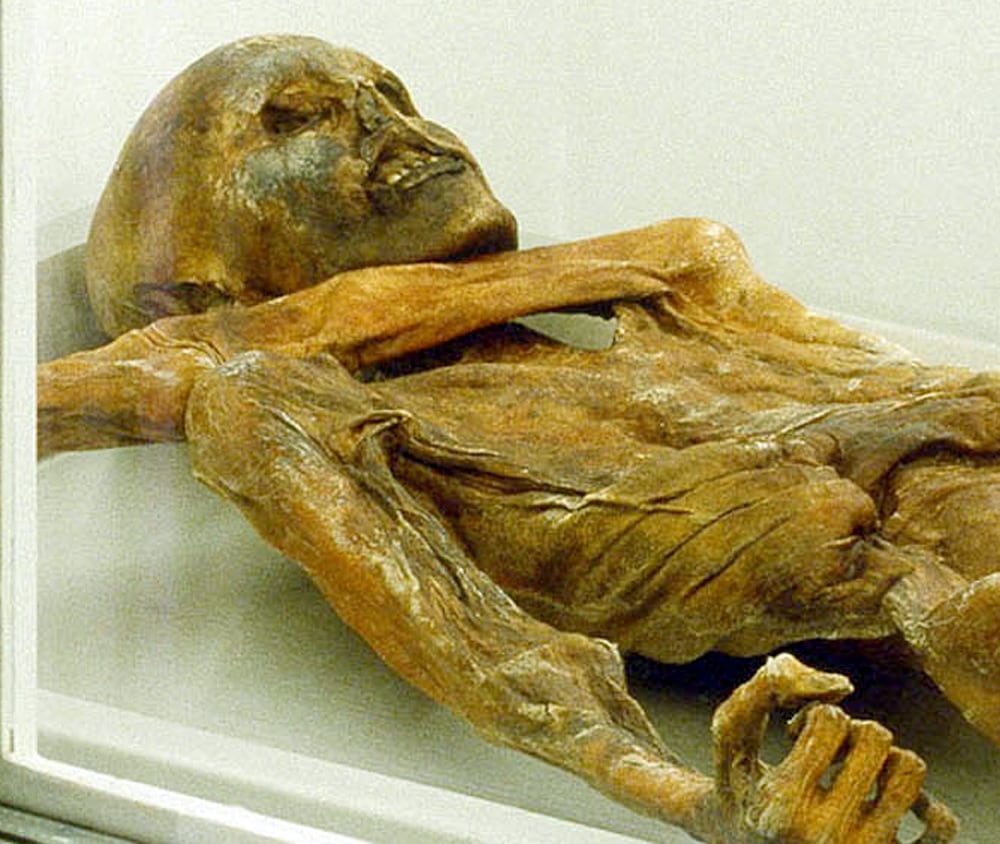
In 1991, hikers in the Ötztal Alps on the border of modern-day Austria and Italy stumbled upon what they believed was the body of a recently deceased mountaineer. Instead, they had discovered one of the most important archaeological finds of the 20th century. The frozen body became known as Ötzi the Iceman.
Dating to around 3300 BCE, Ötzi is over 5,000 years old. Unlike Egyptian mummies preserved through ritual, Ötzi was naturally mummified by ice. His body, clothing, tools, and even stomach contents were locked in a glacial tomb.
Scientific studies have revealed astonishing details about his final days. CT scans showed that he died from an arrow wound to the shoulder that severed a major artery. There were also signs of head trauma, suggesting a violent encounter. Analysis of his stomach contents revealed his last meals included ibex meat and grains. Pollen trapped in his digestive system helped determine the season of his death.
Ötzi’s clothing was made from animal hides and grass fibers, demonstrating advanced knowledge of materials. He carried a copper axe, a rare and valuable object at the time. DNA analysis has provided insights into his ancestry and health, revealing that he had lactose intolerance and was predisposed to heart disease.
His preservation is so remarkable that even his tattoos—more than sixty of them—remain visible. These tattoos may have had therapeutic or ritual significance. Ötzi stands not as a myth but as a person from the Copper Age whose life and violent death have been reconstructed with extraordinary detail.
2. Tutankhamun
When British archaeologist Howard Carter opened the tomb of Tutankhamun in 1922 in the Valley of the Kings in Egypt, he uncovered one of the most famous archaeological discoveries in history. The young pharaoh’s tomb had been largely undisturbed for over 3,000 years.
Tutankhamun, who ruled during the 18th Dynasty of ancient Egypt, died around 1323 BCE at approximately 19 years of age. His mummified body was found inside nested coffins, including one made of solid gold.
The mummification process in ancient Egypt was deliberate and highly ritualized. Organs were removed, the body was dehydrated using natron salts, and the skin was treated with resins and oils. These methods aimed to preserve the body for the afterlife.
Modern CT scans have revealed that Tutankhamun had several health issues, including a clubfoot and evidence of malaria infection. Contrary to earlier theories of assassination, current evidence suggests he likely died from complications related to injury and disease.
His preservation offers insight into royal embalming techniques and the political-religious beliefs of ancient Egypt. Though tales of a “curse” followed those who entered his tomb, the real power of Tutankhamun lies not in superstition but in the scientific and cultural knowledge his mummy has provided.
3. Lady Dai
In 1971, workers in Changsha, China, uncovered a tomb dating back to the Han Dynasty. Inside was the body of Xin Zhui, better known as Lady Dai, who died around 163 BCE. Her preservation stunned scientists.
Unlike typical mummies, Lady Dai’s body was not dried out. Her skin remained soft and flexible. Her joints could still bend. Even her internal organs were intact.
She had been buried in multiple nested coffins, sealed with charcoal and white clay to create an airtight environment. Her body was immersed in an unknown acidic liquid that likely contributed to preservation.
Autopsy revealed that Lady Dai was about 50 years old and suffered from heart disease, gallstones, and obesity. Her arteries showed significant blockage, making her one of the earliest known documented cases of atherosclerosis.
Her stomach contents included melon seeds, indicating she died in summer. The level of preservation allowed scientists to conduct detailed anatomical and pathological studies rarely possible with ancient remains.
Lady Dai’s body is not just a marvel of preservation. It is a window into elite life during the Han Dynasty, revealing diet, disease, and burial practices in astonishing clarity.
4. The Tollund Man
In 1950, peat cutters in Denmark discovered a body buried in a bog. At first glance, the face looked so fresh that police were called, suspecting a recent murder. The body turned out to be over 2,000 years old.
Known as the Tollund Man, he lived during the Iron Age around the 4th century BCE. Peat bogs create unique preservation conditions. The acidic, oxygen-poor environment combined with low temperatures can preserve soft tissues remarkably well.
The Tollund Man’s face is hauntingly peaceful. His eyes and mouth are closed, and a rope still encircles his neck. Scientific analysis determined he died by hanging, likely as a ritual sacrifice.
His last meal, preserved in his stomach, consisted of porridge made from barley and seeds. Radiocarbon dating and forensic techniques have helped reconstruct his final hours.
The chemistry of the bog tanned his skin like leather while dissolving much of his skeleton. He is both eerily lifelike and profoundly ancient. His calm expression invites empathy, even as the rope reminds us of a ritual death.
5. The Llullaillaco Children
High in the Andes Mountains near the summit of Llullaillaco volcano in Argentina, archaeologists discovered three Inca children in 1999. They are among the best-preserved mummies ever found.
The extreme cold and dryness at over 6,700 meters above sea level naturally froze and desiccated their bodies. These children were likely part of a capacocha ritual, a ceremonial sacrifice conducted by the Inca Empire.
Scientific analysis revealed that the children consumed a rich diet of maize and meat in the months before death, suggesting ritual preparation. Hair analysis showed increased consumption of coca leaves and alcohol prior to their final ascent.
The children appear to have died peacefully, possibly from hypothermia or sedation. Their facial features remain intact, eyelashes visible, expressions serene.
CT scans and forensic studies provide insight into Inca religious practices and child sacrifice rituals. The preservation is so extraordinary that their hair, clothing, and even internal organs remain largely intact.
6. Ramses II
Ramses II, often called Ramses the Great, ruled ancient Egypt for 66 years during the 13th century BCE. His mummy, discovered in the Valley of the Kings, is one of the most iconic royal remains.
The mummification techniques used during his era were highly refined. His body was carefully embalmed and wrapped. Despite damage from ancient tomb robbers, his features remain recognizable.
Modern analysis has revealed that Ramses II lived into his 80s, an impressive age for antiquity. He suffered from arthritis and dental abscesses. His hair, preserved and reddish in color, has been studied extensively.
In the 1970s, concerns about fungal damage led to his mummy being flown to France for conservation. He was issued an Egyptian passport listing his occupation as “King (deceased).”
Ramses II’s preserved body bridges ancient imperial power and modern scientific investigation. His mummy is not merely a relic but a testament to longevity, leadership, and advanced embalming knowledge.
7. The Capuchin Catacombs’ Rosalia Lombardo
In the Capuchin Catacombs of Palermo, Sicily, lies Rosalia Lombardo, a two-year-old girl who died in 1920. Her preservation is so extraordinary that she appears to be sleeping.
Embalmed by Alfredo Salafia using a formula that included formalin, alcohol, glycerin, and zinc salts, Rosalia’s body has remained remarkably intact for over a century.
Her eyelashes are visible. Her cheeks remain rounded. At certain angles, her eyes appear to open slightly due to lighting changes and dehydration effects.
Scientific study of her preservation reveals how modern embalming chemistry can halt decomposition. Rosalia represents a transition between ancient mummification and contemporary preservation techniques.
Her presence is both heartbreaking and haunting. Unlike ancient mummies, her story feels close to our own time.
8. The Chinchorro Mummies
Long before Egyptian mummification, the Chinchorro culture of what is now northern Chile and southern Peru practiced artificial mummification as early as 5000 BCE.
Chinchorro mummies are among the oldest deliberately prepared mummies in the world. Unlike Egyptian practices reserved largely for elites, Chinchorro mummification appears to have been applied broadly, including to children and infants.
Their techniques were complex. Bodies were disassembled, organs removed, skin treated, and the corpse reconstructed using sticks and clay. Masks were often placed over the face.
The arid Atacama Desert further aided preservation. Scientific study reveals insights into early human ritual behavior and social organization.
The Chinchorro mummies challenge assumptions about the origins of mummification and demonstrate that sophisticated funerary practices developed independently in multiple regions.
9. The Tarim Basin Mummies
Discovered in the Xinjiang region of western China, the Tarim Basin mummies date from around 2000 BCE onward. The desert environment naturally preserved their bodies.
These mummies are notable for their well-preserved clothing, hair, and facial features. Some were found with felt hats, wool garments, and intricate textiles.
Isotope and genetic studies suggest complex patterns of migration and interaction across Eurasia. Their preservation has allowed researchers to study ancient textile production, diet, and burial customs.
The dry desert sands acted as a natural desiccant, halting decay. Their faces remain expressive, almost contemporary, bridging thousands of years.
10. The Greenland Mummies of Qilakitsoq
In 1972, hunters in Greenland discovered eight naturally mummified bodies in a rock shelter near Qilakitsoq. They date to around the 15th century and belong to the Thule culture, ancestors of modern Inuit.
The cold Arctic climate freeze-dried their bodies. Their clothing, made from sealskin and other animal materials, remains remarkably intact.
Among them were women and children, carefully arranged and dressed. Scientific analysis provided insight into Arctic survival, diet, and traditional clothing construction.
Their preservation demonstrates how extreme cold can halt decomposition. They are a testament to human adaptation in one of the harshest environments on Earth.
The Science Behind the Stillness
Mummification, whether intentional or accidental, depends on environmental conditions that prevent microbial decay. Extreme dryness, cold, acidity, or chemical treatment can inhibit bacteria and enzymes responsible for decomposition.
Modern technology has revolutionized mummy research. CT scans allow non-invasive internal examination. DNA sequencing provides genetic insights. Stable isotope analysis reveals diet and migration patterns. Radiocarbon dating establishes age.
Mummies are not merely preserved bodies. They are biological time capsules. Each one extends the reach of science backward through centuries.
Echoes That Refuse to Fade
The haunting power of mummies lies not only in their preservation but in their humanity. A wrinkle on a forehead. A child’s braid. A rope around a neck. These details dissolve the barrier between past and present.
They remind us that history is not abstract. It is made of individuals who loved, feared, worked, and dreamed. Their preservation is accidental immortality.
In studying them, we do not disturb their rest for spectacle. We listen. We reconstruct. We learn.
The best-preserved mummies are not just archaeological wonders. They are conversations across time. And in their silence, they tell us who we were—and perhaps who we still are.