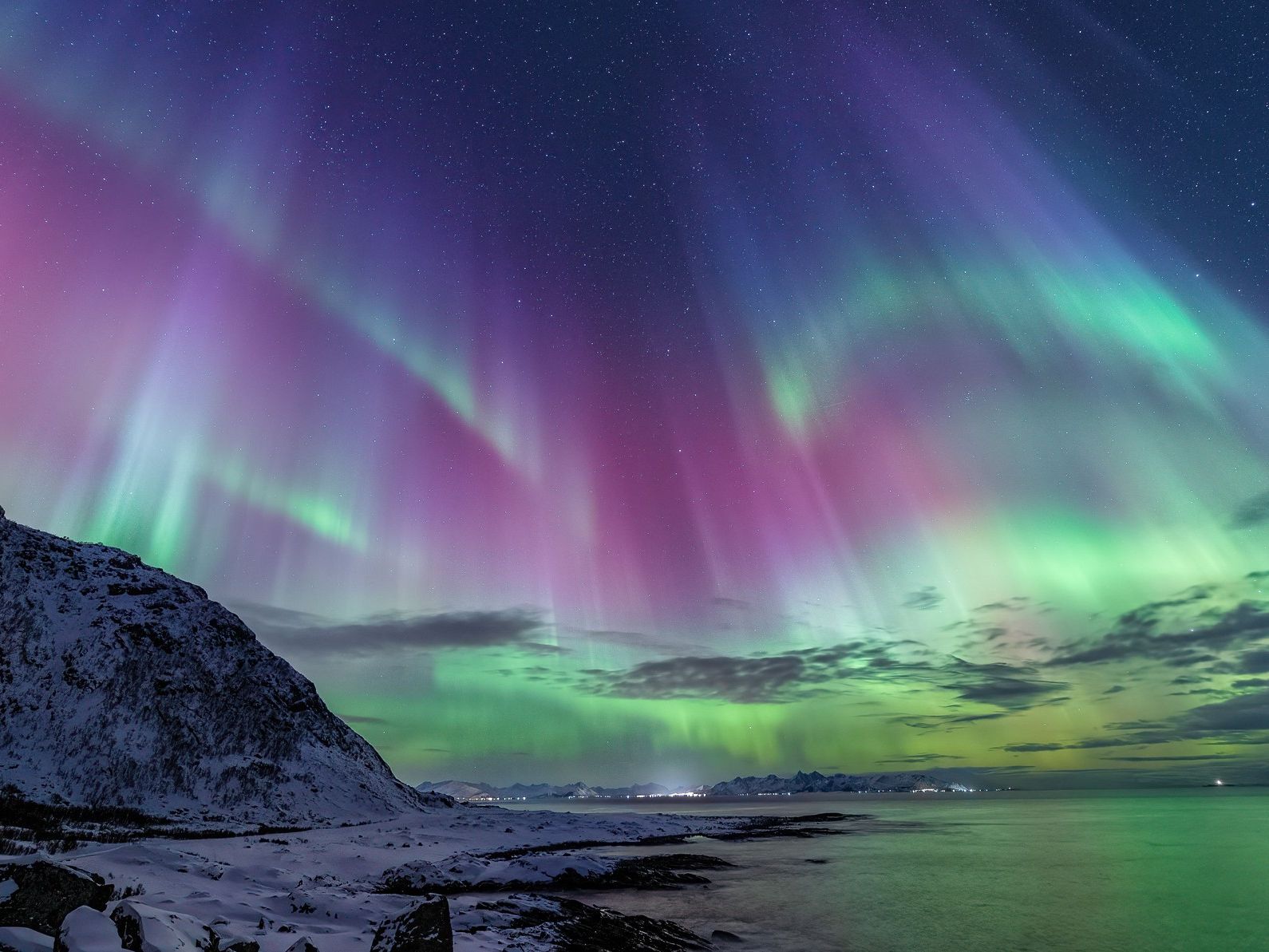
Imagine standing beneath a dark Arctic sky on a cold winter night. The stars shine brightly overhead, and the air is so still that every sound seems distant. Suddenly, a faint green glow appears on the horizon. It slowly stretches upward, forming a luminous curtain across the heavens. Within moments, the glow begins to move. Waves of light ripple across the sky. Emerald ribbons twist and swirl. Purple and red streaks emerge, dancing as if an invisible artist is painting the atmosphere with light.
For many people, witnessing the Aurora Borealis—commonly known as the Northern Lights—is one of the most unforgettable experiences on Earth.
The display feels almost magical. It is easy to understand why ancient cultures filled these glowing skies with myths, legends, and spiritual meanings. To generations of people who had no scientific explanation, the lights appeared supernatural. They seemed like messages from gods, spirits, ancestors, or unseen worlds.
Yet behind this breathtaking spectacle lies an extraordinary scientific story.
The Northern Lights are the result of a cosmic connection between the Sun and Earth. Every shimmering wave and glowing curtain is produced by energetic particles traveling millions of kilometers through space before colliding with atoms high above our planet. What appears to be a silent dance of colors is actually the visible result of powerful forces operating across the solar system.
The Aurora Borealis is more than a beautiful light show. It is a reminder that Earth is connected to the Sun in ways we cannot usually see. It reveals that our planet exists within a dynamic cosmic environment, constantly influenced by events occurring far beyond our atmosphere.
Understanding the aurora means exploring solar activity, magnetic fields, atmospheric physics, and the remarkable relationship between Earth and its star.
What Is the Aurora Borealis?
The Aurora Borealis is a natural light display that occurs primarily in high-latitude regions near Earth’s North Pole.
The term “Aurora Borealis” combines two ancient names. Aurora was the Roman goddess of dawn, while Boreas was the Greek god of the north wind. Together, the phrase essentially means “northern dawn.”
The phenomenon appears as glowing lights in the night sky, often displaying shades of green, red, pink, purple, blue, and white. These lights may form arcs, curtains, rays, spirals, or moving waves that seem to dance across the heavens.
The Northern Lights are not physical objects floating in the atmosphere. Instead, they are produced when charged particles from the Sun interact with gases in Earth’s upper atmosphere.
These interactions release energy in the form of light.
The result is one of nature’s most spectacular displays.
The Southern Counterpart
Although the Northern Lights receive much attention, Earth actually experiences a similar phenomenon in the Southern Hemisphere.
This southern version is known as the Aurora Australis, or Southern Lights.
The word “Australis” comes from a Latin term meaning southern.
The same physical processes that create the Northern Lights also produce the Southern Lights. The primary difference is location.
While the Aurora Borealis occurs near the Arctic regions, the Aurora Australis appears near Antarctica and surrounding southern latitudes.
Because far fewer people live near Antarctica, the Southern Lights are observed less frequently. However, they can be just as beautiful and dramatic as their northern counterpart.
Together, these phenomena reveal the global nature of Earth’s interaction with space.
Humanity’s Ancient Fascination with the Lights
Long before scientists understood the aurora, people created stories to explain the mysterious lights.
For thousands of years, the glowing displays inspired wonder, fear, curiosity, and imagination.
Many Indigenous Arctic cultures developed rich traditions surrounding the phenomenon.
Some believed the lights represented the spirits of ancestors dancing across the sky.
Others viewed them as celestial beings communicating with the living.
In parts of Scandinavia, legends connected the lights to powerful supernatural forces. Certain stories suggested they were reflections from armor worn by mythical warriors.
Some communities considered the lights good omens, while others regarded them with caution or reverence.
These myths reveal something important about human nature.
When people encounter something beautiful and mysterious, they naturally seek meaning.
Although modern science has explained the physical causes of the aurora, the sense of wonder it inspires remains unchanged.
The Sun: The True Source of the Aurora
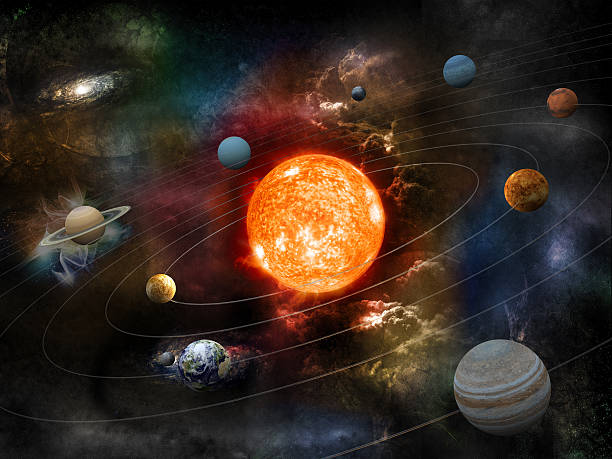
To understand the Northern Lights, we must begin nearly 150 million kilometers away at the Sun.
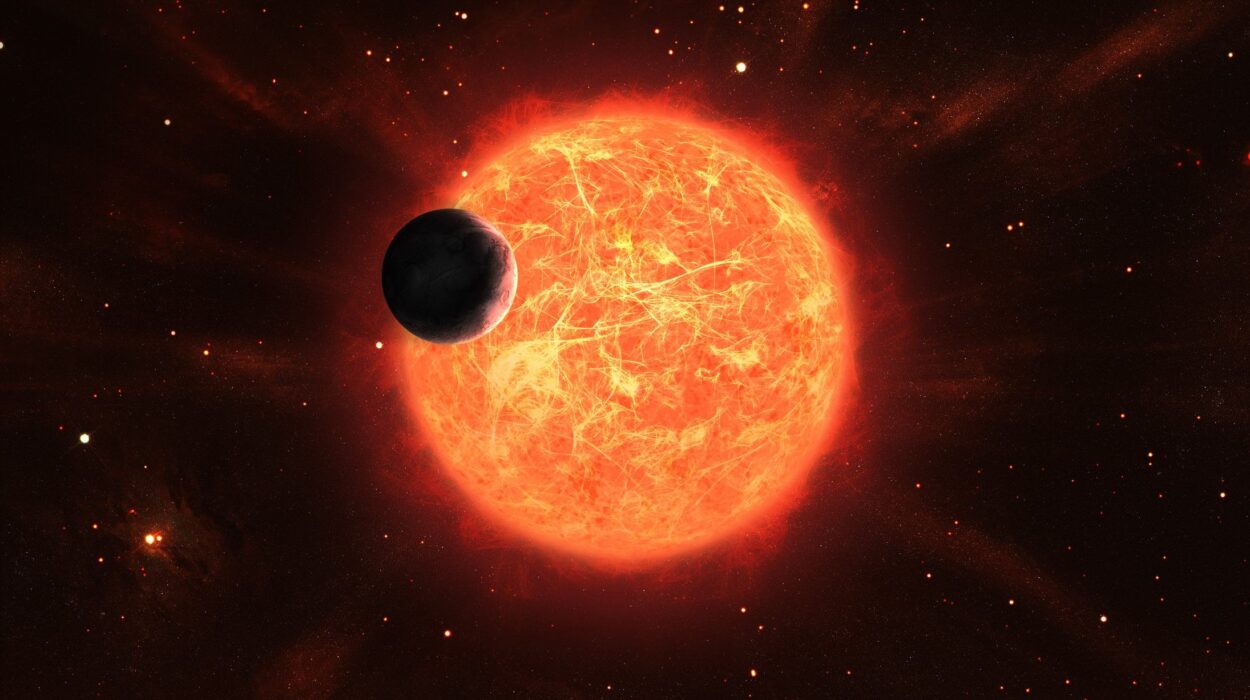
The Sun is not merely a glowing ball of light. It is a massive sphere of hot plasma where nuclear fusion continuously converts hydrogen into helium.
This process releases enormous amounts of energy.
Every second, the Sun emits light, heat, radiation, and streams of charged particles into space.
These particles primarily consist of electrons and protons.
Together, this continuous flow is known as the solar wind.
The solar wind travels outward in all directions, carrying solar material throughout the solar system.
Earth is constantly immersed in this stream.
Most of the time, we are unaware of it.
However, during periods of intense solar activity, the effects become visible through phenomena such as the aurora.
What Is the Solar Wind?
The solar wind is a continuous flow of charged particles escaping from the Sun’s outer atmosphere.
Unlike ordinary wind on Earth, which consists of moving air molecules, the solar wind is composed of electrically charged particles.
These particles travel at astonishing speeds.
In many cases, solar wind speeds range from hundreds to over a thousand kilometers per second.
If Earth lacked protection, this relentless stream could gradually strip away parts of our atmosphere.
Fortunately, our planet possesses a powerful defense system.
That defense is Earth’s magnetic field.
Without it, the world would be dramatically different.
Earth’s Invisible Shield
Earth acts like a giant magnet.
Deep within the planet, molten iron circulates through the outer core. These movements generate a magnetic field that extends far into space.
This field surrounds Earth in a region called the magnetosphere.
The magnetosphere functions like an invisible protective bubble.
When solar wind particles approach Earth, most are deflected by this magnetic shield.
Instead of striking the atmosphere directly, many particles are guided around the planet.
Without this protection, life on Earth would face significantly greater exposure to harmful radiation.
The magnetosphere is therefore essential not only for the aurora but also for maintaining conditions suitable for life.
How Charged Particles Become Trapped
Although Earth’s magnetic field blocks most solar wind particles, it does not stop all of them.
The magnetic field lines converge near the North and South Poles.
These regions create pathways through which some charged particles can travel.
Rather than being completely deflected, certain particles become trapped and guided along magnetic field lines toward the polar atmosphere.
As they spiral downward, they gain access to Earth’s upper atmospheric layers.
This journey ultimately produces the aurora.
In a sense, Earth’s magnetic field acts like a giant funnel.
It channels energetic particles toward the poles, concentrating auroral activity in these regions.
The Collision That Creates Light
The actual creation of auroral light occurs high above Earth’s surface.
As charged particles descend into the upper atmosphere, they collide with atoms and molecules.
The most important atmospheric gases involved are oxygen and nitrogen.
These collisions transfer energy to the atmospheric particles.
When oxygen or nitrogen absorbs energy, its electrons move into excited states.
However, excited states are temporary.
The particles soon release the excess energy and return to lower energy levels.
When this happens, light is emitted.
This process is similar to what occurs in fluorescent lights or neon signs.
The colors we see in the aurora come directly from these emissions.
Every glowing ribbon in the sky is the result of countless microscopic collisions occurring simultaneously.
Why the Aurora Is Usually Green
Green is the most common auroral color.
When people imagine the Northern Lights, they typically picture brilliant green curtains stretching across the sky.
This color is primarily produced by oxygen atoms located approximately 100 to 250 kilometers above Earth’s surface.
When energetic particles excite oxygen at these altitudes, the atoms emit green light as they return to their normal state.
Because oxygen is abundant in these atmospheric regions and because the green emission is particularly efficient, green often dominates auroral displays.
The result is the iconic emerald glow that has captivated observers for centuries.
The Mystery of Red Auroras
Although green is most common, auroras can also appear red.
Red auroras are generally produced by oxygen atoms located at much higher altitudes, often above 250 kilometers.
At these elevations, atmospheric density is lower.
Collisions occur less frequently, allowing oxygen atoms to remain excited longer before releasing their energy.
This process produces deep red emissions.
Red auroras are usually fainter than green ones but can create stunning displays.
During intense geomagnetic storms, red auroras may extend across large portions of the sky, creating an almost otherworldly appearance.
Blue and Purple Colors in the Sky
Nitrogen contributes additional colors to the aurora.
When charged particles interact with nitrogen molecules, blue and purple emissions can occur.
These colors often appear near the lower edges of auroral curtains, where atmospheric density is greater.
Sometimes blue and purple shades blend with green and red light, creating spectacular multicolored displays.
The exact colors visible depend on factors such as altitude, atmospheric composition, particle energy, and viewing conditions.
The sky becomes a dynamic canvas painted by atomic physics.
Why the Lights Move
One of the most mesmerizing aspects of the aurora is its motion.
The lights rarely remain still.
They ripple, swirl, brighten, fade, twist, and race across the sky.
This movement occurs because the flow of charged particles entering Earth’s atmosphere is constantly changing.
Conditions within the solar wind fluctuate.
Earth’s magnetic field responds dynamically.
Plasma waves travel through the magnetosphere.
These interactions create shifting patterns of energy deposition in the atmosphere.
As different regions become energized, the visible aurora changes shape.
The result resembles a celestial dance.
Although the movements appear graceful and artistic, they are driven by powerful electromagnetic processes occurring high above Earth.
Auroral Arcs and Curtains
Auroras can take many forms.
One common structure is the auroral arc.
An arc appears as a glowing band stretching across the sky.
Under certain conditions, these arcs develop folds and ripples that resemble enormous curtains.
The curtain effect occurs because charged particles follow magnetic field lines extending into the atmosphere.
As countless field lines become illuminated simultaneously, vertical structures emerge.
Observers often describe these curtains as shimmering drapes of light hanging from the heavens.
When they begin to wave and move, the effect becomes unforgettable.
Geomagnetic Storms and Powerful Displays
Auroral activity increases dramatically during geomagnetic storms.
These storms occur when intense bursts of solar material interact with Earth’s magnetosphere.
One major cause is a phenomenon called a coronal mass ejection.
A coronal mass ejection is an enormous eruption of plasma and magnetic fields from the Sun.
When such an eruption is directed toward Earth, vast quantities of charged particles can reach our planet.
The resulting interaction may trigger strong geomagnetic disturbances.
During these events, auroras become brighter, larger, and more active.
They can even extend far beyond their usual polar locations.
People living in regions that rarely experience auroras may suddenly witness spectacular displays.
The Aurora Zone
Auroras occur most frequently within regions known as auroral zones.
These zones form oval-shaped rings around Earth’s magnetic poles.
Because magnetic field lines guide charged particles toward the poles, auroral activity is concentrated there.
Countries such as Norway, Sweden, Finland, Iceland, Canada, Greenland, and Alaska are among the best places to observe the Northern Lights.
In the Southern Hemisphere, auroral viewing opportunities exist in Antarctica and parts of New Zealand, Australia, and nearby regions.
People living within these zones often see auroras many times throughout the year.
The Best Conditions for Viewing
Even when auroras are active, seeing them requires favorable conditions.
Dark skies are essential.
Artificial light from cities can overwhelm faint auroral emissions.
This is why remote locations provide the best viewing opportunities.
Clear weather is equally important.
Clouds block the view just as effectively as they block stars.
Winter months often offer excellent observing conditions because nights are longer in polar regions.
Patience also helps.
Auroras can vary significantly in brightness and activity over short periods.
A display that appears faint one moment may become spectacular minutes later.
The Sound of the Aurora
One intriguing mystery involves reports of auroral sounds.
For centuries, some observers claimed they heard faint crackling, hissing, or whispering noises during intense displays.
Scientists initially dismissed these accounts.
The aurora occurs far above Earth’s surface, making direct sound transmission impossible.
However, recent research suggests that under certain atmospheric conditions, electromagnetic disturbances associated with auroras may generate sounds closer to the ground.
The exact mechanisms remain an active area of investigation.
While the phenomenon is still not fully understood, it illustrates how much there is yet to learn about these remarkable displays.
Aurora and Space Weather
The aurora is part of a broader phenomenon known as space weather.
Just as Earth experiences weather driven by atmospheric processes, the space environment experiences changing conditions driven by solar activity.
Space weather can influence satellites, communication systems, navigation networks, and electrical infrastructure.
Strong geomagnetic storms may disrupt radio transmissions, interfere with GPS signals, and even affect power grids.
The aurora represents the most beautiful and visible consequence of these interactions.
By studying auroras, scientists gain valuable information about the broader relationship between the Sun and Earth.
The Role of Modern Technology
Modern technology has transformed auroral research.
Satellites continuously monitor solar activity.
Spacecraft observe the solar wind as it travels toward Earth.
Ground-based observatories track magnetic field variations and auroral activity.
High-resolution cameras capture stunning images of auroral structures.
Advanced computer models help scientists understand the complex interactions occurring within Earth’s magnetosphere.
Together, these tools allow researchers to predict auroral activity more accurately than ever before.
Although many mysteries remain, our understanding continues to improve.
Auroras Beyond Earth
Earth is not the only planet that experiences auroras.
Several worlds within our solar system possess magnetic fields and atmospheres capable of producing similar phenomena.
The giant planet Jupiter hosts extraordinarily powerful auroras driven by its immense magnetic field.
Saturn also displays auroral activity near its poles.
Even planets such as Mars and Uranus exhibit auroral phenomena under certain conditions.
Studying extraterrestrial auroras helps scientists compare magnetic environments across the solar system.
These observations reveal that auroras are not uniquely terrestrial. They are a natural consequence of interactions between charged particles, magnetic fields, and atmospheres.
Why Auroras Inspire Such Strong Emotions
Science explains how auroras form, but it does not fully explain how they make people feel.
Many observers describe profound emotional reactions when witnessing the Northern Lights for the first time.
Some feel awe.
Others experience joy, wonder, or even a sense of spiritual connection.
Part of this response comes from the rarity and beauty of the phenomenon.
Another part comes from the realization that we are watching a visible interaction between Earth and the Sun.
The lights remind us that our planet is not isolated.
We exist within a vast cosmic system shaped by forces extending across millions of kilometers.
The aurora transforms invisible space weather into something we can actually see.
The Northern Lights in Art and Culture
Throughout history, auroras have inspired artists, writers, musicians, and storytellers.
Paintings attempt to capture their luminous beauty.
Poets describe their shifting colors and dreamlike movements.
Photographers travel great distances seeking the perfect auroral image.
Modern tourism has even developed around the phenomenon.
Thousands of people journey to Arctic destinations each year hoping to witness the lights.
The aurora occupies a unique place where science and human imagination meet.
It is both a physical process and a source of cultural inspiration.
What the Aurora Teaches Us About the Universe
The Northern Lights reveal something profound about our place in the cosmos.
They demonstrate that space is not empty.
Invisible streams of particles constantly flow through the solar system.
Magnetic fields shape planetary environments.
Solar activity influences conditions on Earth.
The aurora serves as a visible reminder that our world is part of a larger interconnected system.
Every shimmering wave of light represents a journey that began on the Sun and ended in Earth’s atmosphere.
In that sense, the aurora is a bridge between our planet and the broader universe.
Conclusion
The Aurora Borealis, or Northern Lights, is one of nature’s most breathtaking spectacles. Created when charged particles from the Sun collide with oxygen and nitrogen in Earth’s upper atmosphere, the aurora transforms invisible cosmic processes into dazzling displays of light. Guided by Earth’s magnetic field toward the polar regions, these particles produce glowing curtains, arcs, and waves that dance across the night sky in shades of green, red, blue, purple, and pink.
Far more than a beautiful phenomenon, the aurora reveals the dynamic relationship between Earth and the Sun. It provides scientists with valuable insights into space weather, magnetic fields, atmospheric physics, and the behavior of charged particles. At the same time, it continues to inspire wonder, curiosity, and imagination in everyone fortunate enough to witness it.
The Northern Lights remind us that the universe is alive with energy and movement. Above the frozen landscapes of the Arctic, the sky becomes a stage where physics performs one of its most elegant shows. What appears as a magical dance of light is actually a remarkable story of stars, magnetism, atoms, and space itself—a story that continues to unfold every time the heavens glow with the colors of the aurora.