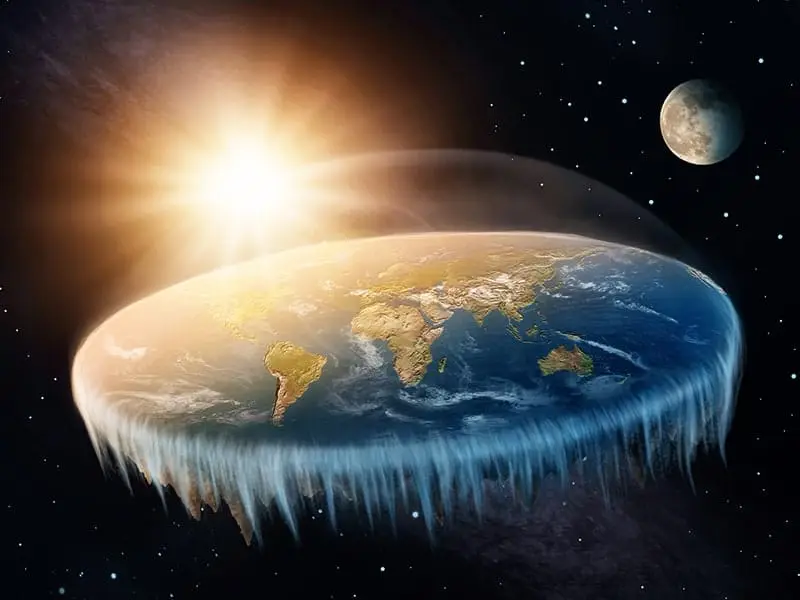
The idea of a flat Earth has a strange emotional pull. It feels simple, intimate, and human-scaled, as if the universe were designed just for us. A flat world seems easier to imagine than a spinning sphere racing through space at enormous speed. Yet science is not built on comfort; it is built on reality. To ask “What if Earth was flat?” is not merely to challenge a shape, but to challenge the deepest structures of physics, astronomy, geology, and everyday experience. When examined carefully, a flat Earth does not just contradict a few measurements—it unravels the entire fabric of how the universe works.
This is not a story about mocking beliefs. It is a story about consequences. If Earth were flat, the universe would have to be fundamentally different. Gravity would behave in ways that break known physics. The sky would lie to us. Time would fracture. Life itself would struggle to exist. To imagine a flat Earth seriously is to walk into a world where almost everything we observe becomes impossible.
Shape Is Not Just Geometry, It Is Destiny
The shape of a planet is not a cosmetic detail. It is the natural outcome of forces acting over immense time. In our universe, gravity pulls matter toward a center. When enough mass gathers, that inward pull smooths irregularities and produces a sphere. This is not a preference or design choice; it is a consequence of physics. A flat Earth would require gravity to abandon its most basic behavior.
If Earth were flat, gravity could not pull equally toward a center because a flat object has no single center in three dimensions. Objects near the edge would experience gravity differently than objects near the middle. In our lived reality, gravity points downward everywhere. Drop a stone in Bangladesh, Brazil, or Canada, and it falls straight toward the ground. On a flat Earth, “down” would tilt outward as you moved away from the center. People near the edges would feel gravity pulling sideways.
This is not a subtle effect. It would dominate daily life. Rivers would not flow predictably. Mountains would collapse asymmetrically. Buildings would require bizarre engineering to stop them from sliding inward or outward. The simple act of standing upright would feel different depending on where you lived.
Gravity Would Become a Nightmare
In a spherical Earth, gravity pulls everything toward the center of mass, creating a stable surface where oceans settle and atmospheres cling. A flat Earth cannot provide this stability without inventing entirely new physics.
If gravity pulled uniformly downward across a flat Earth, it would have to be a mysterious force acting parallel everywhere, ignoring distance and mass. This would violate everything we know about gravity, which weakens with distance and depends on mass. Such a force would not just contradict Earth-based experiments but also celestial mechanics. The Moon, the Sun, and planets would no longer follow predictable paths.
Alternatively, if gravity pulled toward the center of a flat disk, objects near the edges would constantly slide inward. Oceans would pool at the center, leaving the edges dry and elevated. The further you traveled, the steeper the ground would feel beneath your feet. The horizon itself would betray this curvature of force, not through shape but through sensation.
Life depends on stable gravity. Cells rely on consistent physical forces to function. Blood circulation, plant growth, and animal movement evolved under uniform gravitational conditions. A flat Earth’s uneven gravity would distort evolution itself, producing radically different life forms—or none at all.
The Sky Would Betray the Illusion
One of the most powerful pieces of evidence for a spherical Earth lies above us. The sky is not just decoration; it is a precise physical record of our planet’s shape and motion.
On a spherical Earth, the stars change with latitude. Travel north or south, and new constellations rise while others sink below the horizon. On a flat Earth, everyone should see the same stars, merely at different angles. But this is not what we observe. Entire constellations disappear permanently as you cross hemispheres.
The Sun’s behavior would also become impossible. On a flat Earth, explaining day and night requires the Sun to hover above the surface like a spotlight. Yet the Sun’s apparent size remains nearly constant throughout the day. If it were moving closer and farther, as required by flat-Earth explanations, its size would visibly change. It does not.
Sunsets are another fatal problem. On a flat Earth, the Sun should shrink into the distance, never dropping below the horizon. Instead, it sinks cleanly, its lower edge disappearing first, exactly as expected on a curved surface. No amount of perspective can replicate this behavior consistently across the globe.
Time Zones Would Collapse
Time is shaped by Earth’s rotation. A spherical Earth turning in space naturally creates time zones as different regions face the Sun at different moments. This explains why dawn reaches Dhaka before London and New York hours later.
On a flat Earth, time zones become absurdly complex. If the Sun hovered above the surface, it would illuminate large areas simultaneously. Sharp boundaries between night and day would be impossible to maintain. Twilight would stretch endlessly. Midnight Sun phenomena near the poles would have no explanation.
The fact that time zones follow clean longitudinal patterns is a quiet but devastating argument against flatness. Our clocks are synchronized not by convention alone but by astronomy. GPS satellites, which rely on precise timekeeping, would fail instantly in a flat-Earth universe.
The Oceans Would Not Behave
Water is honest. It reveals the shape of the world without ideology or belief. On Earth, oceans curve gently with the planet. This curvature is not obvious over short distances, but over long ones it becomes unavoidable.
If Earth were flat, oceans would need to be held in place by walls or edges. Otherwise, water would spread infinitely outward or drain toward the center depending on gravity’s direction. Tides, driven by gravitational interactions with the Moon and Sun, would lose their rhythm or cease entirely.
Ships disappearing hull-first over the horizon are not illusions. They are geometry made visible. The same geometry explains why distant mountains reveal their peaks before their bases. On a flat Earth, these observations would require light to bend in complex, unmeasured ways, selectively fooling cameras, telescopes, and human eyes without leaving experimental evidence.
The Atmosphere Could Not Stay
Earth’s atmosphere clings to the planet because gravity pulls gas molecules inward. On a sphere, this creates a stable envelope. On a flat Earth, especially one with edges, the atmosphere would behave catastrophically.
Gas would either thin toward the edges or spill into space entirely. Wind patterns would be chaotic beyond anything we experience. Pressure differences would become extreme. Breathing at different locations could become impossible without specialized equipment.
Weather depends on rotation, curvature, and energy distribution. Hurricanes form because of Earth’s spin and curved surface. A flat Earth would disrupt these mechanisms, erasing familiar climate patterns. The delicate balance that supports ecosystems would vanish.
Earth’s Interior Would Make No Sense
Geology tells a story written in rock. Earth’s layers, seismic waves, and volcanic activity all point to a spherical planet with a molten interior. Earthquakes send vibrations through the planet, and their travel times reveal its internal structure.
On a flat Earth, seismic waves would behave differently. They would not curve around the planet or reflect as observed. The patterns measured by thousands of instruments worldwide would be impossible to reconcile with a flat geometry.
Volcanoes, too, would lack explanation. Plate tectonics depends on a spherical surface broken into moving plates. On a flat Earth, there is no natural mechanism to drive this motion. Mountain ranges, ocean trenches, and continents would lack coherent origin stories.
Satellites Would Be a Lie Written in the Sky
Modern civilization rests on satellites. Communication, navigation, weather forecasting, and disaster response depend on them. Satellites orbit Earth because they are falling around a sphere, constantly missing the ground due to curvature.
A flat Earth offers no stable orbits. Objects launched upward would fall straight back down or drift unpredictably. The precise paths required for satellites would be impossible.
Yet satellites behave exactly as predicted by spherical Earth physics. They rise and set, pass overhead at calculated times, and disappear below the horizon. GPS works because Earth is round and rotating. A flat Earth would collapse this entire technological framework.
Space Travel Would Be Meaningless
If Earth were flat, space itself would have to be reimagined. Rockets rely on orbital mechanics that assume a spherical Earth. The International Space Station’s continuous free-fall around the planet would be impossible.
Images of Earth from space are not artistic fabrications; they are consistent across decades, nations, and technologies. A flat Earth would require a conspiracy so vast and flawless that it would violate human nature itself. More importantly, it would require physical laws to behave differently in ways no experiment supports.
Light Would Need to Conspire Against Us
To maintain the illusion of a flat Earth, light would need to bend in strange, selective ways. It would have to curve downward to hide distant objects, then straighten out for nearby ones. It would need to mimic curvature without being curvature.
Physics allows light to bend under gravity, but the bending required to fake a spherical Earth on a flat surface would be enormous and inconsistent. Such bending would distort images dramatically, producing obvious visual anomalies. We do not see these distortions.
Cameras, lasers, telescopes, and human eyes all agree on the same observations. This agreement is not cultural; it is physical.
Life’s Fragile Balance Would Break
Life evolved under specific conditions shaped by Earth’s size, shape, and motion. Day and night cycles regulate biology. Seasons drive reproduction and migration. Gravity shapes bones, muscles, and circulation.
A flat Earth would disrupt these cycles. Energy distribution would become uneven. Some regions would overheat while others froze. Ecosystems would collapse under unpredictable conditions.
The fact that life thrives everywhere on Earth, from equator to poles, is evidence of a stable, spherical world that distributes energy gradually and predictably.
The Emotional Appeal of Flatness
Why, then, does the idea of a flat Earth persist? Because it feels personal. A flat world places humanity at the center. It feels manageable, knowable, and intimate. A spherical Earth adrift in a vast universe can feel unsettling.
Science does not exist to comfort us. It exists to tell us what is real. The true wonder is not that Earth is flat and simple, but that it is round, dynamic, and part of something unimaginably vast—and that we are capable of understanding it.
Reality Is Stranger and More Beautiful
A flat Earth would be a smaller, poorer universe. It would strip away the elegance of gravity, the harmony of orbits, and the deep connection between Earth and cosmos. The real Earth, spherical and spinning, is far more astonishing.
It is a world where invisible forces shape continents, where time itself bends under speed and gravity, where atoms forged in stars become living beings capable of asking questions about their own planet.
The Ultimate Impossibility
To make Earth flat, you would have to rewrite gravity, light, time, motion, and matter. You would have to discard centuries of experiments, technologies, and observations that work flawlessly together. You would not merely change a shape; you would destroy the universe as we know it.
The impossibility of a flat Earth is not a failure of imagination. It is a triumph of understanding. It shows how deeply interconnected reality is, how one truth supports another, forming a coherent whole.
The Quiet Power of Truth
Earth is not round because authorities say so. It is round because the universe behaves in ways that leave no alternative. Every sunrise, every satellite pass, every earthquake, and every star rising and setting whispers the same truth.
To accept Earth’s shape is to accept something deeper: that reality exists independent of belief, and that through curiosity, humility, and effort, humans can come to know it.
That, ultimately, is the most powerful and beautiful lesson science offers.