The oldest civilizations in the world emerged thousands of years ago as human communities developed agriculture, established permanent settlements, organized governments, and created systems of writing and trade. Among the earliest were Mesopotamia in the Middle East, ancient Egypt in northeastern Africa, the Indus Valley civilization in South Asia, and early Chinese civilization in East Asia. Other early urban societies developed independently in the Americas, including the Norte Chico civilization in present-day Peru.
Determining which civilization was the oldest depends on what qualifies as a civilization. Humans built settlements, cultivated crops, and developed complex social relationships long before the first cities appeared. If civilization means a society with large settlements, specialized occupations, organized institutions, and extensive social networks, the earliest examples emerged during the fourth millennium BCE, with some of their foundations reaching back several thousand years earlier.
Civilization did not arise in a single place or spread outward from one original source. Different populations developed increasingly complex societies under different environmental conditions, often independently of one another. Their histories reveal how food production, population growth, technology, trade, and political organization transformed human life.
What makes a society a civilization?
The word civilization describes a complex form of human society rather than a single technological achievement. Historians and archaeologists commonly look for evidence of permanent settlements, urban centers, specialized labor, social hierarchies, political institutions, long-distance exchange, and, in many cases, writing and monumental construction.
No single feature defines every civilization. Some early societies built impressive ceremonial centers before developing cities in the familiar sense. Others organized large communities without leaving written records. Writing is especially valuable to historians because it provides direct evidence of how people recorded transactions, governed communities, practiced religion, and understood their world. However, a society does not have to possess a writing system to qualify as complex.
Civilization also differs from the broader history of human culture. Humans lived in organized communities for tens of thousands of years before agriculture became widespread. They made sophisticated tools, created art, maintained social networks, and passed knowledge between generations. The emergence of civilization was therefore not the beginning of human intelligence or culture. It was a major change in how people organized their economies, settlements, and institutions.
The dates associated with early civilizations are approximate because archaeologists reconstruct the past from physical evidence. A settlement may grow gradually over centuries, making it difficult to identify a precise moment when it became a city or a civilization.
A historical timeline of the world’s oldest civilizations
The following timeline traces major developments from the earliest agricultural communities to the formation of complex societies across several continents. Dates are approximate and use BCE, meaning before the Common Era, a dating system equivalent to BC.
| Approximate date | Civilization or cultural development | Modern geographical region |
|---|---|---|
| 10,000–7000 BCE | Early agricultural communities | Southwest Asia |
| 7000–4000 BCE | Growth of settled communities and early regional centers | Mesopotamia and surrounding regions |
| 4000–3100 BCE | Expansion of urban society in southern Mesopotamia | Modern Iraq |
| Around 3500–3000 BCE | Development of cities and early writing in Mesopotamia | Modern Iraq |
| Around 3100 BCE | Political unification of ancient Egypt | Modern Egypt |
| Around 3000–1900 BCE | Mature urban phase of the Indus Valley civilization | Modern Pakistan and northwestern India |
| Around 3000–1900 BCE | Development of complex societies in the Americas, including early Andean centers | Modern Peru and neighboring regions |
| Around 2000–1600 BCE | Flourishing of the Minoan civilization | Crete, Greece |
| Around 2000–1500 BCE | Growth of early Chinese states and the Erlitou culture | Northern China |
| Around 1600–1046 BCE | Shang dynasty in China | Northern China |
| Around 1200–400 BCE | Development of early Mesoamerican civilizations, including the Olmec | Southern Mexico |
These developments did not occur in isolation. Some societies exchanged materials, technologies, and ideas through trade and migration. Others developed complex institutions independently. The timeline is a guide to major milestones, not a ranking of cultures by importance or achievement.
Mesopotamia: The earliest urban civilization
Mesopotamia is widely recognized as one of the earliest centers of civilization and is often associated with the world’s first cities and earliest known writing systems. Its name comes from Greek words meaning “between rivers,” referring to the Tigris and Euphrates, which flow through much of modern Iraq and neighboring areas.
The region’s development began long before the first cities. Communities in Southwest Asia increasingly relied on cultivated crops and domesticated animals during the Neolithic period, which began roughly 10,000 BCE in parts of the region. Agriculture made it possible for some populations to remain in one place rather than move continually in search of food. Over time, farming settlements grew, exchanged goods, and developed more elaborate social arrangements.
Southern Mesopotamia presented both opportunities and challenges. Its rivers deposited fertile sediments, but rainfall was often insufficient for dependable agriculture. Farmers developed irrigation systems that directed water toward fields. These systems could increase agricultural production, but they also required coordinated maintenance, labor, and decisions about how water would be distributed.
By the fourth millennium BCE, settlements in southern Mesopotamia were growing into major urban centers. Uruk became one of the most important early cities. Its population supported craft specialists, administrators, religious institutions, and increasingly complex systems for storing and distributing resources.
Administrative needs helped encourage the development of writing. The earliest Mesopotamian writing emerged around the late fourth millennium BCE, initially serving practical purposes such as recording goods and economic transactions. Over time, scribes developed cuneiform, a writing system made by pressing a shaped stylus into clay tablets. It eventually recorded laws, literature, royal inscriptions, religious texts, and other forms of information.
Mesopotamia was not a single continuous empire. It contained numerous city-states, including Uruk, Ur, and Lagash, whose rulers sometimes cooperated and sometimes fought for territory and resources. Later, larger kingdoms and empires brought many cities under centralized rule.
The region’s importance lies not only in its early cities and writing. Mesopotamian societies developed complex legal traditions, mathematical methods, astronomical observations, and literary works. Their institutions helped establish patterns of urban administration that influenced later societies across the ancient Near East.
Ancient Egypt: A civilization shaped by the Nile
Ancient Egypt emerged along the Nile River in northeastern Africa. Although agricultural communities existed in the region long before political unification, Egypt became a centralized territorial state around 3100 BCE, traditionally associated with a ruler known as Narmer and the beginnings of the Early Dynastic Period.
The Nile played a crucial role in this development. Its annual floods historically deposited nutrient-rich sediments across the surrounding floodplain, creating productive farmland within an otherwise arid landscape. Egyptian farmers cultivated crops such as wheat and barley, while the river provided water, transportation, and a natural route linking communities along its banks.
Agricultural production supported a growing population and allowed some people to specialize in occupations beyond farming. Craftspeople, priests, administrators, soldiers, and builders contributed to a society with increasingly elaborate institutions. A centralized government could collect agricultural surpluses, organize labor, maintain infrastructure, and coordinate religious and political activities.
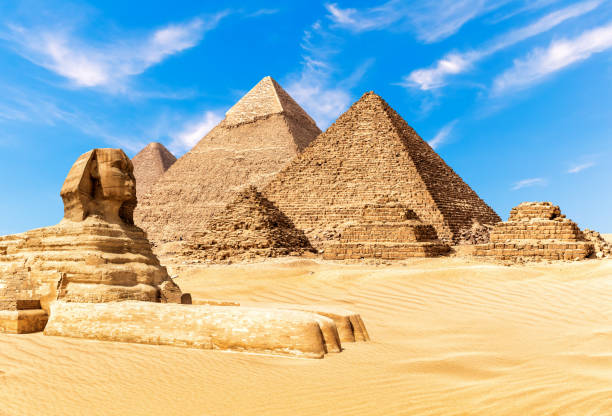
Egyptian rulers, known as pharaohs, combined political authority with religious significance. Monumental construction, including temples and pyramids, demonstrated the state’s ability to mobilize resources and skilled labor. The pyramids of Giza were built during the Old Kingdom, particularly in the third millennium BCE, several centuries after the formation of the Egyptian state.
Egyptians developed a writing system that included hieroglyphs, using signs to represent words, sounds, and other linguistic elements. Written records supported administration, religious practice, and cultural continuity. Egyptian scribes also contributed to practical knowledge in mathematics, medicine, and astronomy.
Compared with Mesopotamia, Egypt benefited from a relatively unified geographical corridor along the Nile. Natural barriers helped limit some forms of invasion, while the river connected settlements across long distances. Nevertheless, Egypt experienced periods of political fragmentation, foreign rule, and reunification throughout its long history.
Ancient Egyptian civilization endured for thousands of years, although its political structures, religious practices, and cultural influences changed substantially. Its longevity makes it one of the most prominent examples of a civilization that maintained a recognizable cultural identity while adapting to changing circumstances.
The Indus Valley civilization: Cities with remarkable planning
The Indus Valley civilization, also called the Harappan civilization, developed in parts of present-day Pakistan and northwestern India. Its mature urban phase flourished approximately 2600–1900 BCE, although its agricultural communities and regional cultural traditions began earlier.
The civilization included major cities such as Harappa and Mohenjo-daro, along with numerous smaller settlements. These cities demonstrate a high degree of planning, including organized streets, standardized bricks, wells, and drainage systems. Many houses were connected to carefully constructed drains, suggesting that managing water and household waste was an important part of urban life.
The scale of these settlements indicates that their inhabitants coordinated labor and maintained shared standards for construction and other activities. Archaeologists have also found evidence of craft production, including pottery, beads, metal objects, and seals. Trade connected Indus communities with neighboring regions, including Mesopotamia.
One of the civilization’s most intriguing features is its writing system. Indus inscriptions appear on seals and other objects, but the script has not been reliably deciphered. As a result, historians cannot confidently reconstruct the names of its rulers, the languages represented by the script, or many aspects of its political organization.
Unlike ancient Egypt and Mesopotamia, the Indus Valley civilization has left relatively little clear evidence of royal monuments or elaborate displays of individual rulers. This does not prove that it lacked kings or centralized authority. It means that its political structures remain less certain than those of civilizations whose written records can be read.
After around 1900 BCE, many major urban centers declined, and settlement patterns changed. Researchers have proposed several contributing factors, including shifts in river systems, changing monsoon patterns, and transformations in trade and economic organization. The evidence does not support reducing the decline to one universally accepted cause.
The Indus Valley civilization is especially important because it demonstrates that early urban life could take forms different from those found in Egypt or Mesopotamia. Its sophisticated infrastructure suggests that large settlements could organize daily life around shared systems of planning and resource management.
Ancient China: Early states and the rise of dynastic rule
Complex societies emerged in several parts of China, where communities developed agriculture, pottery, specialized crafts, and increasingly organized settlements over thousands of years. Unlike civilizations whose early development can be traced to a single major river valley, early Chinese civilization grew from multiple regional centers.
The Yellow River basin became a particularly important center of early agricultural and political development. Communities cultivated millet and other crops, while settlements grew in size and complexity. The Yangtze River basin also supported early farming societies, including communities that cultivated rice.
By the early second millennium BCE, archaeological evidence indicates the presence of complex societies with specialized production, social hierarchies, and substantial settlements. The Erlitou culture, dating broadly to around 1900–1500 BCE, is associated with an important early center in the Yellow River region. Some scholars connect it with the Xia dynasty described in later Chinese historical traditions, but that identification remains uncertain.
The Shang dynasty, which ruled approximately 1600–1046 BCE, provides clearer evidence of an established early Chinese state. Archaeological discoveries at sites such as Anyang reveal palatial structures, craft workshops, elite burials, bronze production, and inscriptions on oracle bones.
Oracle bones were animal bones or turtle shells used in divination rituals. Questions were inscribed on them, and the results were sometimes recorded. These inscriptions provide direct evidence of Shang political and religious practices and represent the earliest substantial body of known Chinese writing.
Bronze technology was particularly significant. Shang artisans produced elaborate ritual vessels and weapons through specialized production techniques that required substantial technical knowledge and organized labor. Such objects reflect a society with powerful elites and complex religious institutions.
Early Chinese civilization developed distinctive traditions of political authority, ancestor worship, writing, and craftsmanship. Its later dynasties inherited and transformed many of these traditions, although Chinese history was never a simple, uninterrupted sequence of stable central governments.
Early civilizations in the Americas
The earliest civilizations did not all develop in the Old World. Across the Americas, communities independently developed agriculture, permanent settlements, ceremonial centers, and increasingly complex forms of social organization. These developments followed their own timelines and should not be treated merely as extensions of civilizations in Africa or Asia.
One of the earliest major centers of complex society in the Americas emerged along the coast of present-day Peru. The Norte Chico civilization, also known as Caral-Supe, developed during the third millennium BCE, with major sites dating to approximately 3000–1800 BCE.
Sites such as Caral contained large ceremonial structures, sunken circular plazas, and substantial public architecture. Their scale indicates that communities could organize extensive construction projects and maintain shared institutions. The region’s economy combined agricultural production with resources obtained from coastal environments, including marine foods.
The precise relationship between inland farming communities and coastal fishing populations remains an important subject of archaeological research. The evidence shows that early Andean societies combined resources from different ecological zones rather than relying exclusively on agriculture in the narrow sense.
In Mesoamerica, the region encompassing much of present-day Mexico and Central America, complex societies also emerged over time. The Olmec civilization flourished particularly between approximately 1200 and 400 BCE in parts of southern Mexico. Olmec centers such as San Lorenzo and La Venta featured monumental architecture and enormous carved stone heads.
The Olmec developed within a much longer history of settlement and agricultural life in the region. Their ceremonial centers and artistic traditions influenced later Mesoamerican societies, although the precise pathways of that influence remain debated.
Agriculture in the Americas developed through the domestication and cultivation of plants such as maize, beans, squash, and other regionally important crops. These processes occurred over long periods and varied by location. Maize eventually became a foundational food crop for many societies, supporting population growth and more specialized forms of social organization.
The Americas therefore provide important evidence that urbanism and complex political institutions could emerge independently in different environments, without direct transmission from the earliest civilizations of the Near East.
Why did the first civilizations emerge?
The emergence of civilization was not caused by a single invention or environmental condition. It resulted from several interacting processes that unfolded over generations. Agriculture was a major foundation, but its effects depended on local ecology, population growth, social relationships, technology, and political decisions.
Agriculture and food surpluses
For most of human history, people obtained food through hunting, fishing, and gathering wild plants. The gradual development of agriculture changed the relationship between communities and their environments.
By cultivating plants and domesticating animals, some populations could produce food in relatively predictable locations. In favorable circumstances, farming generated surpluses: food beyond what producers needed for immediate consumption. Surpluses could support people who specialized in crafts, administration, construction, religious activities, or trade.
Agriculture did not automatically create cities. Farming communities existed for thousands of years before some of them developed large urban centers. Crop yields, storage methods, access to water, and the ability to transport food all influenced whether a settlement could sustain a large population.
Rivers, irrigation, and environmental management
Many early civilizations developed near rivers because waterways provided water, fertile land, food, and transportation. River systems could support dense populations, but they also created risks. Floods could damage fields and settlements, while droughts and changes in water availability could threaten food supplies.
Irrigation allowed farmers to direct water toward fields when rainfall was insufficient. Maintaining canals, drainage systems, and embankments often required coordinated labor. Over time, these tasks could encourage new forms of leadership and collective decision-making.
However, rivers alone do not explain civilization. Complex societies also emerged in regions where communities combined farming with fishing, trade, or other resources. The natural environment created opportunities and constraints, while human institutions determined how people responded to them.
Population growth and specialized work
As food production became more dependable in some regions, settlements could grow. Larger populations created demand for tools, pottery, textiles, building materials, transportation, and other goods.
Not everyone needed to produce food directly. Some people could specialize in crafts, trade, administration, or religious roles. Specialization often increased productivity and encouraged new technologies, but it also made communities more dependent on networks of exchange and systems for distributing resources.
Larger settlements also required ways to manage disputes, organize shared projects, and regulate access to land and water. These needs contributed to the development of institutions, although the specific forms of government varied widely.
Trade, writing, and administration
Trade connected communities to resources unavailable in their immediate surroundings. Metals, stones, timber, textiles, food, and luxury goods moved across regional networks. These exchanges encouraged specialized production and helped spread ideas and technologies.
As economies grew more complex, people developed ways to track goods, debts, labor obligations, and property. In Mesopotamia, early writing emerged partly from these administrative needs. Other writing systems developed in different historical contexts, including ancient Egypt and China.
Writing made it possible to preserve information beyond the limits of human memory and direct face-to-face communication. It strengthened administration and enabled the transmission of knowledge across generations. Yet writing was neither necessary for every complex society nor sufficient on its own to create a civilization.
Which civilization was the oldest?
If the question concerns the earliest widely recognized urban civilization, Mesopotamia is usually the leading answer. Its southern cities developed during the fourth millennium BCE, and the region produced the earliest known writing system by the late fourth millennium BCE.
Ancient Egypt became a unified state around 3100 BCE, while the mature Indus Valley civilization flourished later, especially during the third millennium BCE. Early Chinese states developed over a long period, with the Shang dynasty providing particularly clear evidence of a literate, organized state by the second millennium BCE.
The answer changes when the definition changes. If civilization includes early farming villages, the timeline extends thousands of years before the first cities. If it refers to large ceremonial centers and organized public construction, early Andean societies in the Americas also deserve a prominent place in the discussion.
It is also important to distinguish the oldest civilization from the oldest surviving nation, state, or cultural tradition. Civilizations changed their borders, political systems, languages, religions, and populations. Modern countries do not simply represent ancient civilizations preserved unchanged through time.
For this reason, historians generally avoid treating the history of civilization as a race with one permanent winner. The evidence instead reveals multiple centers of innovation, each developing distinctive ways of organizing society.
How archaeologists reconstruct the earliest civilizations
Much of what is known about early civilizations comes from archaeology, the systematic study of past human societies through material remains. Excavations reveal houses, streets, workshops, burials, tools, pottery, monuments, and other evidence of daily life.
Researchers establish chronologies through methods such as radiocarbon dating, which estimates the age of once-living materials by measuring the remaining radioactive carbon-14. The method is particularly useful for organic materials such as wood, seeds, and bone, although its results must be interpreted carefully and calibrated against known changes in atmospheric carbon-14.
Archaeologists also study layers of soil and debris. In undisturbed sites, deeper layers are generally older than those above them, although construction, erosion, burrowing animals, and later human activity can complicate this pattern.
Written records provide another source of evidence, but they must be interpreted in context. Royal inscriptions may exaggerate victories, while religious texts may describe events in symbolic terms. Archaeological evidence can confirm, challenge, or refine what written sources claim.
Not every question can be answered with certainty. The Indus script remains undeciphered, and the relationship between some archaeological cultures and names preserved in later historical traditions is disputed. Researchers distinguish established conclusions from hypotheses by comparing evidence from different sites, dating methods, environmental records, and written sources.
These limitations do not make the history of early civilization unknowable. They show how scientific methods gradually improve our understanding while leaving room for revision when new evidence appears.
What the oldest civilizations reveal about human history
The emergence of civilization transformed how many people lived, worked, and interacted. Large settlements created new opportunities for trade, learning, craftsmanship, and collective construction. Writing and administration allowed information to be preserved and institutions to operate across increasingly complex networks.
These changes also introduced new challenges. Dense populations could face disease, food shortages, environmental degradation, political conflict, and unequal access to resources. Systems designed to coordinate labor and manage surpluses could also concentrate wealth and power. Civilization brought neither universal prosperity nor inevitable progress; its effects differed among individuals, communities, and historical periods.
The earliest civilizations also demonstrate that complex societies can develop in more than one way. Mesopotamian city-states, Egypt’s centralized kingdom, the planned cities of the Indus Valley, early Chinese states, and the ceremonial centers of the ancient Americas each reflected particular combinations of environment, technology, economic activity, and social organization.
Their histories are not merely stories of ancient rulers and monuments. They reveal the long processes through which human communities built institutions, managed shared resources, developed systems of communication, and adapted to changing environments.
The oldest civilizations emerged at different times and followed different paths, but together they mark a fundamental transformation in human history: the rise of large, organized societies capable of sustaining cities, specialized occupations, enduring cultural traditions, and increasingly complex systems of collective life.