Astronomers have confirmed one of the most distant exploding stars ever observed, using the James Webb Space Telescope to study a supernova whose light has traveled about 11.7 billion years to reach Earth. The explosion, SN 2023aeaf, occurred in a young, metal-poor dwarf galaxy when the universe was only about 2 billion years old.
Astronomers have learned much of what they know about core-collapse supernovae from relatively nearby explosions. These events happen when massive stars run out of nuclear fuel and their cores collapse under gravity. They can also affect the gas around them, and the number of such explosions can provide an indirect measure of how actively stars were forming across cosmic history.
The problem is that the conditions in the early universe were different. Young galaxies contained relatively few heavy elements, leaving open the question of whether massive stars exploded differently under those conditions.
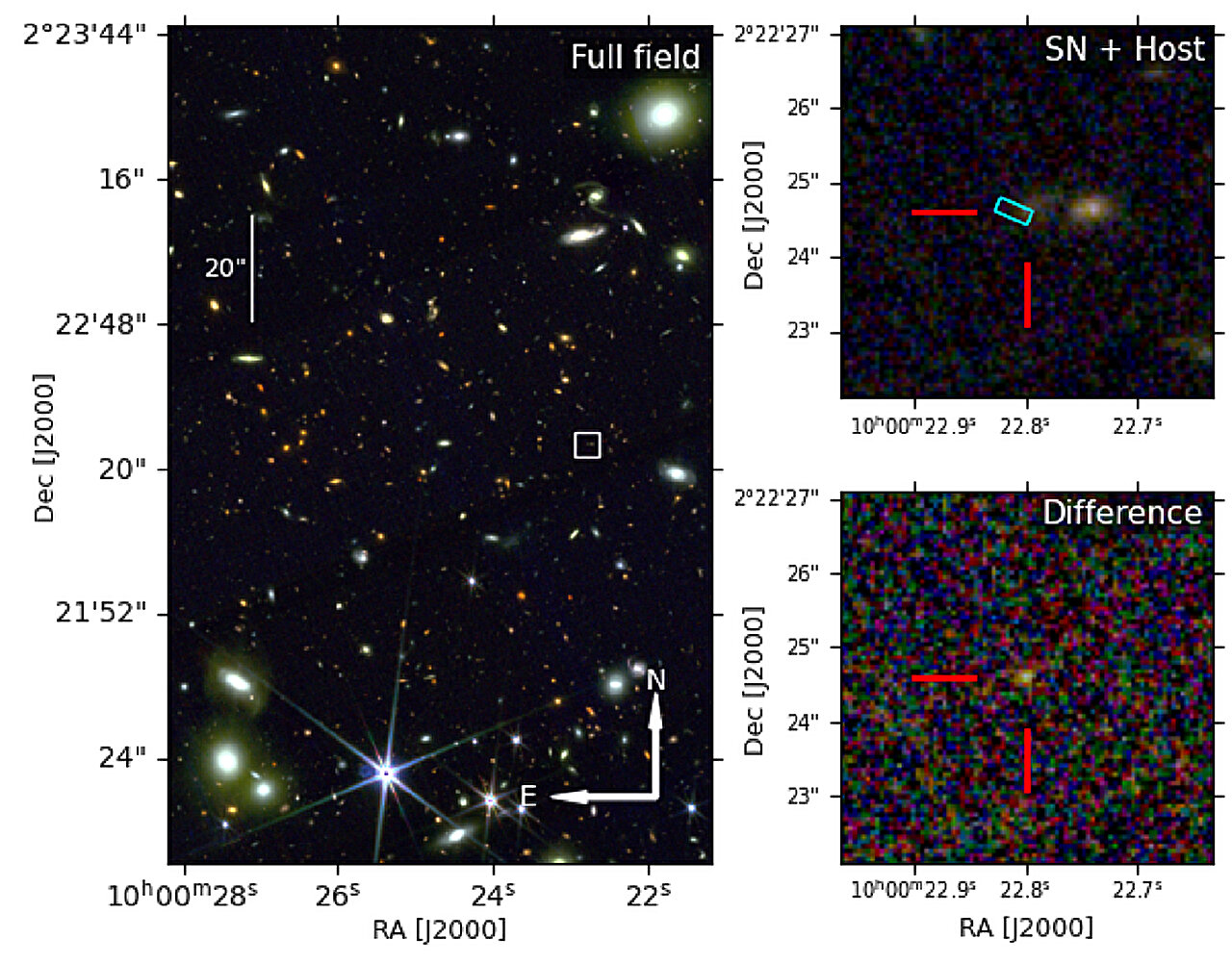
Finding distant supernovae is difficult because they are extremely faint. The sensitivity of the James Webb Space Telescope has made it possible to search for more of them in deep surveys, including COSMOS-Web, where SN 2023aeaf was found.
Spectroscopic observations established its redshift at 3.195. That places the explosion at a time when the universe was roughly 2 billion years old.
The explosion was a Type II supernova
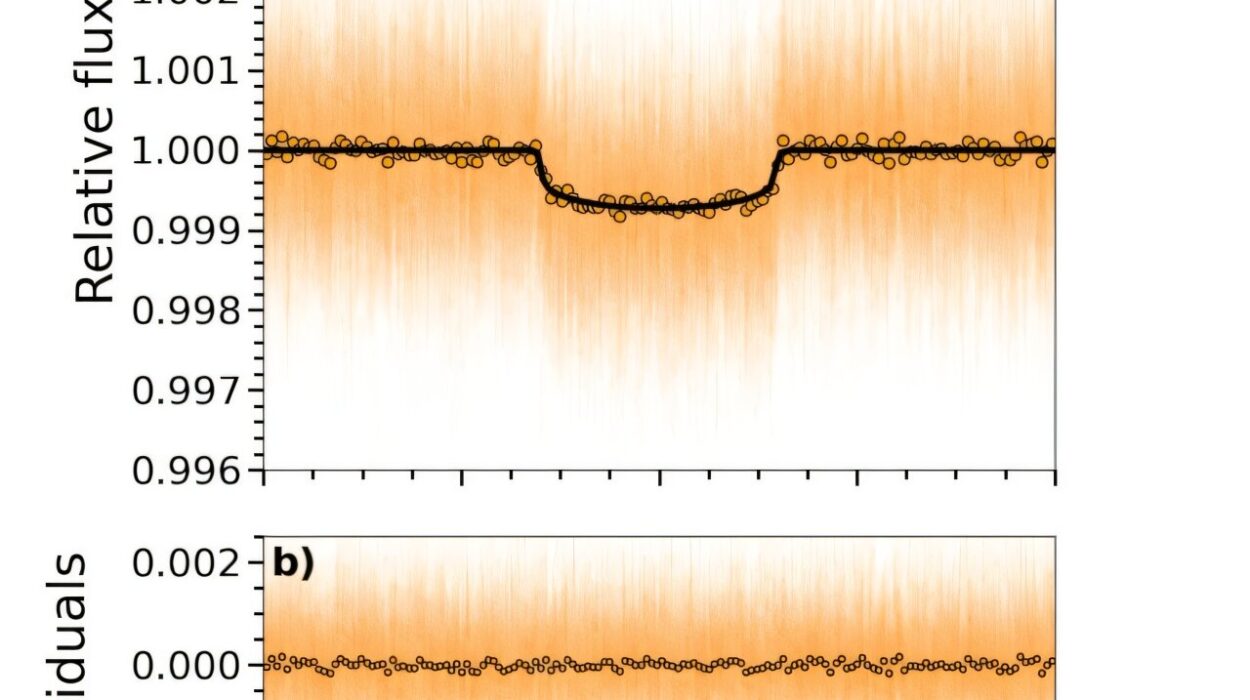
Valeria Aparicio of the Institute for Astronomy at the University of Hawai’i and her colleagues examined the supernova’s changing brightness and color. They compared those observations with simulated supernova populations.
The evidence favored a Type II supernova, with a classification probability of 97.2%. In these explosions, a massive star retains its hydrogen-rich outer layers as its iron core collapses, leaving hydrogen lines in the resulting spectrum.
The researchers also examined the galaxy that hosted SN 2023aeaf. It is a young dwarf galaxy that is actively forming stars and has a relatively low proportion of heavier elements.
That environment is consistent with expectations for massive-star explosions in chemically young galaxies at a redshift near 3.
An unusually hot start
The researchers used specialized software called STELLA to model the explosion’s behavior.
Early in its evolution, SN 2023aeaf appeared unusually hot and blue. The simulations indicated that the best explanation was an interaction between the explosion’s blast wave and a compact shell of gas the star had expelled shortly before it died.
As that interaction faded, the supernova cooled into the plateau phase associated with Type II explosions.
The limited observations also placed constraints on the star that produced the explosion. The researchers found that the available data were most consistent with a progenitor star about 12 times the mass of the Sun, surrounded by roughly half a solar mass of material.
Those estimates remain imprecise. Only a couple of observations were available at different times, preventing the team from determining the exploding star’s detailed properties with much precision.
More distant explosions are needed
SN 2023aeaf adds to the still-small group of supernovae identified beyond redshift 3. The researchers say that a larger sample will be needed to properly characterize this population.
As more distant supernovae are found, their occurrence rate could help astronomers constrain the history of star formation across the universe.
The study was published in The Astrophysical Journal.