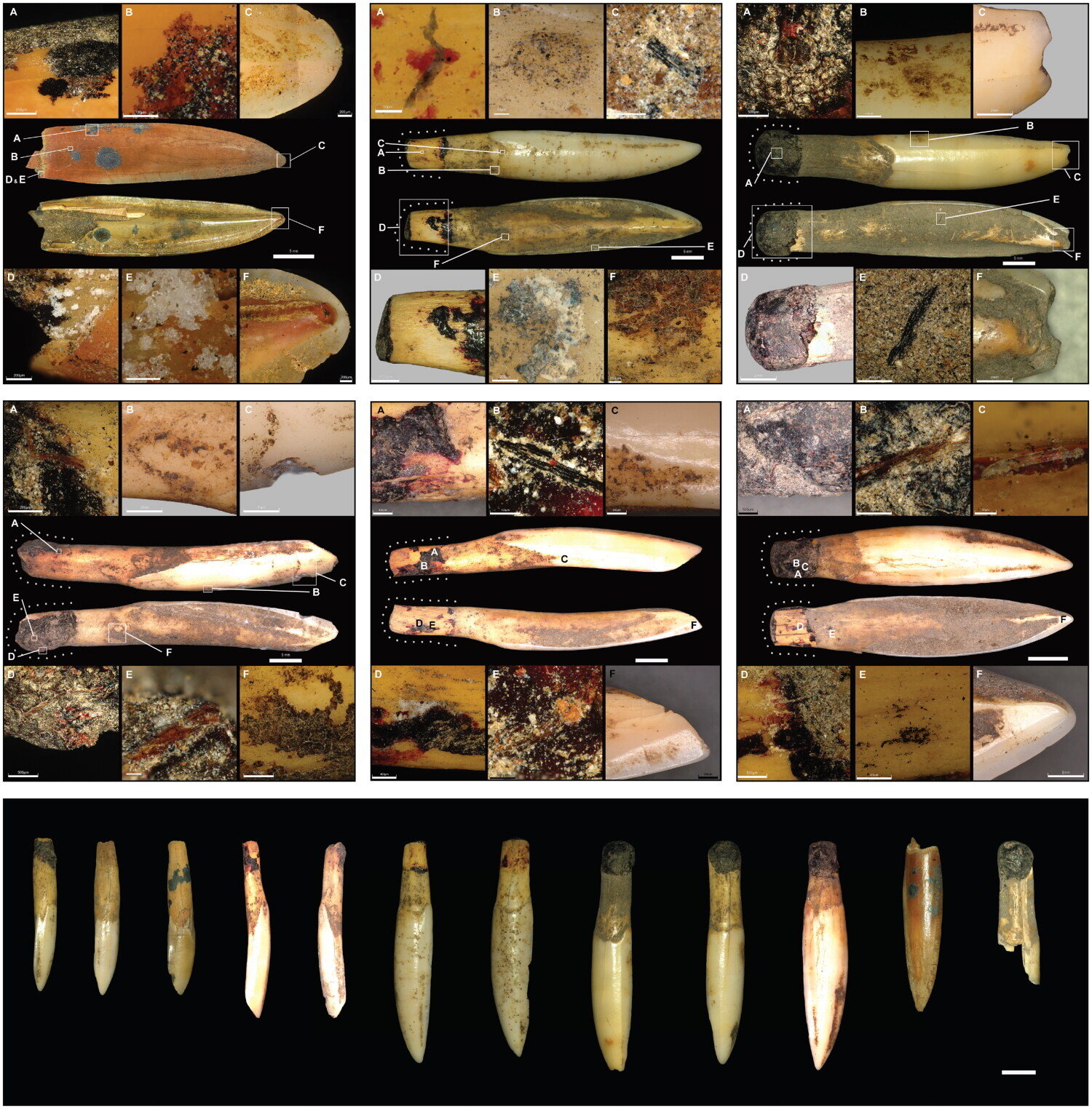
Twelve wallaby teeth found at a Queensland rock shelter were each fitted with small balls of plant resin, providing the first known evidence of this kind of tooth ornament from Cape York Peninsula and the only known example of such ornaments found outside burials in northeastern Australia.
The first tooth appeared during routine sorting of animal bones from Windmill Way, a rock shelter in Quinkan Country in southeastern Cape York Peninsula. Archaeologist Lynley Wallis of Griffith University noticed that a dark, sticky-looking lump was attached to the tip of the tooth’s root.
She stopped to inspect it more closely and passed it to Sam Lowdown, a Traditional Owner and member of the Laura Ranger team. Lowdown recognized the material as resin.
The team eventually found 11 more teeth carrying the same substance. All 12 were wallaby teeth, and they were more than 1,000 years old.
The discovery is unusual because organic materials such as wood, string and plant gum rarely survive for long in the archaeological record. Windmill Way is an exception. More than 500 pieces of plant-fiber string have been recovered there, together with ocher, shell, worked wood and thousands of gnawed animal bones.
The abundance of gnawed bones initially led researchers to consider whether the shelter might have been used by dingoes.
The resin came from local trees
The researchers wanted to identify the material attached to the teeth. Elders and Rangers from the Laura community used their knowledge to suggest which plants might have supplied the resin.
Two laboratory methods were then used to test those possibilities. Infrared analysis examines how chemical bonds absorb infrared light, producing a chemical pattern that can be compared with patterns from known resins. Liquid chromatography-mass spectrometry separates a mixture into individual compounds and measures their molecular weights.
Together, the tests showed that the resin mounting every tooth came from grass trees, which still grow on the rocky slopes around the shelter.
One tooth contained additional traces of resin from ironwoods, trees that grow along nearby waterways.
The teeth were not being used as tools
Macropod teeth, including those from kangaroos and wallabies, were used in the region to make tools such as chisels and drills for scraping and engraving. The 12 teeth from Windmill Way, however, did not show signs of having been used in that way.
The resin itself provided another clue. Plant fibers and a small piece of animal hide were still attached to some of the resin balls.
The researchers suggested that the teeth may once have been part of a necklace or headband. In that interpretation, the resin would have worked as a stopper, holding the teeth in place on a string.
That possibility fits with the broader archaeological record of tooth ornaments in Australia, which includes necklaces and headbands made from animal teeth. Most known examples, however, have been recovered from burials, and nearly all of those come from southeastern Australia.
Cape York Peninsula had produced no known animal-tooth jewelry despite decades of archaeological research.
The Windmill Way teeth provide the first such evidence from the peninsula.
How common was this type of jewelry?
The discovery does not establish how widespread tooth jewelry was in Cape York Peninsula. The researchers could find only one other potentially similar example, a wallaby-tooth necklace held by the Pitt Rivers Museum in Oxford.
Its records identify its origin only as “Australia,” leaving its more specific source unknown.
Wallis said the team consulted museum curators but could not determine where the necklace came from. Because many tooth necklaces in museum collections were made using other methods, she considers the possibility that resin-mounted tooth jewelry was rare on the peninsula.
The Windmill Way ornaments therefore add a previously undocumented form of material culture to the archaeological record of Cape York Peninsula, while questions about how common the practice was remain unresolved.
The study was published in Australian Archaeology.