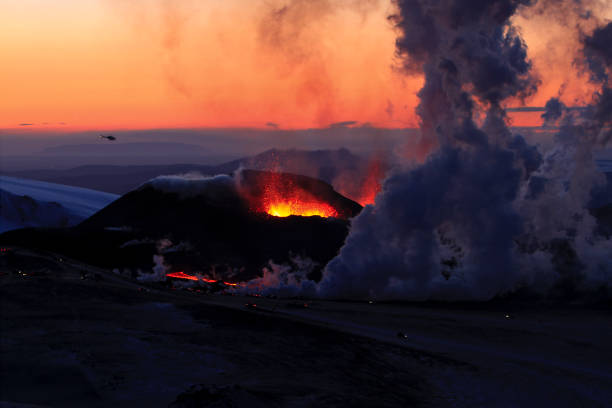
Deep beneath the surface of the Earth, in the silent, sweltering dark of a magma chamber, a volatile dance is constantly unfolding. For decades, geologists believed they understood the choreography of this dance. They thought they knew exactly what pushed a sleeping giant like Japan’s Aso caldera to finally break its silence and tear through the crust. But a groundbreaking new study published in Nature Communications suggests we may have been looking at the rhythm of the dance entirely backward. Instead of gas escaping the molten rock to trigger a blast, it appears that gas dissolving back into the liquid—a process called volatile resorption—is the hidden hand that primes the world’s largest volcanoes for disaster.
The Traditional Tale of the Bubbling Cauldron
To understand this shift in thinking, one must first look at the long-standing theory of volatile exsolution. In this traditional model, magma is treated much like a bottle of soda. While under the immense pressure of the Earth’s crust, gases like water vapor, carbon dioxide, and sulfur remain dissolved within the silicate melt. However, as magma rises or cools, its ability to hold these gases—its solubility—drops. The gases separate from the liquid, forming tiny bubbles.
The logic seemed airtight: as these bubbles grow, they create massive magmatic overpressure. This internal bloating was thought to be the primary engine driving eruptions, particularly in systems rich in silica. Some researchers even suggested that these exsolved gases act as a buffer, soaking up pressure and making eruptions less frequent, but far more catastrophic when the lid finally blows.
Yet, there is a catch to this classic story. For volatile exsolution to actually trigger an eruption, the gas has to form faster than the Earth can relax around it. It requires rapid crystallization rates that are incredibly difficult to maintain in the massive, heat-trapping reservoirs that feed the world’s most dangerous volcanoes. In these giant systems, the bubbles might actually make the magma more compressible, essentially acting as a sponge that absorbs the stress of new magma entering the chamber rather than triggering a break.
A Paradoxical Turn Toward the Liquid
If the “soda bottle” theory doesn’t perfectly fit the largest volcanic systems, what does? The research team decided to explore the mirror image of exsolution: volatile resorption. This is the process where gases that have already formed into bubbles are forced back into the molten rock. While it sounds counterintuitive that losing bubbles could cause a blast, the physics of the magma chamber tell a different story.
When gas is resorbed into the melt, the magma compressibility decreases significantly. Imagine trying to squeeze a balloon filled with air versus a balloon filled with water; the air-filled one yields easily, while the water-filled one resists. By dissolving the gas back into the liquid, the “sponge” is removed. The magmatic system becomes rigid and sensitive.
This change in state modulates how the volcano responds to recharge, which is the arrival of fresh, hot magma from deeper in the Earth. Because the magma is now harder to compress, even a small amount of new material creates a sudden, violent spike in pressure. The study suggests that this resorption-induced loss of the magmatic volatile phase—the very thing that usually buffers pressure—is what actually expedites the path to a catastrophic eruption.
Whispers from the Ancient Apatite
To test this provocative new theory, the researchers turned to the ghost of a prehistoric disaster: the Aso-4 eruption. Approximately 86,000 years ago, the Aso caldera in Japan produced a colossal eruption that reshaped the landscape. To reconstruct the events leading up to that day, the team looked at microscopic witnesses called apatite.
Apatite is a calcium phosphate mineral that crystallizes within the magma and is eventually spat out during an eruption. These crystals act as tiny chemical flight recorders, preserving a record of the water saturation levels within the magma at the time they grew. By analyzing the data trapped within Aso’s apatite crystals, the team was able to calibrate a thermo-mechanical numerical model to simulate the life of the magma chamber.
The team ran various simulations, tweaking variables like recharge rates, volatile contents, and thermal conditions. They wanted to see exactly when volatile resorption would take over and how it would affect the stability of the entire chamber. The results were startling. In cases where the magma contained 5 wt% H2O, the simulations showed that the pressurization rate was substantially higher when resorption was occurring.
A Race Against Geological Time
The simulations revealed a dramatic difference in timing between the two processes. In the scenarios where gas was resorbed, the pressure built so rapidly that an eruption was triggered after only 2.3 thousand years. In contrast, the simulations involving the traditional exsolving process failed to produce an eruption even after 5 thousand years.
The reason for this speed is twofold. First, the volatile resorbing runs experienced higher recharge rates, meaning more fresh magma was pumping into the system. Second, and more importantly, the reduction in magma compressibility meant the system could no longer handle the internal stress. Without the gas bubbles to act as a pressure buffer, the chamber reached its breaking point with terrifying efficiency.
While these models are a simplified version of the messy, complex reality of a volcano, they provide a new lens through which to view the world’s most dangerous peaks. The researchers believe that this study is just a starting point. By combining these sophisticated models with real-time monitoring of active volcanoes, scientists might one day be able to identify the specific chemical signatures of volatile resorption as they happen.
Why Decoding the Magma Matters
This research is not merely an academic exercise in fluid dynamics; it is a vital step toward protecting human life and global stability. Large-scale volcanic eruptions are among the most infrequent but devastating natural hazards on Earth. They have the power to alter global climates, destroy regional economies, and cause massive loss of life.
By shifting the focus from gas leaving the magma to gas entering it, we gain a more accurate “stress test” for the Earth’s crust. Understanding that volatile resorption can trigger eruptions faster than previously thought means our window for warning might be different than we assumed. As models become more complex and data from minerals like apatite becomes more refined, we move closer to a future where the internal pressure of a caldera is no longer a mystery. Ultimately, this new understanding offers a vital tool for hazard assessment, providing a potential way to predict when a sleeping giant is truly beginning to wake, and ensuring we are not caught off guard when the dance of the volatiles turns deadly.
Study Details
Franziska Keller et al, Volatile resorption expedites eruption onset in large silicic systems, Nature Communications (2026). DOI: 10.1038/s41467-026-70206-8