Long after massive stars collapse and disappear from view, their black hole remnants continue reshaping the Galaxy in silence. Many are flung far above the Milky Way’s stellar disk, some escape the Galaxy altogether, and only a small fraction remain paired with visible companion stars. By reconstructing these hidden journeys across billions of years, astronomers have built one of the most detailed simulations yet of the Milky Way’s unseen black hole population—finding that where a black hole ends up today carries clues about how it formed, how violently its parent star exploded, and even how much of the dying star fell back into the newborn black hole.
Black holes are among the most difficult objects in the Milky Way to study because most emit little or no light. Nearly every stellar-mass black hole discovered so far has been found only because it belongs to a binary system, where interactions with a companion make its presence detectable.
The new study asks a much broader question: what does the entire hidden population of Milky Way black holes actually look like?
To answer it, the researchers simulated the birth, evolution, and motion of black holes throughout the Galaxy using a framework that follows both binary stellar evolution and the gravitational paths of those objects through the Milky Way.
Rather than modeling only currently observable systems, the simulations attempted to reconstruct the intrinsic Galactic population. The team evolved stellar populations formed throughout the Milky Way’s history, accounting for where stars were born, how they interacted with companions, how they exploded, and how the resulting compact remnants traveled through the Galaxy afterward.
Across all model variations explored in the study, the simulations followed the evolution of roughly 53 million black holes, representing one-hundredth of the Milky Way’s stellar mass and then scaling to the full Galaxy.
Hundreds of millions of black holes may have formed
In the study’s fiducial model, approximately 1.7 × 10⁸ stellar-mass black holes formed during the Milky Way’s history.
Together they contain roughly 1.5 × 10⁹ solar masses of material.
The simulations indicate these black holes originated from approximately 6.7 × 10⁸ core-collapse events. Neutron stars were even more common, forming at a rate about 2.9 times higher than black holes.
Most simulated black holes clustered toward relatively low masses. The distribution peaked at the model’s minimum allowed black hole mass of 3 solar masses, while extending upward to roughly 55 solar masses. The median mass was 7.2 solar masses.
But perhaps the biggest surprise is not how many black holes exist—it’s how few remain attached to visible stars.
Most black holes end up alone
Although the simulations assumed that essentially all massive stars formed in binary systems, the overwhelming majority of present-day black holes did not stay in them.
About 91% are isolated.
Roughly 59% of the entire black hole population became isolated after a supernova disrupted their binary systems.
Another 33% became isolated for a different reason: their progenitor stars merged before either star reached core collapse, leaving behind a single object that later formed a black hole.
Only about 9% of black holes remain in binaries today.
Among those surviving binaries, most companions are themselves compact remnants—either another black hole or a white dwarf. Only around 10⁵ black holes across the Milky Way are predicted to retain a luminous stellar companion.
That rarity matters because those systems are the ones most likely to be observed directly.
The Milky Way’s black holes have spread far beyond its visible stellar disk
After their birth, black holes do not simply stay where their parent stars lived.
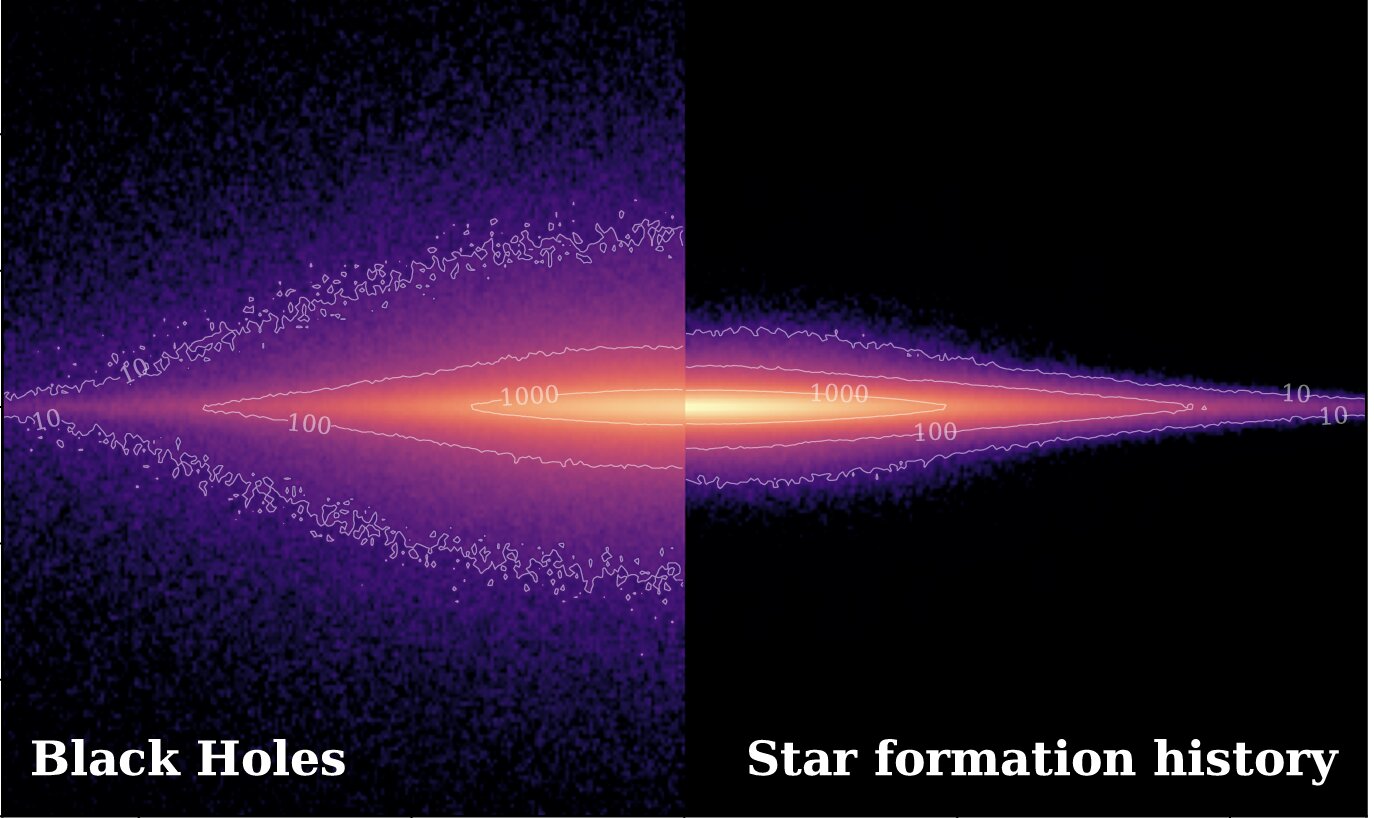
The simulations indicate that the Milky Way’s black holes are distributed much more diffusely than ordinary stars.
The researchers calculated an effective vertical scale height of approximately 786 parsecs for black holes compared with 306 parsecs for the Galaxy’s visible stellar population.
In other words, the hidden black hole population extends about 2.5 times farther above and below the Galactic plane.
The reason lies largely in supernova natal kicks.
When massive stars collapse, asymmetries during the explosion can impart substantial velocities to the newly formed compact object. Those kicks gradually scatter black holes into thicker Galactic orbits over billions of years.
The simulations indicate that orbital motion inherited from binary systems contributes relatively little compared with these natal kicks.
The heavier black holes stay closer to home
One of the study’s strongest patterns emerged only after comparing black hole masses with their present-day locations.
The simulations predict that heavier black holes tend to remain closer to the Galactic plane, while lighter ones are much more common at large distances above or below it.
Near the Galactic plane, within one kiloparsec, the median black hole mass is about 7.7 solar masses.
For black holes located at least 10 kiloparsecs from the plane, the median falls to about 5 solar masses.
This relationship arises because the simulations assign weaker natal kicks to heavier black holes.
The underlying mechanism involves “fallback”—material from the exploding star that falls back onto the newly formed black hole. Larger amounts of fallback damp the effects of explosion asymmetries, reducing the velocity kick.
As a result, higher-mass black holes generally remain closer to their birthplaces, while lower-mass ones are launched into more extended Galactic orbits.
Interestingly, the authors note that this present-day trend is the opposite of the relationship imprinted at the moment of formation. At birth, black holes farther from the Galactic plane are, on average, more massive because those regions contain lower-metallicity stars that retain more mass before collapse. According to the simulations, natal kicks are strong enough to reverse that initial pattern over time.
Some black holes leave the Milky Way entirely
Not every black hole remains gravitationally bound to the Galaxy.
The fiducial simulation predicts that about 3% acquire enough energy to escape the Milky Way.
Nearly all of these escapees are isolated black holes.
Only about 0.03% of escaping black holes leave while still accompanied by another object.
Because stronger kicks preferentially affect lower-mass black holes, the escapees are also lighter than average, with a median mass of 4.4 solar masses.
Altogether, the escaping population corresponds to roughly 2.4 × 10⁷ solar masses of black holes leaving the Galaxy over approximately 12 billion years.
Using the median escaping mass, the authors estimate that the Milky Way loses roughly one black hole every two millennia.
Nearby black holes may be closer than expected
The simulations also estimate the local density of black holes near the Sun.
Within the modeled solar neighborhood, the predicted number density is approximately 1.6 × 10⁻⁴ black holes per cubic parsec.
Based on that density, the nearest black hole is expected to lie, on average, about 19 parsecs from the Sun.
The study does not identify any specific nearby objects, but instead provides a statistical expectation from the simulated Galactic population.
Different assumptions dramatically change the hidden Galaxy
The researchers did not stop with a single simulation.
They tested 32 variations covering uncertainties in binary evolution, supernova physics, remnant formation, initial stellar populations, and the Galactic gravitational potential.
Some assumptions had enormous consequences.
Depending on the model, the predicted number of Milky Way black holes varied by more than an order of magnitude.
The effective scale height ranged from 368 parsecs to 2,557 parsecs.
The fraction of black holes escaping the Galaxy ranged from 0% to 15.5%.
Among the most influential choices were the prescriptions used to determine remnant masses and natal kicks.
Different remnant-mass models produced markedly different black hole mass distributions, with distinct peaks, gaps, and total numbers of black holes.
The authors conclude that future observations of Galactic black holes could therefore help distinguish between competing models of how collapsing stars produce black holes.
A changing Milky Way also changes the outcome
The team also examined what happens if the Milky Way’s gravitational potential evolves over time instead of remaining static.
Accounting for that evolution increased the predicted escape fraction from about 2.7% to 6.8%.
It also increased the bound population’s scale height by roughly 20%.
Another comparison highlighted the importance of binary evolution.
Assuming all stars evolved as single stars produced a noticeably thicker black hole distribution. According to the authors, neglecting binary interactions overestimates the black hole scale height by roughly 30%.
Preparing for a flood of future discoveries
The authors frame their work as preparation for a new generation of observations.
Upcoming datasets from the Nancy Grace Roman Space Telescope, Gaia Data Release 4, and spectroscopic surveys are expected to greatly expand the known population of Milky Way black holes.
The simulations suggest that those future discoveries could do far more than count hidden black holes.
Because the present-day masses, locations, motions, and binary companions all respond differently to supernova physics and remnant formation, the authors argue that observations of the Milky Way’s black hole population may eventually help constrain how massive stars explode, how much material falls back during collapse, and how natal kicks are produced.
Instead of treating black holes simply as the final products of stellar evolution, the study presents them as long-lived records of events that occurred billions of years ago. Their positions throughout today’s Galaxy are not random—they preserve information about the explosions that created them, turning the Milky Way itself into a vast archive of stellar deaths that future observations may finally begin to read.
Publication details
Tom Wagg et al, Charting the Galactic Underworld I: Comprehensive simulations of the kinematics, rates, and demographics of Milky Way black holes, arXiv (2026). DOI: 10.48550/arxiv.2607.22814