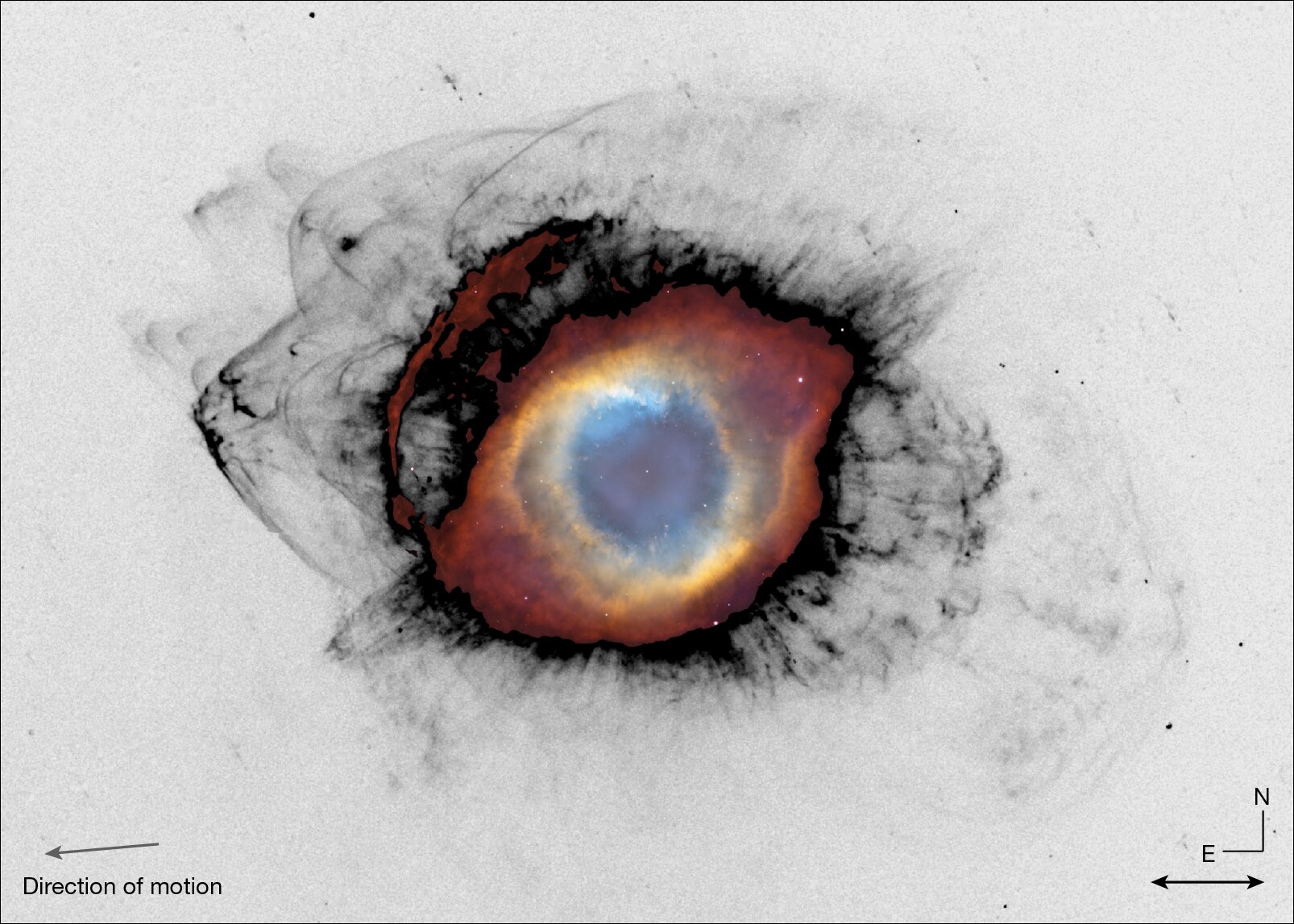
A dying star has left behind something far more intricate than a smooth cloud of gas: dozens of tiny shock waves are now racing through the outskirts of the Helix Nebula, marking dense fragments of stellar material as they are stripped apart and mixed into the surrounding space. In a new study, astronomers have identified at least 22 of these compact bow shocks and found that they become dramatically smaller and more ragged with distance from the nebula’s central star—a pattern that may offer a rare direct view of how material expelled by a dying star eventually loses its identity and becomes part of the interstellar medium.
The scene is easy to imagine as a kind of cosmic aftermath.
A star near the end of its life has spent thousands of years shedding material into space. That material does not simply disappear. It expands outward, collides with the surrounding interstellar gas and, eventually, is expected to become part of the vast reservoir of matter between stars.
But astronomers have had difficulty watching that final transition happen.
The Helix Nebula, also known as NGC 7293, now appears to offer an unusually detailed view of that process.
Using the partially completed Modular Optical Telephoto Hyperspectral Robotic Array, or MOTHRA, Pieter van Dokkum and colleagues observed the Helix in Hα, [N II] and [O III] emission. Their findings were published in Nature.
What emerged in the Hα image was a striking forest of arcs and partial arcs on the eastern side of the nebula. The researchers identified at least 22 of them.
These are not ordinary structures surrounding the central star. The researchers interpret them as bow shocks produced by individual fragments of stellar ejecta as they plow through the interstellar medium.
And the most revealing part may not be the number of shocks.
It is how they change.
The farther out they are, the smaller they become
Close to the white dwarf at the heart of the Helix, the bow shocks are relatively large, thin and sharply defined.
Farther away, they become smaller, broader, fuzzier and increasingly irregular.
The change is not subtle.
Across a radial range extending from about 0.4 to 1.4 parsecs from the central star, the characteristic radius of curvature of the bows decreases by roughly two orders of magnitude. A parsec is about 3.26 light-years, so these structures span a region several light-years across.
The researchers quantified the pattern by measuring the radius of curvature of each bow—the characteristic scale describing how tightly its arc bends.
Their fit gives an exponential decline with an e-folding length of about 0.27 parsec.
That geometric pattern is important because the researchers do not interpret it simply as a collection of differently sized shocks.
Instead, they propose that the sequence records what happens to the fragments themselves as they travel outward.
The dense pieces of the old stellar shell appear to be progressively stripped and broken apart as they interact with the surrounding medium.
In other words, the nebula may be showing astronomers a process that is normally hidden.
The shocks reveal objects that barely shine
There is another remarkable feature of the observations.
At the apparent focus of most of the fitted bow shocks, there is little or no corresponding emission in Hα, [O III] or [N II].
The researchers interpret this absence as evidence that the objects driving the shocks are largely neutral.
That creates an unusual observational situation. The fragments themselves are difficult to see directly. Instead, astronomers detect them through the shocks they generate as they encounter surrounding gas.
It is somewhat like finding an otherwise invisible object because of the disturbance it creates around itself.
The bow shocks therefore act as signposts for pieces of stellar ejecta that would otherwise be difficult to identify.
And the shocks are not merely passive markers.
Their existence means that the fragments and surrounding gas are exchanging momentum. As the fragments move through the ambient medium, material can be stripped from them and mixed into the surrounding flow.
The farther-out, fuzzier structures are consistent with that process continuing over time.
The researchers describe the bows as both signposts of the fragments and agents of their destruction.
These fragments appear to be older than the Helix itself
The velocities provide another clue to the history of the material.
The Helix Nebula’s central white dwarf is moving through the interstellar medium at a combined velocity of about 45 kilometers per second relative to that surrounding gas.
The bow shocks are strongest on the eastern side of the nebula. By comparing their emission-line ratios with radiative shock models calculated using the MAPPINGS V code, the researchers infer shock velocities of about 80–90 kilometers per second there.
The eastern shock velocity, combined with the nebula’s motion through the interstellar medium, implies that the ejecta themselves are expanding outward at roughly 35–45 kilometers per second.
That speed leads to an important result.
At a distance of about 1 parsec from the central star, the fragments would have a dynamical age of roughly 20,000–30,000 years.
That predates the formation of the planetary nebula, which the paper places at roughly 12,000 years ago.
The implication is that these fragments are probably not simply leftovers from the most recent stage that created the visible planetary nebula. Instead, the researchers conclude that the material most likely belongs to an older circumstellar envelope expelled during the late asymptotic giant branch, or AGB, phase of the star’s evolution.
The material has since fragmented into individual clumps.
Those fragments are now making their way through the surrounding environment.
Why the eastern side is so much brighter
The Helix does not display the bow shocks equally strongly on all sides.
The prominent structures are concentrated in the east and northeast. Fainter arc-like features also appear on the western side at roughly comparable distances from the white dwarf.
The researchers can explain much of this asymmetry through velocity.
On the eastern side, the expanding stellar material encounters the ambient interstellar medium with a relative shock velocity of about 85 kilometers per second.
On the western side, the ejecta instead encounter a turbulent postshock wake. The resulting shock velocity is estimated at roughly 35 kilometers per second.
That difference matters enormously for Hα emission.
The researchers’ shock models show that, in this velocity range, Hα luminosity changes steeply with shock speed. They calculate that the western shocks should therefore be about one to two orders of magnitude fainter than those in the east.
The observed surface brightness differs by roughly a factor of ten, broadly consistent with the model prediction.
This also helps explain why the eastern structures stand out so dramatically in the new image while their western counterparts are much harder to see.
The faint western structures are not thought to be produced by the nearby high-speed jet. That jet moves at roughly 300 kilometers per second, and shocks driven by it would be expected to show strong [O III] emission, which is not observed in these features.
MOTHRA made the faint structures visible
The discovery was made possible by MOTHRA, an unusual telescope being built as an array of telephoto lenses at the El Sauce Observatory in Chile.
When complete, MOTHRA will contain 1,140 lenses distributed over 30 mounts and will be optically equivalent to a 4.8-meter f/0.08 refractor.
The Helix observations were obtained while only the first five mounts were operational.
Because the array was still under construction, the observations are equivalent to about 20 minutes of on-source exposure with the completed array.
Even in that early configuration, the instrument revealed numerous faint features in the outer regions of the nebula that had not previously been seen in Hα.
The researchers used extremely narrow filters to isolate emission from Hα, [O III] and [N II]. The reduced Hα images reached a 1-sigma depth of roughly 2 × 10⁻¹⁹ erg s⁻¹ cm⁻² on one-arcminute scales.
The result was a much deeper look into the nebula’s faint outskirts.
There, the forest of arcs became visible.
The bows appear to record a sequence of destruction
The researchers fitted the 22 structures with several mathematical shapes, including parabolas, hyperbolas, ellipses and Wilkin profiles.
They used parabolic fits as their primary model, but they were careful not to assign a direct physical interpretation to the particular shape of the fitting function. Many of the structures are incomplete, and some are broader and less sharply bounded than an ideal thin-shell bow shock.
Instead, the fits were used to extract geometric measurements, especially the characteristic curvature scale.
That distinction matters.
The researchers are not claiming that every bow is a perfect textbook shock whose shape directly reveals its dynamics. They are using the geometry to establish a remarkably consistent trend across the population.
The trend is that the coherent bow-forming structures become smaller with increasing distance from the central star.
At about 0.8 parsec from the white dwarf, the representative bows are still relatively large and well defined.
At around 1.3 parsecs, the structures include much smaller and broader features.
The researchers interpret this progression as a sequence of shell-fragment disruption.
As material is stripped away from the dense fragments, the surviving heads become smaller and more porous. At the same time, an increasing share of the Hα emission may come from mixed, mass-loaded gas associated with the fragments rather than from a simple, geometrically thin shock front.
The outer bows therefore look less like crisp arcs and more like structures in the process of coming apart.
A clock hidden in the nebula
The researchers can take the observed spatial sequence one step further.
If the bows at different distances represent fragments at different stages of outward evolution, their locations can be treated approximately as a time sequence. Using an expansion velocity of about 40 kilometers per second, the observed decline in curvature corresponds to an e-folding time of roughly 7,000 years.
From this, the researchers infer that the coherent dense fragment–bow systems are disrupted on a timescale of about 10,000 years.
That number is one of the study’s most important results.
It is not a direct measurement of a particular mass-loss rate or momentum-transfer rate. Rather, the researchers emphasize that it represents the approximate survival time of a coherent dense fragment and the bow structure it produces.
That distinction is crucial.
The observation is of the changing geometry and morphology of the shocks. The physical interpretation is that the fragments are being stripped, fragmented and mixed as they move outward.
The resulting timescale is therefore an empirical constraint on how long these dense pieces of stellar ejecta retain their coherent identity.
A different kind of stellar wind story
Astronomers have previously observed large-scale bow shocks around evolved stars.
A famous example is Mira, where a stellar wind interacts with the surrounding interstellar medium and produces a large bow-shaped structure.
Those structures can persist for roughly 100,000 years and reveal where the stellar wind meets its environment.
But they do not necessarily show what happens to the wind after it has broken into individual pieces.
The Helix offers something different.
Here, the researchers see numerous compact bow shocks with no luminous source at their apparent centers. They interpret these as evidence that the interaction between the old stellar ejecta and the interstellar medium has fragmented into dense, largely line-dark obstacles.
Those obstacles are then progressively ablated and entrained into the surrounding gas.
That makes the Helix’s outer halo unusually valuable: rather than seeing only the broad boundary between a stellar wind and the interstellar medium, astronomers can follow individual fragments as they appear to lose their coherence.
Watching stellar material become part of interstellar space
The significance of this process extends beyond the Helix.
Low- and intermediate-mass stars eventually return material to their surroundings. That expelled material contains gas, dust and elements produced during stellar evolution.
But the final step—when fragmented stellar ejecta are actually dispersed and mixed into the interstellar medium—has been difficult to observe directly.
The Helix observations provide a possible window onto that stage.
The inferred roughly 10,000-year disruption time suggests that once the ejecta have fragmented and become exposed to the diffuse surrounding medium, they lose their coherent identity relatively quickly.
The authors note that galaxy-formation simulations generally have to represent unresolved mixing and transport processes using subgrid prescriptions for turbulent mixing and diffusion.
The Helix’s observed fragment disruption therefore provides an observational benchmark that such models can potentially be compared against.
The researchers are careful, however, about what the observation establishes. The study does not measure a universal mixing time for all stellar ejecta. It provides a characteristic disruption timescale for the coherent dense fragments traced by these bow shocks in the Helix.
Whether similar behavior occurs elsewhere remains an open question.
The next test may be to find more dying stars doing the same thing
If the interpretation is correct, the Helix should not be unique.
The authors describe the nebula as a fairly typical planetary nebula and suggest that similar fragment-driven bow shocks should be present in the outskirts of other planetary nebulae.
Their visibility will depend strongly on velocity. Because Hα luminosity rises steeply with shock velocity in the relevant regime, the researchers expect these structures to be easiest to detect when a planetary nebula’s bulk motion relative to the interstellar medium exceeds roughly 40 kilometers per second.
The completed MOTHRA array should make such searches more accessible.
There is also another way to look for the otherwise faint fragments.
By analogy with the molecular cometary knots already known in the Helix, the researchers suggest that the Hα-dark clumps inferred from the shocks could potentially be detectable through carbon monoxide rotational emission and, particularly, the H₂ 1–0 S(1) line at 2.12 micrometers.
For now, the 22 bow shocks provide something unusually tangible.
They turn an invisible process into a visible sequence: dense pieces of an ancient stellar envelope moving outward, driving shocks into the surrounding gas, becoming progressively smaller and less coherent, and apparently approaching the point where their material can no longer be distinguished from the interstellar medium.
The Helix Nebula is therefore not simply displaying the remains of a dying star.
It may be showing astronomers, piece by piece, how those remains finally disappear into the space between the stars.