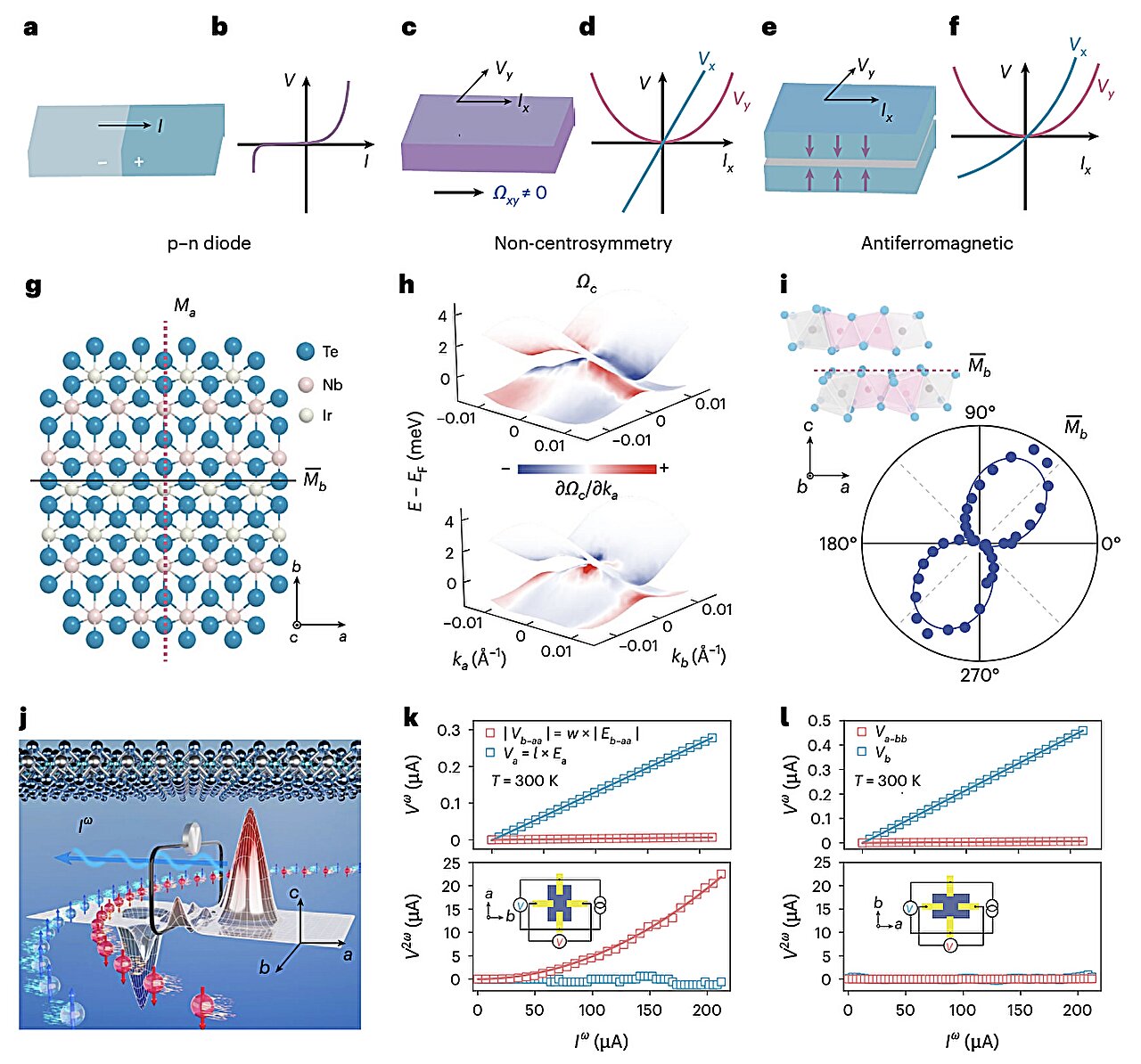
The world we live in is a silent, invisible sea of energy. Every time you send a text, use a GPS, or walk through a security scanner, you are interacting with electromagnetic waves. These oscillating electric and magnetic fields are the lifeblood of modern technology, yet they are useless to our gadgets in their raw, wavy form. To make them work, we rely on a humble component called a p-n diode. These tiny semiconducting devices act as translators, converting those wild oscillations into the steady electrical signals that power our digital lives. But for decades, these translators have been hitting a wall, struggling to keep up with the sheer speed and complexity of the modern world.
The Invisible Speed Limit of the Digital Age
To understand why our current tech is reaching its limits, we have to look at how a conventional diode actually works. It relies on something called nonlinear transport of electrons. In simple terms, when you apply voltage to these devices, the current doesn’t just change in a straight, predictable line. This “nonlinear” behavior is actually a superpower; it allows the diode to rectify signals, turning alternating current into the direct current that electronics crave. It also allows them to mix signals of different frequencies, a process essential for wireless communication.
Shutterstock
Explore
However, these traditional designs are plagued by two persistent ghosts: thermal noise and transit time. Because conventional diodes rely on the physical movement of electrons across a material, heat causes those electrons to bounce around randomly. This creates “noise” that drowns out weak signals, making it nearly impossible to detect subtle data. Furthermore, electrons take a finite amount of time to travel across the device. This transit time might seem instantaneous to a human, but at the incredibly high frequencies required for next-generation tech, it acts like a speed limit. When the waves are oscillating faster than the electrons can move, the system simply breaks down.
A Quantum Leap into the Unknown
Recognizing that the old ways were failing, researchers at the Chinese Academy of Sciences turned to the frontier of physics. They didn’t just want to tweak the old diode; they wanted to reinvent the translator itself. Their secret weapon is a material that sounds like something out of a science fiction novel: a type-II Weyl semimetal. This isn’t your standard silicon; it is a quantum material with a unique internal structure known as band geometry and topology.
Unlike traditional semiconductors, where electrons struggle against the “traffic” of the material’s atoms, the Weyl semimetal allows for nonlinear electron transport that is governed by the very shape of the material’s energy states. This allowed the team to create an “all-in-one” device known as a rectenna. The name is a hybrid of “rectifier” and “antenna,” and it represents a massive shift in how we capture energy. By using a specific semimetal called niobium iridium tetratelluride (NbIrTe4), the researchers found they could bypass the old thermal-voltage thresholds and transit-time limits that have hampered electronics for years.
Mastering the Chaos of High Frequencies
The true test of any new technology is how it handles the pressure of the real world. Many quantum breakthroughs only work in the extreme cold of a laboratory deep-freeze, but this new rectenna was designed to thrive at room temperature. This is a game-changer for practical use. When the team put their NbIrTe4 device to the test, the results were staggering. They demonstrated the ability to handle photonic frequencies ranging from 20 GHz to 820 GHz. To put that in perspective, this covers a massive portion of the spectrum where traditional electronics usually start to fail.
The device didn’t just translate signals; it manipulated them with surgical precision. It generated a broadband frequency comb that exceeded the 27th order, a feat of signal processing that allows for incredibly complex data transmission. It also performed subharmonic mixing at remarkably low power levels of –25 dBm. This means the device can pick up and process incredibly faint signals using very little energy. Perhaps most impressively, it showed a tuneable sideband bandwidth higher than 100 GHz and handled intermediate-frequency signals of over 27 GHz. In the world of data, bandwidth is everything—it is the width of the pipe through which information flows. This new device effectively replaced a narrow straw with a massive industrial water main.
The Architecture of Tomorrow’s Connectivity
The success of this nonlinear Hall rectenna opens up a roadmap for a future that was previously blocked by the limitations of physics. Because this device works as both an antenna and a rectifier simultaneously, it creates a much more efficient path for converting electromagnetic waves into usable data. By relying on the topology of the material rather than the slow, physical drift of electrons, the researchers have created a device that is essentially “faster” than the speed limits imposed on traditional semiconductors.
Looking ahead, the integration of these Weyl semimetal components could lead to the birth of wireless communication systems that operate at millimeter-wave and terahertz frequencies. These are the ultra-high speeds needed for the next leap in mobile data and satellite communication. Because the device is so sensitive and requires such low power, it also paves the way for a new generation of compact sensors and optoelectronic devices that are smaller and more efficient than anything we have today.
Why This Research Matters
This breakthrough is about more than just faster internet or clearer cell phone reception; it represents a fundamental shift in how we interface with the physical universe. For decades, we have been limited by the physical “friction” of electrons moving through matter. By utilizing quantum materials and the strange rules of topology, we are learning how to harvest information from the electromagnetic spectrum with almost no wasted effort.
The move toward terahertz frequencies and room-temperature quantum electronics means that the future of technology will be defined by devices that are not only more powerful but also significantly more energy-efficient. As engineers draw inspiration from this NbIrTe4 design, we may see a whole new family of topological materials entering our daily lives. This research effectively breaks the “speed limit” of modern electronics, ensuring that as our world becomes more data-hungry and interconnected, our technology will actually have the power to keep up.
Study Details
Zhen Hu et al, An all-in-one Hall rectenna with a bandwidth over 100 GHz, Nature Electronics (2026). DOI: 10.1038/s41928-026-01574-8.