Scientists have long looked to the stars to understand the origin of everything, but some of the most profound secrets of the universe are being unraveled within a circular tunnel on Long Island. New data from the PHENIX experiment at the Relativistic Heavy Ion Collider has provided direct evidence that the universe’s earliest form of matter can be recreated in even the smallest of atomic collisions. This substance, known as quark-gluon plasma, is a roiling primordial soup of free quarks and gluons that filled the entire cosmos just a fraction of a second after the Big Bang.
For decades, the standard scientific consensus held that this exotic state of matter could only be forged by smashing massive objects together, such as the nuclei of gold atoms. The logic was simple: only the most violent, high-energy impacts could generate enough heat and pressure to “melt” protons and neutrons into their fundamental building blocks. However, a groundbreaking analysis published in Physical Review Letters has turned that assumption on its head, proving that tiny droplets of this prehistoric soup can form during collisions between very small nuclei and large ones.
The Mystery of the Disappearing Particles
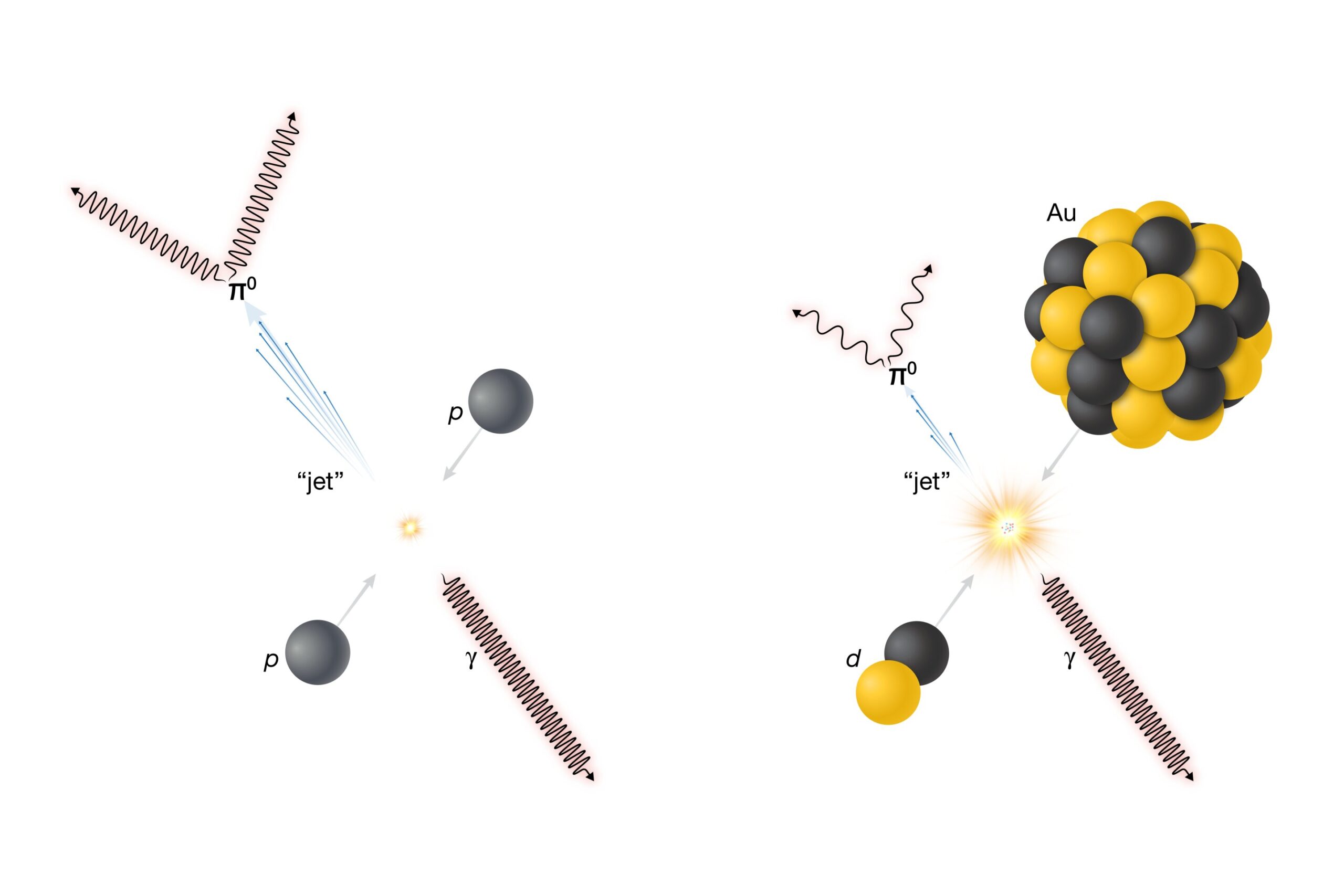
The discovery centers on a phenomenon known as jet quenching. In the high-speed environment of the collider, intense interactions between quarks can kick a single particle free with an immense amount of energy. This particle typically transforms into a cascade of other particles, which physicists call a jet. If there is no quark-gluon plasma present, these jets sail through the wreckage of the collision and hit the detectors with their energy intact.
However, if a plasma has formed, the environment changes completely. The free-roaming quarks and gluons in the plasma interact with the high-energy jet, causing it to lose energy and slow down significantly before it can escape. Physicists describe this effect as the difference between running through thin air and running through water. The plasma acts as the water, dragging on the particles and “quenching” their energy.
While scientists have routinely observed this suppression in large-scale gold-gold collisions, seeing it in small systems—such as a deuteron, which consists of only one proton and one neutron, hitting a gold nucleus—was considered unlikely. Previous attempts to find this signature in small collisions led to confusing results, including an unexplained increase in jets in some scenarios. The new PHENIX data finally provides the first direct evidence that these high-energy particles are indeed being suppressed in smaller smashups, confirming the presence of the plasma.
Counting Photons to Reveal the Truth
The breakthrough required a radical shift in how scientists measure the “centrality” of a collision, or how close to dead-center two nuclei hit each other. Traditionally, researchers used mathematical models to estimate how many protons and neutrons were involved in a strike. But in small systems, these indirect calculations were prone to errors that masked the true behavior of the particles.
To solve this, the research team turned to direct photons. These are high-energy particles of light produced in the same instant a quark is kicked free. Because photons do not interact with the quark-gluon plasma, they escape the collision zone completely unaffected. By counting these light particles, the team could directly measure exactly how many high-energy jets they should expect to see.
When the researchers compared the number of detected jet particles to the number of direct photons, the results were unmistakable. In the most central, head-on collisions, the number of jet particles was significantly lower than the photon count would suggest. This unambiguous suppression proved that the jets were being caught in a tiny, fleeting speck of quark-gluon plasma. By relying on observable quantities rather than theoretical models, the team removed the artifacts that had clouded previous studies.
Why This Matters
The discovery that quark-gluon plasma can form in such small-scale environments fundamentally changes our understanding of the strong force, the fundamental interaction that holds atomic nuclei together. By proving that even a handful of protons and neutrons can “melt” into a primordial liquid, researchers are gaining a more precise look at the conditions of the early universe.
This research indicates that the quark-gluon plasma is more resilient and easier to form than previously imagined. Understanding how these tiny droplets behave helps physicists map the transition from a universe of free-floating subatomic particles to the structured world of atoms and molecules we see today. As the team moves forward to analyze data from other small systems, such as proton-gold and helium-3-gold collisions, they are moving closer to a unified map of the matter that birthed the stars, the planets, and ourselves.
Study Details
N. J. Abdulameer et al, Disentangling Centrality Bias and Final-State Effects in the Production of High- pT Neutral Pions Using Direct Photon in d+Au Collisions at sNN=200 GeV, Physical Review Letters (2025). DOI: 10.1103/PhysRevLett.134.022302. On arXiv: DOI: 10.48550/arxiv.2303.12899