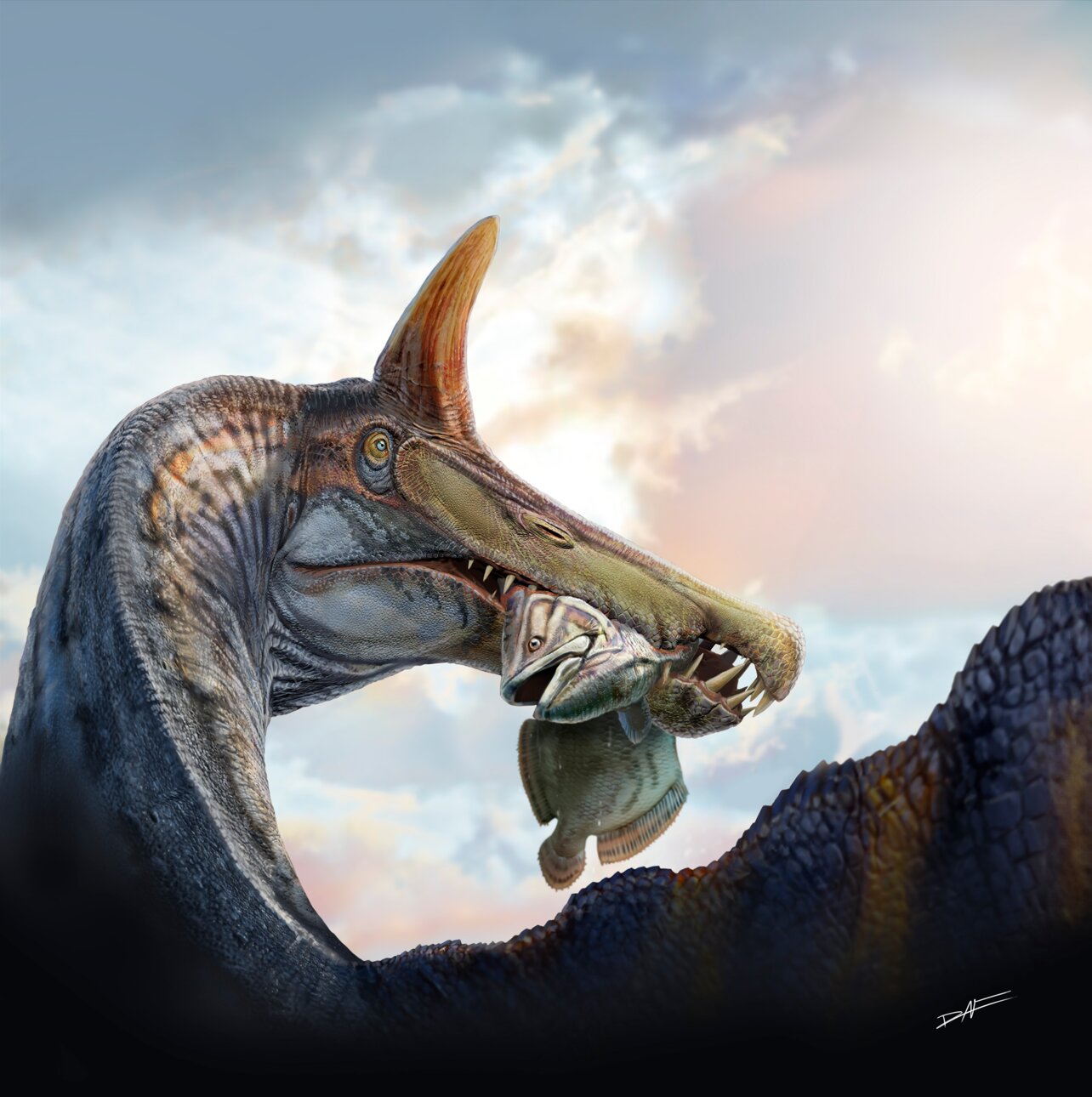
In the vast stillness of the central Sahara, something impossible was waiting just beneath the surface. It did not look like a dinosaur bone at first. When paleontologists lifted it from the desert floor in November 2019, it appeared almost too strange to classify. It curved like a blade, sweeping upward with dramatic elegance. Its shape was so unusual that the researchers hesitated, unsure what they were holding.
Only later would they understand they had found the towering crest of a creature never seen before — a new species named Spinosaurus mirabilis.
The discovery, published in the journal Science, was led by Paul Sereno, Ph.D., Professor of Organismal Biology and Anatomy at the University of Chicago. Alongside a 20-member research team, Sereno had traveled deep into Niger, searching for traces of ancient predators that once dominated Africa’s prehistoric waterways.
What they found instead would reshape the closing chapter of spinosaurid evolution.
The Crest That Reached for the Sky
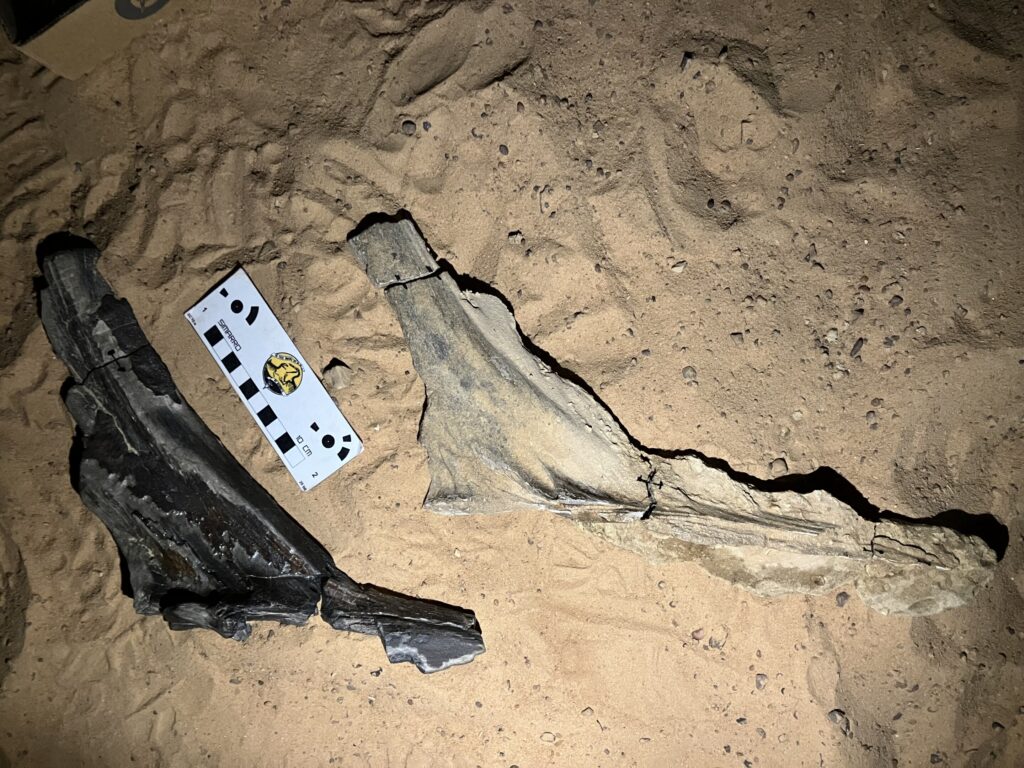
At first, the discovery came in fragments. A piece of crest here. A section of jaw there. Wind-worn bones scattered across an unforgiving desert surface. But even these fragments hinted at something extraordinary.
When the team returned in 2022 with more researchers and equipment, they uncovered two additional crests. That was the moment realization struck. This was not simply a variation of a known dinosaur. It was something entirely new.
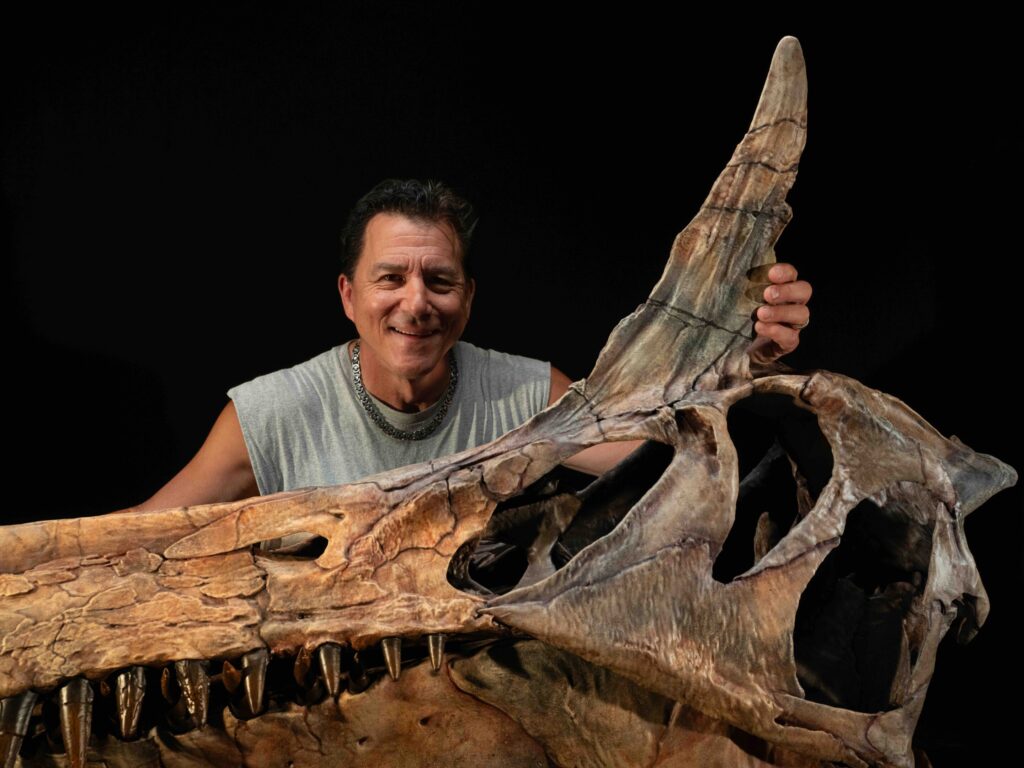
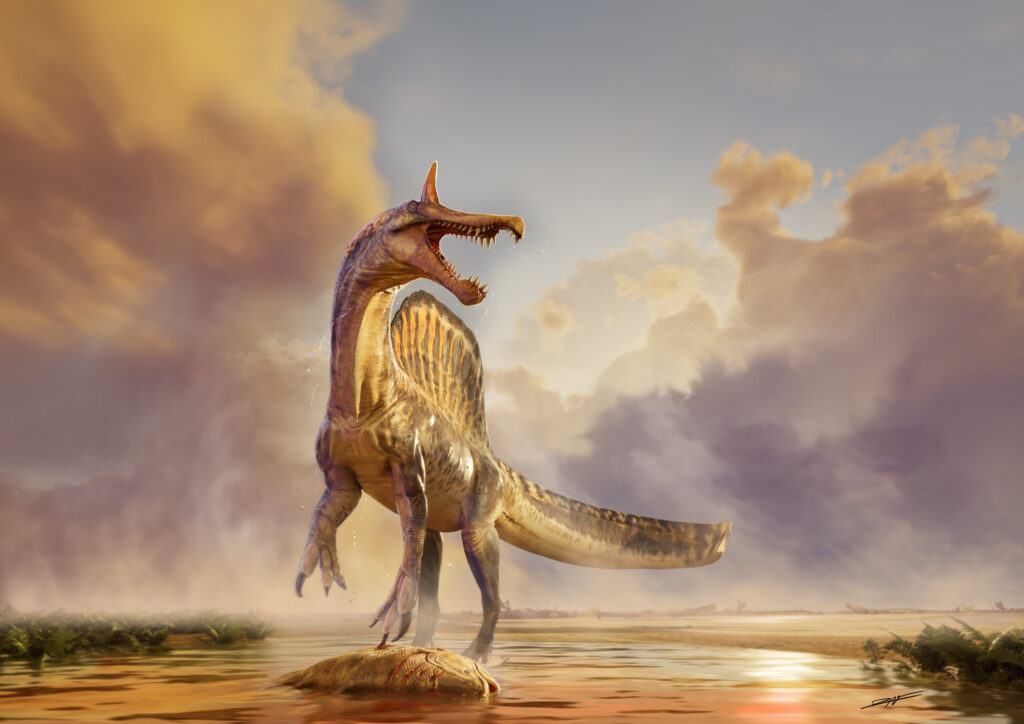
The crest itself was unlike anything previously documented. It curved upward like a scimitar blade, its sweeping form rising dramatically from the skull. Detailed study of its surface texture and internal vascular canals revealed that it had likely been covered in keratin, the same tough biological material that forms horns, claws, and beaks. In life, the researchers believe, this crest may have been brightly colored — a towering visual signal arcing toward the sky like a living banner.
It was not merely decorative. It was presence. It was display. It was a structure built to be seen.
Yet the crest was only one piece of the mystery.
Teeth Built for the Slipperiest Prey
When paleontologists reconstructed the skull, another striking feature emerged. The upper and lower teeth of Spinosaurus mirabilis did not meet in a simple bite. Instead, they interdigitated — the lower teeth protruding outward and sliding precisely between the upper ones.
This arrangement formed a living trap.
For animals that hunt slippery fish, such an adaptation is brutally effective. Once prey is caught, escape becomes nearly impossible. Interlocking teeth hold fast even against struggling, twisting movement.
This tooth structure has appeared across the fossil record among dedicated fish hunters — from aquatic reptiles to airborne predators. But among dinosaurs, it is rare. It marks the spinosaur lineage as uniquely specialized, built for a lifestyle centered around water and aquatic prey.
For Sereno and his team, seeing these features come together was an emotional turning point. In their remote desert camp, powered only by solar energy, one researcher assembled 3D digital models of the bones. The team gathered around a laptop, watching the skull take shape piece by piece.
That was when the discovery became real.
A Predator Far From the Sea
For years, scientists had found spinosaur bones mainly in coastal deposits. Because of this pattern, some researchers proposed that these fish-eating theropods might have been fully aquatic, pursuing prey underwater like modern marine hunters.
But the fossils of Spinosaurus mirabilis told a different story.
The new fossil site lay far inland — roughly 500 to 1,000 kilometers from the nearest marine shoreline. These animals were not living beside an ocean. They were thriving deep within continental landscapes.
The surrounding evidence painted a vivid ecological scene. Nearby were intact partial skeletons of long-necked dinosaurs, all buried in river sediments. This indicated a forested inland habitat, crossed by rivers rich with large fish.
Sereno imagined the creature not as a marine swimmer but as something more grounded — a towering predator wading confidently through water, perhaps two meters deep, yet spending much of its time stalking shallower river channels where prey gathered.
He described it vividly as a kind of “hell heron.”
A predator patient enough to wait. Powerful enough to strike. Built for rivers, not oceans.
A Journey That Began With a Single Sentence
The path to this discovery began decades earlier — not in the desert, but in a forgotten scientific monograph from the 1950s.
In that text, a French geologist had mentioned finding a single saber-shaped fossilized tooth. The description resembled those of a giant predator discovered long ago in Egypt’s Western Desert. The brief reference lingered in the literature, unexplored for more than seventy years.
No one had returned to that site.
Until Sereno decided to search for it.
The expedition became an odyssey through vast sand seas. The team wandered across remote terrain, guided by fragments of historical record and instinct. Eventually, they encountered a local Tuareg man who offered to help. He led them by motorbike deep into the heart of the desert, toward a place where he had seen enormous fossil bones.
After nearly a full day of travel, doubt began to grow. The desert stretched endlessly. But at last, they arrived at a fossil field.
With little time before needing to return to camp, the researchers began searching. And there, scattered across the ground, they found teeth and jaw fragments — unmistakable signs of a new species of Spinosaurus.
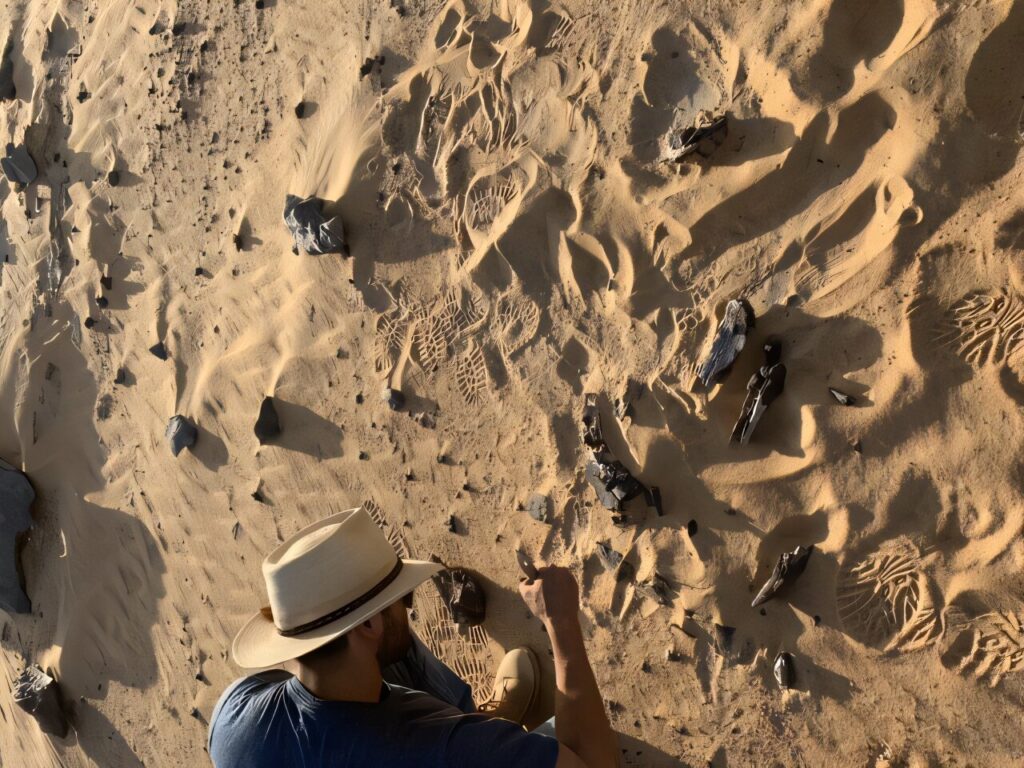
The desert had kept its secret for millions of years.
The Sahara’s Magnetic Pull
For Sereno, the Sahara holds a powerful allure. He first set foot there decades ago and describes its beauty and danger in equal measure.
The environment is harsh, unpredictable, and immense. Yet beneath its surface lies an archive of vanished worlds.
Over years of work, his team has excavated more than 100 tons of fossil finds. Each discovery adds to the deep prehistoric legacy of Niger — a country rich in both paleontology and archaeology.
This legacy is now being preserved in a remarkable cultural project. Sereno helped lead an international effort to build the world’s first zero-energy museum, the Museum of the River, located on an island in the center of Niamey. The museum will showcase fossils from Africa’s lost dinosaur ecosystems, alongside evidence of ancient human cultures that once lived in a greener Sahara.
The discoveries belong not only to science, but to the people of the region who helped uncover them.
Rebuilding a Lost Predator
Back in Chicago, the research moved from desert fieldwork to laboratory precision. At Sereno’s fossil lab, scientists cleaned the bones and conducted detailed CT scans, allowing them to peer inside the structures without damaging them.
From these scans, they built a digital reconstruction of the skull.
That digital model became the foundation for something even more vivid. Working with paleoartist Dani Navarro in Madrid, Sereno helped create a dynamic scene showing the animal with flesh restored, locked in a struggle over prey. Navarro later transformed the digital work into a detailed physical model, carefully layering muscle and skin over the skeletal framework.
Additional artists in Chicago and Italy animated the model, bringing motion and realism to the reconstruction. Advanced imaging, drones, and digital rendering tools have transformed paleontology into a multimedia science, capable of reviving creatures that vanished millions of years ago.
For the first time, Spinosaurus mirabilis could be seen not just as bones, but as a living presence.
The Moment Children Can Touch the Past
The story does not end in laboratories or scientific journals. Replicas of the reconstructed skull and a colorful, touchable version of the towering crest have been prepared for public display.
Beginning March 1, these models will join the Dinosaur Expedition exhibit at the Chicago Children’s Museum, where young visitors will encounter this new species face to face — or at least crest to eye level.
For Sereno, this is essential. The excitement of discovery must be shared. Curiosity must be passed forward.
He believes the next generation of scientists will emerge from moments like these — moments when children realize the Earth still holds secrets waiting to be uncovered.
Why This Discovery Matters
The discovery of Spinosaurus mirabilis changes how scientists understand the final chapters of spinosaur evolution. Its unusual anatomy reveals how specialized these predators became, refining adaptations for catching aquatic prey with remarkable efficiency. Its towering keratin-covered crest suggests powerful visual signaling, hinting at complex behavior or communication.
Perhaps most importantly, its inland habitat reshapes assumptions about how spinosaurids lived. Instead of being confined to coastal environments or fully aquatic lifestyles, this species thrived far from the sea, in river-crossed forests deep within continental landscapes. That single insight transforms scientific interpretations of their ecological roles.
The find also demonstrates how much of Earth’s prehistoric record remains hidden in remote places, waiting for persistence, collaboration, and curiosity to bring it to light. From a single sentence in an old monograph to a dramatic reconstruction of a living predator, the journey of discovery shows how science moves forward — step by step, fragment by fragment.
And beneath the shifting sands of the Sahara, more chapters of life’s ancient story may still be waiting to rise into the light.
Study Details
Paul C. Sereno et al, New scimitar-crested Spinosaurus species from the Sahara caps stepwise spinosaurid radiation, Science (2026). DOI: 10.1126/science.adx5486. www.science.org/doi/10.1126/science.adx5486