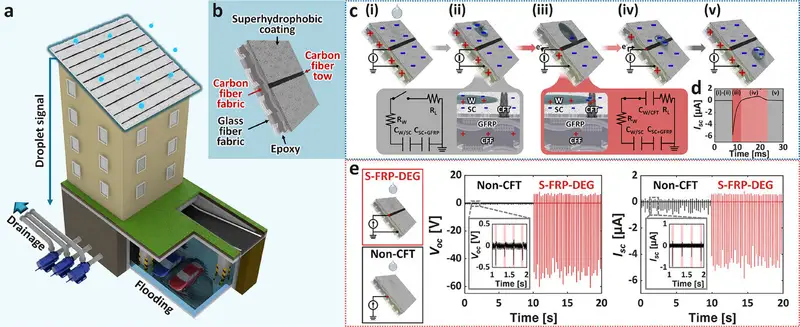
The sound of rain hitting a rooftop is usually just background noise, a rhythmic patter that signals a change in the weather. For most of us, these droplets are simply water to be channeled away through gutters and pipes. However, a team of researchers at UNIST has reimagined the very nature of a rainstorm. Led by Professor Young-Bin Park, the team has found a way to turn the kinetic energy of a falling raindrop into a functional power source, transforming rooftops into active, self-powered guardians against the dangers of urban flooding.
A Material Born for the Storm
To capture energy from the sky, the researchers needed a material that was both tough enough to withstand the elements and conductive enough to move electricity. They turned to carbon fiber-reinforced polymer, commonly known as CFRP. This composite is already a favorite in the aerospace and construction industries because it is incredibly lightweight, yet stronger than many metals. Unlike traditional metal components that quickly succumb to rust and corrosion when exposed to moisture and city pollutants, CFRP is naturally resilient.
By using this material as the foundation for their droplet-based electricity generator, or DEG, the team created a device they call the S-FRP-DEG. It is designed to live outdoors, sitting on the tops of buildings and along drainage systems, ready to greet the first drop of a storm. Because carbon fiber is resistant to the corrosive nature of urban environments, it ensures that the generator can function for years without degrading, even when constantly battered by heavy downpours and environmental soot.
Capturing the Spark of a Droplet
The magic of this technology happens at the moment of impact. The process is remarkably similar to how static electricity builds up on a dry day. Each raindrop typically carries a positive charge as it falls through the atmosphere. The surface of the S-FRP-DEG, however, is engineered to be negatively charged. When the water hits the surface, a transfer of charge occurs.
To make this process as efficient as possible, the researchers looked to nature for inspiration. They applied a lotus-leaf-inspired coating to the device, creating a superhydrophobic surface. This means the water doesn’t just sit there; it is violently repelled. As a droplet strikes the textured surface, it spreads out and then rapidly detaches, rolling away almost instantly. This quick motion of the water across the surface is what drives an electric current through the embedded carbon fibers. In an instant, the mechanical energy of the falling rain is translated into a sharp pulse of electricity.
From Single Drops to Glowing Lights
To understand the potential of this “rain power,” the team conducted rigorous laboratory tests. They found that a single, tiny raindrop—measuring roughly 92 microliters in volume—was capable of generating a surprising 60 volts of electricity. While the current produced by one drop is small, measured in microamps, the potential for scaling the technology is significant.
The researchers proved this scalability by connecting four of these generator units in series. When simulated rain hit the array, the combined power was enough to briefly illuminate 144 LED lights. This demonstration showed that the technology isn’t just a laboratory curiosity; it is a viable method for generating meaningful amounts of power from a natural resource that is often seen as a nuisance. The more it rains, the more energy is harvested, creating a system that thrives during the very conditions that usually cause the most trouble for urban infrastructure.
A Sentient Drainage System
The true test of the S-FRP-DEG came when the team moved their work out of the lab and onto real-world building rooftops and drainage pipes. They discovered that the device could act as a sophisticated sensor. Because the electrical signals become stronger and more frequent as rainfall intensity increases, the system can “feel” the severity of a storm.
This allows for a level of automation never seen before in city planning. The technology can autonomously distinguish between a light drizzle, a moderate shower, and a dangerous heavy rain event. In a practical application, these signals can be used to automatically activate drainage pumps without needing any external electricity or batteries. During a flash flood, where traditional power grids might fail, this self-powered system would continue to monitor the water and move it away from vulnerable structures, using the energy of the rain itself to fight the flood.
Why This Rainfall Revolution Matters
This research represents a fundamental shift in how we think about urban resilience and renewable energy. By integrating electricity-generating capabilities directly into the carbon fiber structures of our cities, we move closer to a world of truly “smart” infrastructure. This technology allows for a self-powered approach to disaster prevention, ensuring that flood warnings and automated drainage control systems are always ready to trigger, regardless of whether the power grid is functioning.
Beyond buildings, the implications are vast. Because carbon fiber composites are already integral to the manufacturing of vehicles and aircraft, Professor Park suggests that this technology could one day be integrated into mobility systems. Imagine a car or a plane that harvests energy from the rain it passes through, powering its own sensors or auxiliary systems. By turning a rainy day into a source of power, this research provides a sustainable, corrosion-resistant, and autonomous way to protect our cities and keep our technology running, even in the middle of a storm.
Study Details
Seonghwan Lee et al, Structural Droplet‐Based Electricity Generator Using Superhydrophobic Fiber‐Reinforced Polymer for Smart Stormwater Management, Advanced Functional Materials (2025). DOI: 10.1002/adfm.202522178