Changing the nitrogen substituent on a light-sensitive molecule can redirect a reaction that normally favors one ring-closing route, allowing closely related starting materials to produce either a bridged bicyclo[2.1.1] framework or the much harder-to-access fused bicyclo[2.2.0] structure.
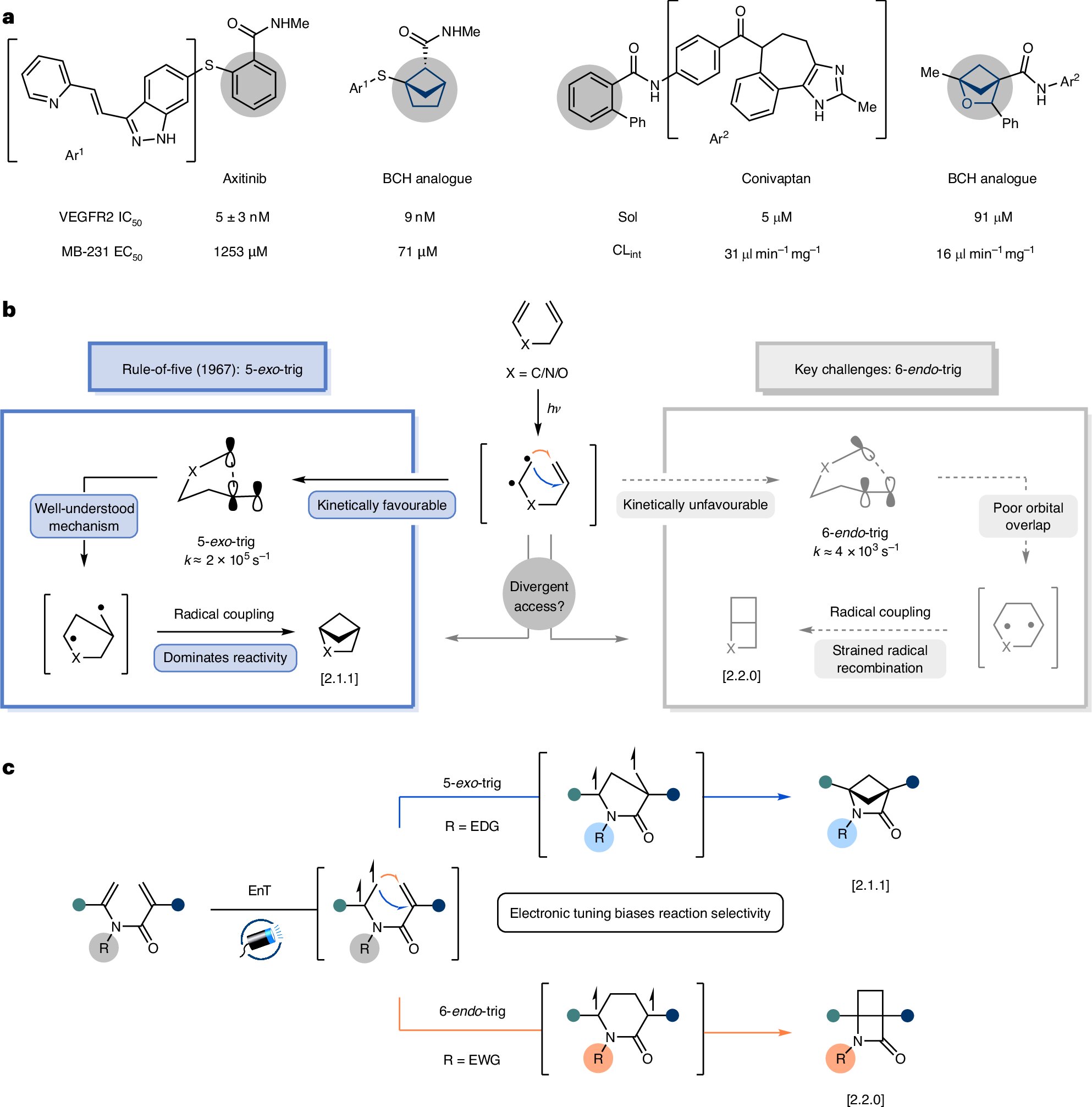
The reaction starts with an acyclic molecule containing two carbon-carbon double bonds arranged as a 1,5-diene. When such systems undergo radical cyclization, the conventional preference is for a 5-exo-trig closure. The competing 6-endo-trig route has unfavorable orbital alignment and has been described as more than 50 times slower than the 5-exo pathway. Even if that less-favored route occurs, forming the second bond needed for the compact [2.2.0] framework presents additional strain and bridgehead-compression problems.
That preference has made the chemistry difficult to control when the desired product requires the 6-endo pathway. The authors were particularly interested in the possibility of making either of two different rigid bicyclic structures from closely related acyclic precursors. One is the bridged [2.1.1] framework produced by the conventional 5-exo route. The other is the fused [2.2.0] framework produced through the normally disfavored 6-endo route.
The design centered on an amide attached to the diene. The researchers hypothesized that the amide could influence the polarity of the initial radical addition and make attack at the β-position of the α,β-unsaturated amide more favorable, potentially opening the 6-endo pathway.
Their first experiments did not immediately overturn the usual rule. With an N-alkylated substrate carrying a p-methoxybenzyl group, irradiation with 427-nanometer light in the presence of an iridium photocatalyst produced predominantly the [2.1.1] product from the 5-exo-trig pathway. But the reaction also produced an unstable 3,4-dihydro-2-pyridone, which the researchers interpreted as evidence that some molecules had initially followed the 6-endo route. The problem was that this intermediate did not proceed efficiently to the desired [2.2.0] product.
Then the nitrogen substituent was changed.
The nitrogen group becomes the control switch
The researchers prepared related 1,5-dienes carrying nitrogen substituents with progressively stronger electron-withdrawing properties. Moving through groups including p-methoxybenzyl, benzyl, Boc, Cbz, phenoxycarbonyl, acetyl and Troc changed the reaction from favoring 5-exo-trig cyclization to favoring 6-endo-trig cyclization. With acylated nitrogen substituents, the subsequent radical recombination became feasible and the unusual [2.2.0] framework could be obtained as the major product.
This was the central experimental result: the reaction pathway could be programmed by changing the electronics of a substituent attached to nitrogen, rather than by replacing the entire molecular framework.
The photochemical conditions were also investigated. Different photocatalysts produced yields that tracked their triplet energies rather than their redox potentials. The results therefore supported an energy-transfer mechanism rather than a photoredox mechanism. The authors also found little dependence on solvent polarity for both the N-benzyl and N-acetyl systems, consistent with a neutral energy-transfer process rather than one involving charge separation. Ultraviolet-visible absorption, cyclic voltammetry and triplet-quenching experiments provided additional evidence against direct substrate excitation and the relevant redox pathways.
Without both the photocatalyst and light, the reaction did not proceed. Under the researchers’ optimized conditions, the transformation reached completion within 15 to 30 minutes, and the yield was largely independent of concentration. For consistency across substrates with different solubilities, later experiments used a 0.1 M concentration and 1.5 hours of irradiation.
The standard procedure used 1 mol% of the iridium photocatalyst, anhydrous acetonitrile or, for selected substrates, hexafluoroisopropanol, and a 40-W 427-nanometer Kessil light source at ambient temperature under nitrogen.
The two pathways respond differently to electronic changes
Once the reaction could be directed toward either framework, the researchers tested how broadly the approach worked.
For the [2.1.1] products, they used N-benzyl 1,5-dienes. A range of aryl groups at the C-2 position, including electron-rich, electron-neutral and electron-deficient substituents, underwent the reaction. The conjugated system at this position was necessary because it provides the chromophore needed for energy transfer to the substrate.
Electron-deficient aryl groups generally gave higher yields of the [2.1.1] products than electron-rich groups. The researchers hypothesized that this reflected a change in pathway selectivity, with electron-rich aryl groups promoting the competing 6-endo route.
The scope extended to different substitution patterns. Products bearing CF₃ groups at C-5 could be made in yields comparable to their methyl counterparts, while both unsubstituted and phenyl-substituted versions were also obtained. Moving the amide tether to create 4-aza-1,5-dienes gave the corresponding [2.1.1] structures in good-to-excellent yields, with no evidence of 6-endo cyclization in those cases. The authors attributed that behavior, as a hypothesis, to a polarity mismatch in the alternative radical addition.
The researchers could also selectively remove parts of the products. Mild debenzylation gave an N-H derivative, while related amide cleavage reactions allowed further manipulation of the bicyclic structures.
The [2.2.0] series showed the opposite electronic preference. Electron-rich aryl groups strongly promoted the 6-endo pathway, producing the fused framework with high selectivity. Electron-deficient aryl groups reduced that preference.
For some of those less-selective substrates, switching the solvent from acetonitrile to hexafluoroisopropanol increased the ratio of 6-endo to 5-exo products. The researchers proposed that hydrogen bonding in the solvent partially polarizes the enone and makes the 6-endo radical addition more polarity-matched.
Heteroaryl groups followed the same general trend and gave [2.2.0] products in good-to-excellent yields. But the electronic control was not absolute. When the C-2 substituent was changed to an ester, for example, the strongly electron-withdrawing group switched the outcome completely toward the [2.1.1] scaffold.
More than the nitrogen group can change the outcome
The researchers also varied the electron-withdrawing group attached to nitrogen. In general, stronger electron-withdrawing substituents increasingly favored formation of the [2.2.0] scaffold.
There were notable exceptions that revealed how sensitive the reaction is to molecular structure. A sterically hindered pivaloyl group produced an unexpected six-membered-ring product in high yield. The authors proposed that the orientation of the pivaloyl carbonyl could favor intramolecular acyl transfer from the intermediate generated after 6-endo cyclization.
An enantiomerically enriched carbonyl substituent produced two separable diastereomeric [2.2.0] products. Each was obtained as a separate isomer after flash chromatography.
The carbon framework itself was also tolerant of substantial variation. A methyl group at C-5 was not required for the reaction. Removing it lowered selectivity in some cases, which the authors attributed, again as a proposed explanation, to reduced steric hindrance around the transition state for the 5-exo pathway. Larger alkyl groups at C-5 were tolerated and gave high selectivity, while an aryl group reduced selectivity because both alkene groups could be photoexcited.
Substitution at C-1 was possible as well, producing some products as single diastereomers. Increasing steric hindrance at that position reduced selectivity in comparison with the unsubstituted compound, while a methyl-substituted example reversed the preference, which the authors attributed to steric congestion interfering with the radical attack required for the 6-endo route.
The method was also applied to make a [2.2.0] analogue of the δ-lactam-containing compound HT-0712.
Several reactions were performed on useful scales. For selected examples, the [2.2.0] products were obtained with high selectivity, including a gram-scale reaction using only 0.5 mol% photocatalyst. The reported product ratios were determined by quantitative proton NMR spectroscopy of crude reaction mixtures.
The calculations explain why the switch works
The experimental pattern prompted a computational investigation of the mechanism and the origin of the regioselectivity.
Density functional theory calculations were performed using a specified combination of functionals, basis sets and a solvation model for acetonitrile. For a model substrate, the calculated dynamically vertically accessible triplet energy was 60.8 kcal mol⁻¹, while the adiabatic triplet energy was 50.9 kcal mol⁻¹. The calculated triplet-state spin density was localized on the styrene portion of the molecule, identifying it as the primary chromophore and agreeing with the experimental triplet-quenching evidence.
From the excited triplet state, calculations identified two competing cyclization routes, 6-endo-trig and 5-exo-trig. Both were calculated to be strongly exergonic, but the 6-endo route had a calculated activation advantage of 0.7 kcal mol⁻¹ for the model system. Experimentally, that system showed a 10:1 product distribution corresponding to a 1.4 kcal mol⁻¹ difference in activation free energies. Across a series of 1,5-diene substrates, calculated selectivity differences correlated strongly with the experimental results, with R² = 0.93. The agreement held for substrates differing at nitrogen and at the C-2, C-5 and C-6 positions.
The calculations also changed the picture of how the unusual [2.2.0] product forms.
Rather than directly creating the [2.2.0] ring through simple radical recombination, the calculated 6-endo pathway proceeds through intersystem crossing to a zwitterionic intermediate. That intermediate was calculated to favor a closed-shell form over its corresponding open-shell form. It can then form the [2.2.0] product through a 4π Staudinger-like electrocyclization.
The transition state for that electrocyclization was nevertheless calculated to have diradicaloid character. The researchers attributed this to the geometry required for closure. A conrotatory pathway that might otherwise be expected from the Woodward-Hoffmann rules would produce a trans-fused [2.2.0] system, so the reaction instead proceeds through a disrotatory closure.
This also helps explain why the analogous N-alkyl substrates fail to reach the desired [2.2.0] structure. The calculations indicate that their zwitterionic intermediate is relatively more stable, increasing the barrier for the subsequent 4π electrocyclization. That makes competing reactions, including a hydrogen-shift pathway, more favorable and leads instead to the observed 3,4-dihydro-2-pyridone byproduct.
The competing 5-exo route follows a different calculated sequence. It produces a triplet intermediate that undergoes intersystem crossing to an open-shell diradical, followed by rapid recombination to give the [2.1.1] product. The calculated barrier for that recombination step was only 0.8 kcal mol⁻¹.
Why benzyl and acetyl groups push the reaction in opposite directions
The calculations provided a more detailed explanation for the striking effect of the nitrogen substituent.
Using an N-benzyl system as a reference, the corresponding N-acetyl substrate had a 6-endo-trig activation barrier 1.7 kcal mol⁻¹ lower. The researchers attributed this difference to several factors. The N-acetyl system is more electron-deficient and therefore a better acceptor for the initial radical addition. Its transition state is also more planar, with a reported dihedral angle of 28.1°, compared with 67.3° for the N-benzyl system. That greater planarity allows stronger conjugation between the developing α-carbonyl radical and the carbonyl π bond.
For the 5-exo pathway, the situation was reversed. The N-benzyl system had a 1.7 kcal mol⁻¹ advantage relative to the N-acetyl system. The calculations indicated that the benzylic radical formed during this pathway benefits from greater planarity and greater availability of the nitrogen lone pair. The researchers interpreted this as increased captodative stabilization of the radical and the corresponding transition state.
That effect also provided an explanation for the strong dependence on the electronics of the styrene portion of the molecule. Analysis of the reaction coordinate showed that the nitrogen remained deconjugated from the benzylic radical during the 6-endo pathway. Computational Hammett analysis indicated that electron-withdrawing substituents lowered the barrier for the 5-exo pathway, with a strong correlation to Hammett σ⁺ values, while the 6-endo transition state was affected much less.
The result is a reaction in which the two competing pathways respond differently to electronic changes. Changing the substrate can therefore alter which transition state is easier to reach, rather than merely changing the yield of a single predetermined product.
Turning the compact products into other structures
The resulting [2.2.0] compounds were not treated as endpoints. The researchers demonstrated several ways to modify them.
For example, treating one [2.2.0] product with sodium methoxide selectively cleaved its N-acetyl bond, giving a secondary amide in 64% yield. That intermediate was then converted into urea, thiourea, sulfonamide, N-alkylated and N-arylated derivatives.
A related N-Boc [2.2.0] compound underwent selective cleavage of the internal amide bond under basic conditions, producing a β-amino acid derivative. Oxidation of its aryl ring with ruthenium trichloride then gave the corresponding carboxylic acid in excellent yield. Further reactions converted that acid into amide, O-methylhydroxamic acid and N-hydroxyphthalimide derivatives.
The structures of selected products were also established by X-ray crystallography. Crystallographic data were deposited for compounds 3d, 5p, 6p and 8a under CCDC deposition numbers 2520219, 2520220, 2520221 and 2520222, respectively.
Taken together, the experiments and calculations establish a light-driven reaction in which electronic changes to an amide-tethered 1,5-diene can redirect the initial cyclization and determine whether the molecule proceeds toward a bridged [2.1.1] or fused [2.2.0] bicyclic framework. The computational results connect that selectivity to differences in the electronic and geometric stabilization of the competing transition states and intermediates.
The study was published in Nature Chemistry.