New 3D reconstructions of two unusually well-preserved Neanderthal pelvises suggest that the evolutionary tradeoff behind the human birth canal was not primarily between giving birth to large-brained babies and walking efficiently on two legs. Instead, the evidence points to a different constraint: accommodating childbirth while maintaining pelvic floor stability.
Two Neanderthal pelvises provide new evidence
For decades, the shape of the human pelvis has often been explained through the “obstetrical dilemma.” The idea is that evolution had to balance the need for a sufficiently large birth canal with the demands of efficient bipedal locomotion.
Neanderthals provide an important test of that idea because they shared several characteristics with modern humans, including large bodies, large brains, and the challenges associated with giving birth to large-brained babies. At the same time, their pelvises retained features that differ clearly from those of modern humans.
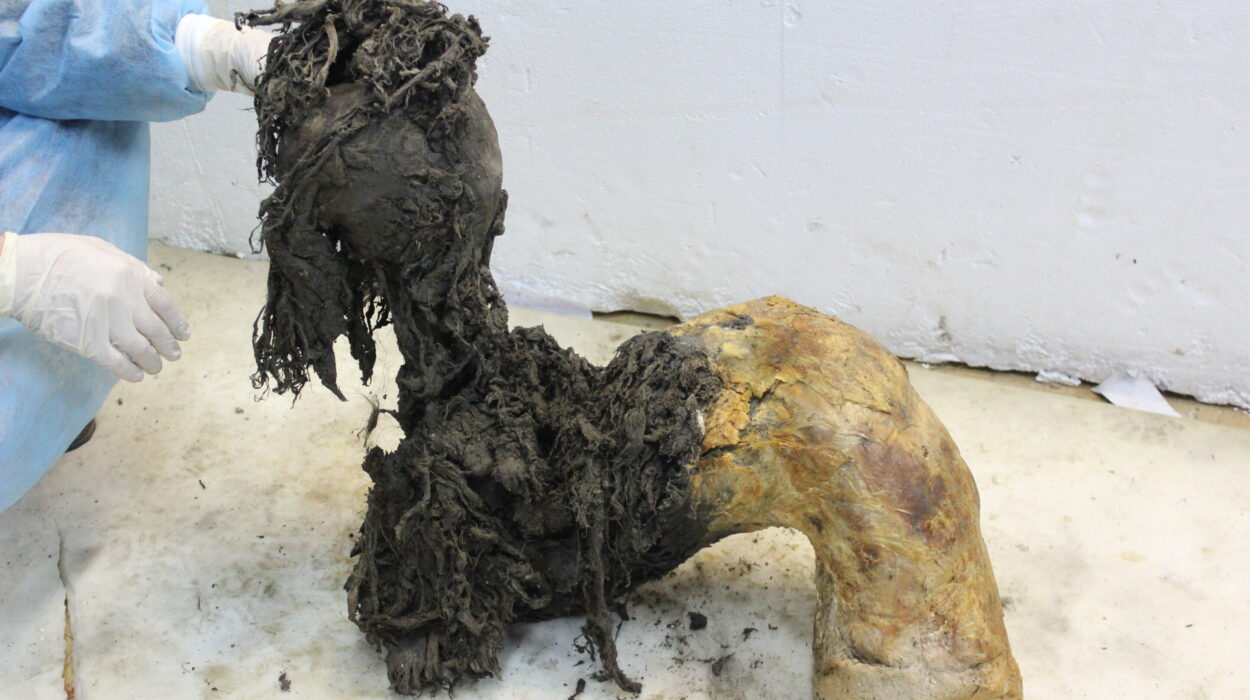
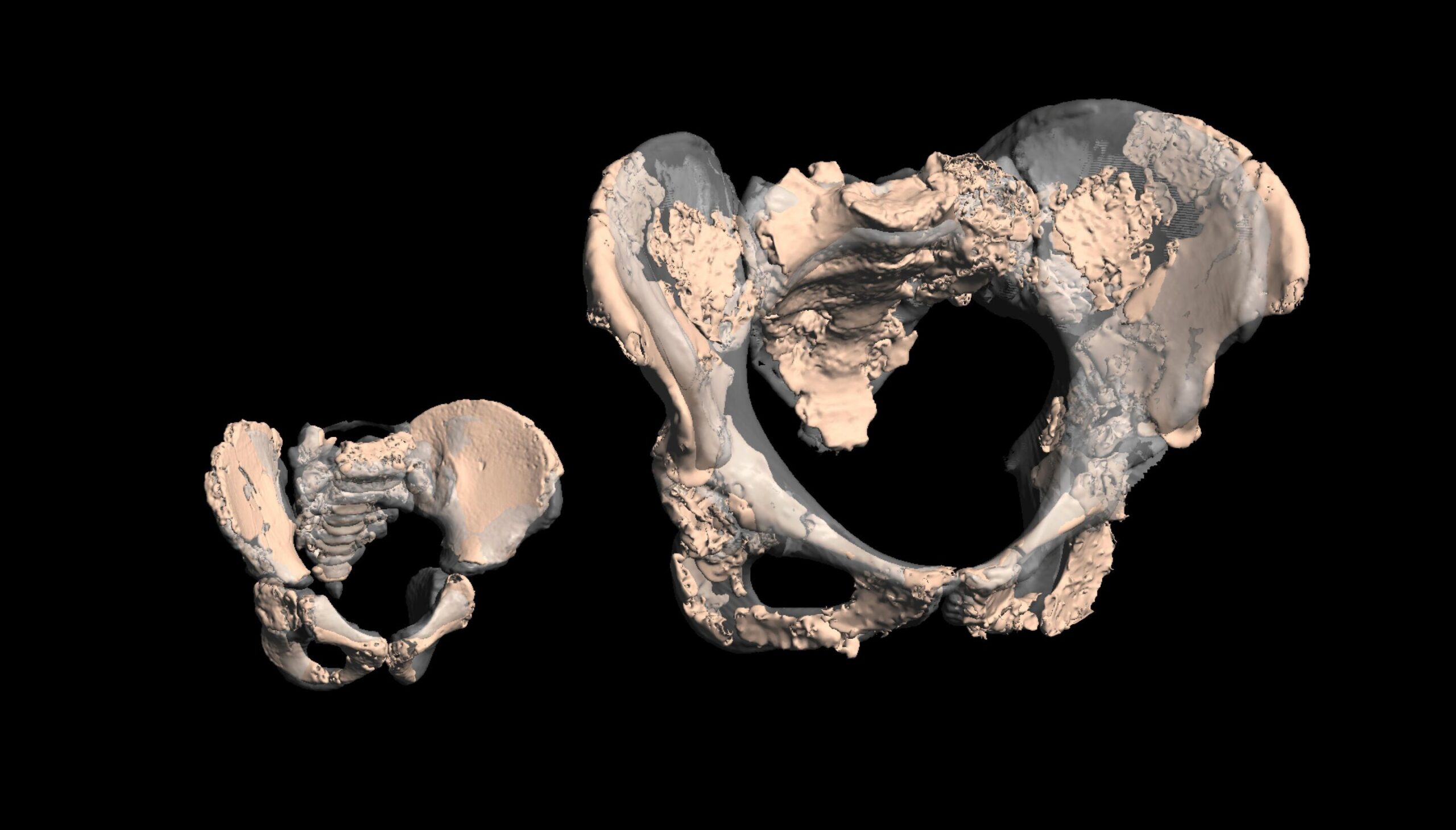
The new analysis focuses on two nearly complete Neanderthal pelvises. One belonged to a 1.5-year-old infant from Dederiyeh Cave in Syria. The other belonged to a young adult female from Sima de las Palomas del Cabezo Gordo in Spain.
The researchers reconstructed both fossils virtually and compared them with other Neanderthal pelvises and modern human samples. The adult comparison included the Tabun female and Kebara male Neanderthals, while the modern human adult sample included 112 individuals, 56 females and 56 males. The infant comparison included 34 modern human individuals between 1 month and 8.4 years of age.
The reconstructions allowed the researchers to examine pelvic shape in three dimensions rather than relying only on isolated fossil measurements.
Neanderthal pelvic differences appeared early
The Dederiyeh infant already had several characteristic Neanderthal pelvic features at about 1.5 years of age.
Its pelvis was relatively short from front to back and wide from side to side. It also had flaring iliac blades, a more posterior position of the anterior iliac crest, and a less inclined sacrum. These features distinguished the infant from the modern human infants in the comparison.
The finding indicates that important differences between Neanderthal and modern human pelvic architecture were established early in development rather than appearing only during adulthood.
The researchers interpret this pattern as consistent with differences in developmental growth between the two species. They describe the pelvis as highly modular, meaning that different regions can develop and evolve relatively independently. The results therefore support the possibility that species-specific differences arose through changes in local growth rates and developmental timing.
Adult Neanderthals also had a distinctive pelvic shape. Their pelvises were relatively wide across and comparatively short from front to back and from top to bottom. The iliac blades flared outward, while the acetabulum, the socket of the hip joint, was positioned and oriented farther toward the rear. Neanderthals also had relatively long pubic rami, a wider subpubic region, a more constricted iliac notch, and a less inclined sacrum.
Despite these differences between the species, the pattern of male-female pelvic differences was broadly similar in Neanderthals and modern humans.
Female Neanderthals had larger birth-canal dimensions
The researchers examined three regions of the adult birth canal: the inlet, midplane, and outlet.
In both Neanderthals and modern humans, females had larger dimensions in these three regions than males. That shared pattern is consistent with a common constraint associated with carrying and giving birth to large-bodied, large-brained babies.
But the shape of those regions tells a different story.
In modern humans, the shape of the pelvic inlet varies substantially among individuals and does not show sexual dimorphism. The study also found no statistically robust relationship between pelvic shape and birth complications when earlier data were reanalyzed.
That matters because pelvic shape has sometimes been used to classify different birth mechanisms. The researchers caution that skeletal shape alone can provide an incomplete picture of childbirth because actual birth involves natural variation in fetal orientation as well as soft tissues and other factors.
The Neanderthal birth canal was wide from side to side and relatively short from front to back. Yet its sex-specific size differences resembled those seen in modern humans.
This combination is central to the study’s interpretation. The Neanderthal pelvis did not need to resemble the modern human pelvis in overall shape to show a similar relationship between female pelvic size and the demands of childbirth.
The evidence points to pelvic floor stability
The lower birth canal has been proposed to reflect adaptations associated with pelvic floor stability during bipedal movement.
Biomechanical models indicate that, when canal area is held constant, a more elongated front-to-back shape can resist pelvic floor deformation better than a rounder shape. But the researchers point to several observations that complicate this explanation.
Human female midplane and outlet shapes vary widely. Females also tend to have rounder canal shapes than males, and female canal shape does not correlate with canal size. These patterns suggest that size may be more important than shape for maintaining pelvic floor stability.
Against that background, the Neanderthal pelvis provides a useful comparison. Its birth canal had a wide transverse dimension and a short front-to-back dimension, yet it showed the same basic female-male size difference seen in modern humans.
The researchers therefore conclude that the evolutionary tradeoff traditionally described as an obstetrical dilemma is more likely to have involved childbirth and pelvic floor stability rather than childbirth and bipedal efficiency. They also conclude that birth-canal size, rather than its shape, was more likely to have been the major evolutionary target.
Wider female pelvises did not mean wider hip joints
The locomotion data provide another important test of the traditional explanation.
If a wider birth canal required the hip joints to be positioned farther apart, females with wider birth canals might also be expected to have a wider distance between the centers of their femoral heads. That wider distance would increase the body’s weight moment arm and potentially affect the mechanics of walking.
The researchers did not find that pattern.
Instead, female pelvic architecture achieved wider transverse obstetrical dimensions through internal changes rather than simply moving the hip joints farther apart. These changes included smaller femoral heads and a more slender region of the pelvis. The female-male difference in abductor mechanical advantage was primarily associated with the reduced lateral distance of the greater trochanter rather than with a longer body-weight lever arm.
The study also notes that previous experimental and modeling work indicates variation in abductor mechanical advantage has little effect on total locomotor cost.
This evidence weakens the idea that a wider female birth canal necessarily imposed a substantial locomotor penalty by forcing the hip joints farther apart.
Neanderthals had different hip mechanics
The Neanderthals themselves showed clear differences from modern humans in several features related to stance and locomotion.
Their acetabular orientation was at the posterior end of the modern human range. They also had wider mediolateral dimensions and longer moment arms for the hip abductors and body weight.
At the same time, their body-weight moment arm was balanced by a correspondingly longer abductor moment arm. This produced an effective mechanical advantage for the hip abductors comparable to that of modern humans.
Other differences were more pronounced. Neanderthals had shorter moment arms for both hip extensors and flexors. The researchers associate these differences with their short ischium, more anteriorly positioned sacrum, and the relative positions of several pelvic and femoral landmarks.
The authors propose that the combination of these features, along with comparatively reduced pelvic tilt and lumbar lordosis, may have favored trunk stability and power during strides rather than endurance running. They emphasize, however, that this interpretation remains a hypothesis.
The study does not establish that Neanderthal locomotion was metabolically less efficient. The biomechanical models were static, and the researchers note that actual muscle activity can change during movement to optimize locomotor costs. They say that testing the locomotor implications will require dynamic, individualized whole-body simulations that also account for differences in limb length and proportions.
The pelvis does not show a clear cold-climate signal
The study also examined whether the broad Neanderthal pelvis could have been an adaptation for conserving heat in cold environments.
Using a model that accounts separately for the pelvis’s front-to-back and transverse dimensions, the researchers found that the surface-to-volume ratios of the Neanderthal pelvises fell within the range of modern human variation.
The Neanderthals examined in the study lived in temperate paleoclimates, and their pelvic morphology did not show a thermoregulatory signal in this analysis. The researchers note that cold adaptation could still be reflected in other parts of the skeleton.
The shape difference has deeper evolutionary roots
The comparison with earlier hominins adds another piece to the picture.
The researchers conclude that the transverse ellipsoid shape seen in Neanderthal pelvises was likely an ancestral hominin condition that became more pronounced during Neanderthal evolution. The more front-to-back elongated shape of the modern human pelvis represents a derived condition.
Their results also indicate that these different pelvic shapes are not necessarily the result of different obstetrical requirements. The extent to which the species-specific differences reflect adaptations to different forms of locomotion, rather than neutral evolutionary divergence, remains unresolved.
The key evidence comes from the unusual combination of similarities and differences. Neanderthals and modern humans developed clearly different overall pelvic architectures, yet their female-male patterns in birth-canal size were broadly similar. At the same time, the pelvic features associated with hip mechanics differed between the species.
Together, these findings provide a different framework for understanding why the human pelvis has its particular form. The evidence is consistent with childbirth and pelvic floor stability acting as interacting constraints, while locomotor features evolved along a partly independent path.
The study was published in PNAS.