The age of a mother can shape how long her offspring live and how much they reproduce, but those effects do not simply build from one generation to the next. Experiments with two strains of the rotifer Brachionus manjavacas found that maternal-age effects remained largely noncumulative across three generations, while some effects weakened or disappeared and others remained tied to the age of earlier generations. The results also showed that the same maternal-age pattern can move in opposite directions in different strains of the same species.
The experiment followed maternal age across generations
Maternal age effects occur when a mother’s age when she produces offspring influences traits in those offspring. Such effects can be beneficial, harmful, or mixed, depending on the species and the trait being measured.
What happens after the first generation is less clear. An effect caused by an older mother could potentially become stronger when the next generation is also produced by an older mother. It could remain about the same, weaken, disappear, or interact with the ages of mothers in earlier generations.
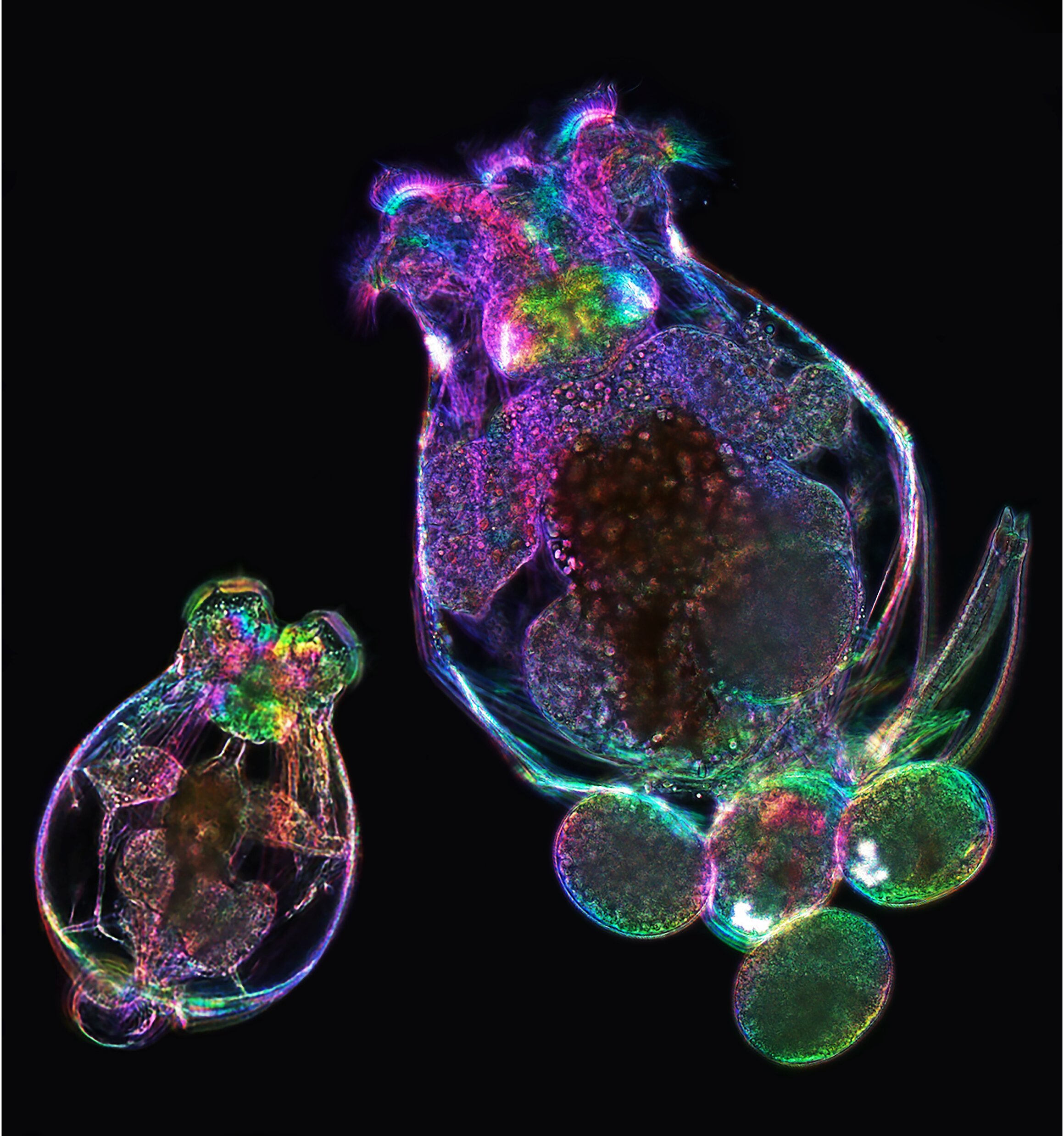
To examine these possibilities, researchers followed two strains of Brachionus manjavacas, a microscopic aquatic rotifer, across four generations, from G0 through G3. The strains were BmanRUS and BmanL5.
The researchers created lineages in which mothers were consistently young or old. Young-mother cohorts were started with 3-day-old mothers. Old-mother cohorts were started when mothers were about 10 or 11 days old, depending on the strain and generation.
The researchers tracked each animal throughout its life. They recorded lifespan and reproduction every day and calculated several measures of reproductive performance, including lifetime reproductive output, maximum daily reproduction, the age at which animals had produced 25% of their lifetime offspring, and the proportion of their lifespan during which they reproduced.
The design also allowed the researchers to ask whether maternal-age effects could be reversed.
In the third generation, they switched maternal ages. Some offspring came from lineages whose earlier mothers had been old but whose immediate mothers were young. Others came from lineages whose earlier mothers had been young but whose immediate mothers were old. This created combinations that separated the effects of maternal age from those of grandmaternal age.
Maternal age effects did not build up over three generations
The clearest result was that maternal-age effects did not accumulate across three generations of constant young or old maternal age in either strain.
That finding was especially clear for lifetime reproductive output, or LRO, which measures the total number of offspring produced during an individual’s life. The effect of maternal age on LRO remained consistent across generations, but its direction depended on the strain.
In BmanRUS, offspring of old mothers produced more offspring over their lifetimes than offspring of young mothers.
In BmanL5, the pattern was reversed. Offspring of young mothers had higher lifetime reproductive output than offspring of old mothers.
These differences persisted across generations without becoming progressively stronger.
The opposite responses were not limited to total reproduction.
For lifespan, offspring of young mothers in BmanL5 lived just over two days longer on average than offspring of old mothers in the first two generations. By the third generation, however, there was no detectable maternal-age effect on lifespan in that strain.
BmanRUS showed the opposite general direction. Offspring of old mothers tended to live longer than offspring of young mothers, although those differences were not statistically significant.
The magnitude of the lifespan effects declined from the first to the third generation in both strains rather than accumulating.
This meant that repeated exposure to the same maternal-age condition did not produce a steadily increasing effect.
Reproduction also depended on the strain
Maximum daily reproduction showed another pattern. In both strains, offspring of old mothers had higher maximum daily reproduction than offspring of young mothers. The difference did not change across generations.
BmanL5 had higher maximum daily reproduction overall than BmanRUS.
The timing of reproduction also differed between the strains.
In BmanL5, offspring of old mothers reached 25% of their lifetime reproductive output earlier than offspring of young mothers. That maternal-age effect remained consistent across generations.
In BmanRUS, maternal age did not significantly affect the age at which animals reached 25% of their lifetime reproductive output.
The proportion of life spent reproducing showed another genotype-specific pattern. In BmanRUS, young-mother offspring were reproductive for a greater proportion of their lifespan in the first two generations, but there was no maternal-age effect in the third generation. In BmanL5, offspring of young mothers remained reproductive for a greater proportion of their lifespan across generations.
The rate at which reproduction declined after its daily maximum also differed between maternal-age groups. In several generations, reproduction declined more steeply in offspring of old mothers, although the difference between maternal-age groups became smaller in the third generation for both strains.
Together, these results showed that maternal age was not producing one simple, universal effect. Different reproductive traits responded differently, and the direction and persistence of those responses depended on genotype.
Switching maternal age changed some effects within one generation
The third-generation switch experiments provided another important result.
In BmanL5, the negative effect of advanced maternal age on lifetime reproductive output was fully reversible within one generation. When maternal age was switched, the resulting reproductive output no longer reflected the original maternal-age condition in the same way. The relevant cohorts were statistically equivalent in the combinations expected for full reversibility.
BmanRUS behaved differently.
For lifespan, the maternal-age effect was only partially reversible. The cohort with young mothers descended from the old maternal-age lineage had the longest average lifespan, while the cohort with young mothers descended from the young lineage had a significantly shorter lifespan. The results indicated reversibility in only one direction.
Lifetime reproductive output showed a similar asymmetry. In BmanRUS, offspring from old-mother lineages whose immediate mothers were old had statistically similar LRO to one switched group, but other combinations differed significantly. The researchers therefore concluded that the maternal-age effect on LRO was reversible in the young-to-old direction only.
This meant that changing a mother’s age could erase some maternal-age effects, but not all of them, and not in the same way in both strains.
Earlier generations could still matter
The switched cohorts also showed why looking only at the immediate mother can miss part of the picture.
In BmanRUS, grandmaternal age affected some traits, and interactions between grandmaternal and maternal age produced patterns that could not be explained by maternal age alone.
Maximum daily reproduction, for example, was higher in rotifers with old grandmothers than in those with young grandmothers. The age at which animals reached 25% of lifetime reproductive output was not significantly affected by either grandmaternal or maternal age in the third-generation experiment.
The rate of reproductive decline also depended on combinations of maternal and grandmaternal ages. In BmanRUS, reproduction declined faster in the OOY cohort than in YYY and faster in OOO than in YYO. In BmanL5, reproduction likewise declined faster in OOY than in YYY and faster in YYO than in OOO.
These patterns meant that effects from earlier generations could persist even when repeated old-maternal-age exposure did not cause effects to accumulate.
The findings point toward reversible biological mechanisms
The experiments did not directly test the molecular mechanisms responsible for these inheritance patterns. But the observed patterns allowed the researchers to propose which mechanisms may be more or less likely.
The lack of cumulative effects argues against age-related mutation accumulation in the germline as the primary explanation. If mutations accumulating with maternal age were driving the effects, the researchers would expect offspring phenotypes to become increasingly harmful across generations and not to be readily reversible.
Changes in maternal resource provisioning were also considered unlikely to be the main explanation because such effects would be expected to accumulate across multiple generations.
Instead, the researchers hypothesized that dynamic epigenetic and mitochondrial mechanisms may better fit the observed patterns.
Some age-related changes could potentially be repaired or reset. The researchers noted that oxidative damage in the germline might be removed through repair processes, while mitochondrial defects could potentially be reset through mechanisms involving mitochondrial quality control.
They also identified epigenetic mechanisms as a probable source of intergenerational and transgenerational maternal-age effects. In Brachionus, however, the researchers noted that 5-methylcytosine DNA methylation has not been detected and DNA methyltransferase genes have not been found in rotifer transcriptomes or genomes. They therefore considered 5-methylcytosine DNA methylation unlikely to be responsible for maternal effects in these rotifers.
The rotifers do have molecular machinery for modifying histone tails, and the expression of these histone modifiers changes with age. The researchers also raised small noncoding RNAs as another possible mechanism, although these have not been well characterized in B. manjavacas in the context of aging or maternal effects.
These mechanisms remain hypotheses rather than demonstrated explanations for the results.
The same species can show different inheritance patterns
The central finding is therefore not simply that maternal age affects offspring. That effect was already known to occur in many species.
The important result is that the inheritance of maternal-age effects can remain noncumulative while still producing complicated patterns across generations. In the two strains examined here, the direction, strength, persistence, and reversibility of the effects differed depending on the trait and genotype.
For lifetime reproductive output, the maternal-age effect stayed consistent across generations but pointed in opposite directions in BmanRUS and BmanL5. For lifespan, effects declined in magnitude across generations. Some traits became fully reversible after a single change in maternal age, while others retained effects associated with earlier maternal or grandmaternal ages.
The researchers concluded that maternal-age effects did not accumulate across three generations in either strain. Comparisons among young, old, and switched lineages showed that reversibility occurred for only certain traits and depended on strain. They proposed that epigenetic and/or mitochondrial mechanisms are more likely to be involved than changes in maternal resource allocation or nuclear DNA mutation.
They also noted that experiments combining different maternal ages across multiple generations will be needed to disentangle the interactions observed in these rotifers.
The study was published in The American Naturalist.