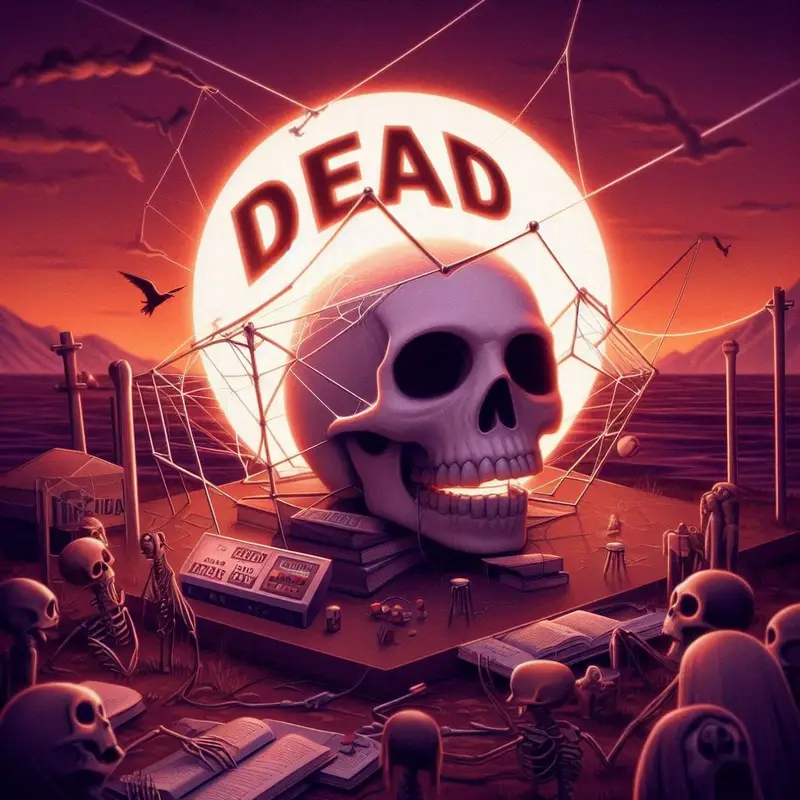
The internet was once imagined as humanity’s collective mind made visible. It was noisy, messy, personal, and unmistakably human. Early web pages bore the fingerprints of their creators: uneven writing, broken links, strange obsessions, and heartfelt sincerity. Over time, however, a growing number of people have begun to feel that something fundamental has changed. Social media feels repetitive, search results seem strangely hollow, comment sections echo with familiar phrases, and entire websites appear designed more for algorithms than for people. From this unease emerged a provocative idea known as the Dead Internet Theory.
The Dead Internet Theory suggests that much of the internet is no longer shaped primarily by human activity, but by automated systems, artificial intelligence, and algorithmically generated content. According to this view, genuine human interaction online has been drowned out or replaced by bots, synthetic media, engagement-optimizing algorithms, and industrial-scale content production. The theory does not claim that humans have vanished from the internet entirely, but that the visible surface of the web is increasingly artificial, curated, and self-referential.
This idea resonates deeply in an era defined by rapid advances in artificial intelligence. As AI systems become capable of writing articles, generating images, producing videos, and even simulating conversation, the boundary between human and machine-generated content has grown increasingly difficult to detect. The Dead Internet Theory captures a widespread anxiety: that the digital space once meant to connect people may now be largely inhabited by machines talking to machines, with humans relegated to passive consumers.
Origins of the Dead Internet Theory
The Dead Internet Theory did not originate in academic journals or formal scientific discourse. Instead, it emerged organically from online communities, particularly forums and social platforms where users began sharing a sense of digital disillusionment. Around the late 2010s and early 2020s, people started to notice patterns that felt unnatural. Comment sections filled with generic responses, social media accounts posted continuously without any sign of personal life, and entire websites appeared designed solely to manipulate search engine rankings.
These observations coincided with a broader shift in the structure of the internet. Large technology companies increasingly centralized online activity within a few dominant platforms. Algorithms optimized for engagement began shaping what people saw, prioritizing content likely to generate clicks, shares, and advertising revenue. At the same time, automated systems for content generation and distribution became more sophisticated and more widespread.
The Dead Internet Theory crystallized these scattered observations into a single narrative. It proposed that the internet, as a living social space, had effectively “died,” replaced by an artificial environment dominated by bots, corporate interests, and algorithmic feedback loops. While the theory is often expressed in dramatic or conspiratorial language, its underlying concerns reflect real, observable changes in how the internet functions.
What the Theory Claims
At its core, the Dead Internet Theory asserts that a significant portion of online content is no longer created by humans for humans. Instead, it is produced by automated systems designed to influence behavior, generate profit, or simulate activity. This includes spam bots, social media automation, content farms, recommendation algorithms, and increasingly, generative AI models capable of producing text, images, and videos at scale.
The theory also suggests that authentic human expression is becoming harder to find. According to this view, genuine conversations are buried beneath layers of algorithmically amplified content, while smaller, personal websites are overshadowed by corporate platforms. The result is an internet that feels repetitive and emotionally flat, despite appearing more active than ever.
Importantly, the Dead Internet Theory is not a single, unified claim with precise boundaries. It exists as a cluster of ideas, ranging from relatively modest concerns about automation to more extreme assertions that most online users are not human at all. To assess its validity, it is necessary to separate metaphor from measurable reality.
The Rise of Bots and Automated Accounts
One of the strongest factual foundations of the Dead Internet Theory lies in the documented rise of automated accounts. Bots have been part of the internet almost since its inception, but their scale and sophistication have increased dramatically. Automated systems now manage social media accounts, post comments, follow users, and engage in conversations with minimal human oversight.
Research consistently shows that a substantial fraction of traffic on major platforms comes from non-human sources. These bots serve many purposes. Some are benign, such as search engine crawlers that index web pages. Others are commercial, promoting products or driving traffic to specific sites. Still others are malicious, spreading misinformation, manipulating public opinion, or engaging in financial fraud.
From a scientific perspective, the existence of widespread automation does not mean the internet is “dead,” but it does support the idea that human activity is no longer the sole or even dominant driver of visible online interactions in certain spaces. When bots interact primarily with other bots, they can create the illusion of vibrant activity while excluding genuine human participation.
Algorithmic Curation and the Loss of Serendipity
Another pillar of the Dead Internet Theory is the role of algorithms in shaping online experience. Modern internet platforms rely heavily on recommendation systems that analyze user behavior to predict what content will maximize engagement. These systems are not inherently malicious; they are designed to manage overwhelming volumes of information and to personalize content.
However, the unintended consequences of algorithmic curation are well-documented. Recommendation systems tend to favor content that is emotionally charged, familiar, or easily consumable. Over time, this leads to homogenization. Users encounter similar themes, repeated formats, and predictable narratives, regardless of the platform they use.
From a cognitive standpoint, humans are highly sensitive to novelty and variation. When online spaces become dominated by repetitive patterns, they can feel artificial or lifeless, even if humans are still present. This experiential “deadness” is a key psychological component of the Dead Internet Theory. The web may not be literally devoid of people, but it can feel devoid of genuine discovery.
Content Farms and Industrialized Writing
Long before the rise of advanced AI language models, the internet saw the emergence of content farms. These operations produced massive volumes of low-quality articles optimized for search engines rather than readers. Writers were often paid per article, incentivizing speed and keyword density over originality or depth.
Content farms exploited the mechanics of search algorithms, flooding the web with superficially informative pages designed to capture ad revenue. Although search engines have since improved their ability to demote such content, its legacy persists. Many users associate the modern web with shallow explanations, repetitive phrasing, and articles that answer questions without providing insight.
This industrialization of writing laid the groundwork for current anxieties about AI-generated content. When writing is already treated as a scalable commodity, the transition from human labor to machine generation feels less like a rupture and more like a continuation. The Dead Internet Theory reflects this continuity, suggesting that the web’s creative vitality was already declining before AI entered the picture.
Generative AI and the Transformation of Online Content
The recent explosion of generative AI has given new urgency to the Dead Internet Theory. Language models can now produce articles, social media posts, reviews, and comments that closely resemble human writing. Image generators create realistic photographs of people who do not exist. Video synthesis tools can fabricate speeches and performances with increasing accuracy.
From a scientific perspective, these systems do not “understand” content in a human sense. They generate outputs based on statistical patterns learned from vast datasets of human-created material. Yet the scale and speed at which they operate fundamentally alter the dynamics of online content production.
If a single system can generate thousands of articles per day, the ratio of human to machine-generated content inevitably shifts. This raises a feedback problem. AI systems trained on internet data increasingly encounter content generated by other AI systems, potentially amplifying errors, biases, and stylistic uniformity. Over time, this recursive process could make online content feel increasingly synthetic.
Measuring the “Deadness” of the Internet
One challenge in evaluating the Dead Internet Theory is that it lacks clear metrics. What does it mean for the internet to be “dead”? From a scientific standpoint, claims must be operationalized to be tested. While it is possible to measure bot traffic, automation rates, and content generation statistics, subjective experiences of authenticity are harder to quantify.
Studies of online ecosystems suggest a complex picture. While large platforms are heavily automated, smaller communities and private networks often remain intensely human. Messaging apps, closed forums, and niche interest groups still facilitate genuine interaction. The internet has not uniformly transformed into an AI-dominated wasteland; rather, it has become stratified.
This stratification helps explain why the Dead Internet Theory feels simultaneously true and false. For users whose online experience is shaped primarily by algorithm-driven platforms, the sense of artificiality is strong. For those who actively seek out smaller, human-centered spaces, the internet can still feel alive.
Psychological Roots of the Theory
The appeal of the Dead Internet Theory cannot be understood purely in technical terms. It also reflects deep psychological responses to change. Humans are acutely sensitive to authenticity and social presence. When digital environments no longer provide reliable cues of human intention, they can trigger discomfort and alienation.
There is also a generational dimension. Early internet users often recall a time when online spaces felt more personal and exploratory. As the web has become commercialized and standardized, nostalgia can amplify perceptions of loss. The theory gives language to this emotional experience, framing it as a systemic transformation rather than a personal adaptation challenge.
From a cognitive science perspective, humans rely on pattern recognition to infer agency. When patterns become too regular or too optimized, they are often perceived as artificial. This may explain why algorithmic feeds and AI-generated text feel unsettling even when they are technically impressive.
Economic Forces Shaping the Modern Web
Behind many of the phenomena associated with the Dead Internet Theory lie powerful economic incentives. The internet’s dominant business model is advertising, which rewards attention rather than understanding. Platforms are designed to maximize time spent, clicks, and engagement, regardless of whether those metrics correspond to meaningful human interaction.
Automation is economically efficient. Bots do not require salaries, rest, or creative fulfillment. Generative AI can produce content at a fraction of the cost of human labor. From a market perspective, the expansion of automated content is a rational response to competitive pressures.
This does not imply a conspiracy to replace humans, but it does suggest that human-centered values are often secondary to profit optimization. The Dead Internet Theory captures the ethical tension between economic efficiency and cultural vitality.
Is the Internet Truly Dying?
Scientifically speaking, the internet is not dying in a biological sense, nor is it devoid of human life. Instead, it is undergoing a structural transformation. Automation, AI, and algorithmic curation are reshaping how content is produced, distributed, and consumed. These changes alter the subjective experience of being online, sometimes in ways that feel dehumanizing.
The term “dead” functions more as a metaphor than a literal description. It expresses a sense that something essential has been lost: spontaneity, diversity of voice, and the feeling of encountering another mind across the digital void. Whether this loss is permanent remains an open question.
History suggests that communication technologies often pass through phases of commercialization and standardization before new forms of expression emerge. Print, radio, and television all underwent similar cycles. The internet’s current state may not be its final one.
Human Presence in a Machine-Dominated Space
Despite the prevalence of automation, humans remain central to the internet’s meaning. Machines generate content, but humans interpret it, respond to it, and assign it value. Even the most advanced AI systems depend on human goals, data, and evaluation.
There is also evidence of counter-movements. People increasingly seek out slow media, long-form writing, and smaller communities. Some deliberately avoid algorithmic feeds, preferring newsletters, personal blogs, and direct communication. These choices reflect an ongoing negotiation between technological capability and human desire.
From a sociological perspective, the internet is not a monolith but a contested space. Its character emerges from the interaction of technology, economics, culture, and individual agency. The Dead Internet Theory highlights one possible trajectory, but it does not determine the outcome.
Ethical and Epistemic Implications
If large portions of online content are generated by AI, significant ethical questions arise. Trust becomes fragile when authorship is uncertain. Misinformation can spread more easily when synthetic content overwhelms human verification. Knowledge ecosystems risk becoming self-referential, detached from empirical reality.
From an epistemological standpoint, the reliability of the internet as a source of information depends on transparency and accountability. When content is produced by opaque systems, these foundations are weakened. Addressing this challenge requires not only technical solutions but also cultural norms that value disclosure and critical evaluation.
The Dead Internet Theory, in this sense, serves as a warning. It invites reflection on what kind of digital world is being built and whose interests it serves.
The Future of the Internet in an Age of AI
Looking forward, the relationship between humans and machines online will likely become more complex rather than more adversarial. AI can augment human creativity, assist with research, and facilitate communication across barriers. The problem arises when automation replaces human presence without preserving human meaning.
Scientific research into human-computer interaction emphasizes the importance of alignment between technological design and human values. Systems that support agency, diversity, and authenticity are more likely to sustain healthy digital ecosystems.
Whether the internet feels alive or dead in the future will depend less on the existence of AI and more on how it is integrated. Design choices, policy decisions, and individual habits will shape the balance between automation and human expression.
Conclusion: A Living Question Rather Than a Final Answer
The Dead Internet Theory captures a widespread intuition that the online world has changed in unsettling ways. It is not a precise scientific claim, but a cultural diagnosis rooted in observable trends and emotional experience. Automation, algorithms, and AI have undeniably transformed the internet, often at the expense of spontaneity and perceived authenticity.
Yet the internet is not a static entity. It is an evolving system shaped by human choices as much as by machines. To declare it dead is to express grief for what it once was, but also to imply a responsibility for what it might become.
In the end, the question is not whether most of the web is already AI, but whether humans will continue to claim space for genuine connection, creativity, and understanding within it. The answer to that question remains unwritten, unfolding in real time as the digital and human worlds continue to intertwine.