In the tropical jungles and wetlands of much of Asia, pythons are almost expected. They move silently through the undergrowth of Vietnam, Thailand, and Indonesia, powerful bodies coiled with patient strength. But travel across the sea to Taiwan’s main island, and something curious happens. The forests are still lush. The climate can be warm and humid. Yet there are no pythons.
For years, this absence has lingered like an unsolved riddle. Did these massive constrictors ever reach Taiwan when sea levels were lower and land bridges may have connected distant shores? Or did they once live there, only to vanish without a trace?
Now, a single fossilized bone has begun to whisper an answer.
The Discovery Hidden in Stone
The clue emerged from the Chiting Formation in Tainan, an area known for its fossil-rich layers of ancient life. Researchers uncovered just one fragment: a fossil trunk vertebra. It was not a skull, not a complete skeleton, not even a full spine. Just one bone from the body of a long-dead snake.
Yet that single vertebra carried extraordinary weight.
The fossil dates back to the Middle Pleistocene, between 800,000 and 400,000 years ago. From careful measurements and statistical modeling based on modern snakes, scientists calculated that the creature it belonged to was at least four meters long. To put that into perspective, the largest snakes living in Taiwan today measure only around two to three meters.
This was not just any snake. This was something bigger, more imposing. Something that does not belong in Taiwan’s modern landscape.
Reading the Language of a Vertebra
How can researchers identify a snake species from just one bone?
The answer lies in the intricate architecture of a snake’s spine. The scientists from National Taiwan University examined the fossil closely and focused on a distinctive structure called the zygosphene. This bony feature helps lock snake vertebrae together and limits twisting. In pythons, the zygosphene has a particularly wide, wedge-like shape that sets it apart from other snakes.
That shape became the key.
By comparing the fossil’s vertebral features to those of modern snakes, the researchers concluded that the bone belonged to a python. Despite having only a single vertebra to study, they used precise measurements and statistical models to estimate the animal’s total size. From one fragment, they reconstructed the shadow of a giant.
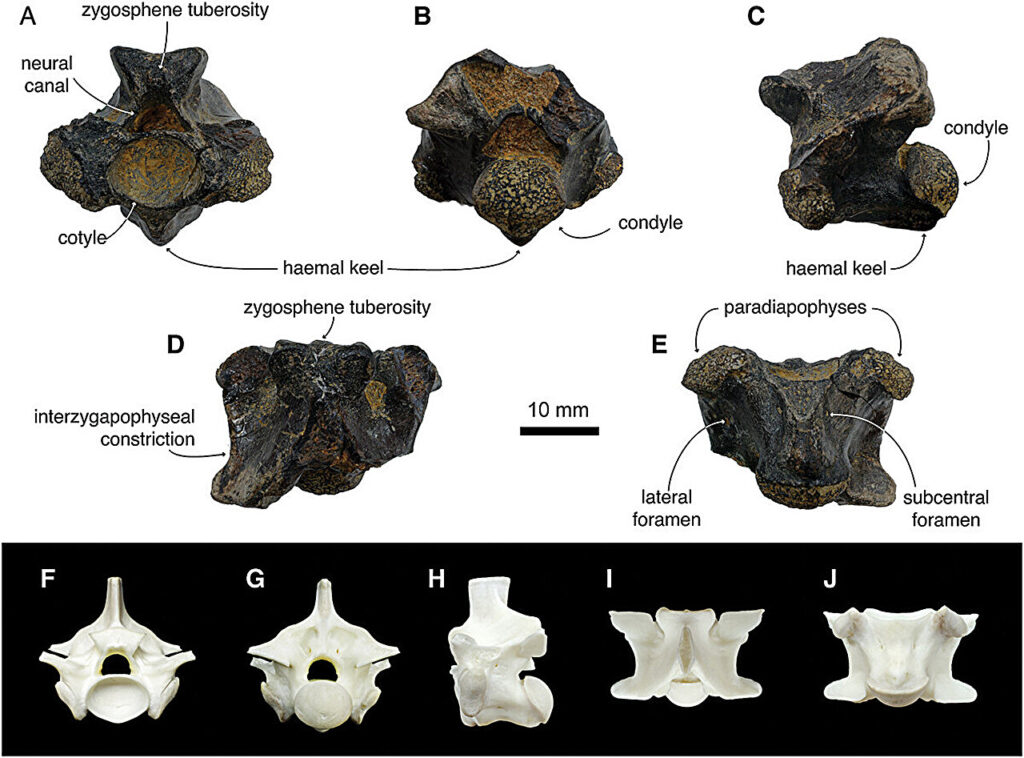
This was the first confirmed evidence of a python ever found in Taiwan’s fossil record.
A Missing Predator in an Island’s Past
Taiwan’s fossil history is not empty. Over the years, excavations have revealed remains of crocodiles, turtles, birds, and even a few other snakes. But never before had a python appeared in the record.
That absence had shaped assumptions about the island’s ecological past. Without evidence, it was easy to imagine that pythons had never made it there at all.
The discovery changes that narrative.
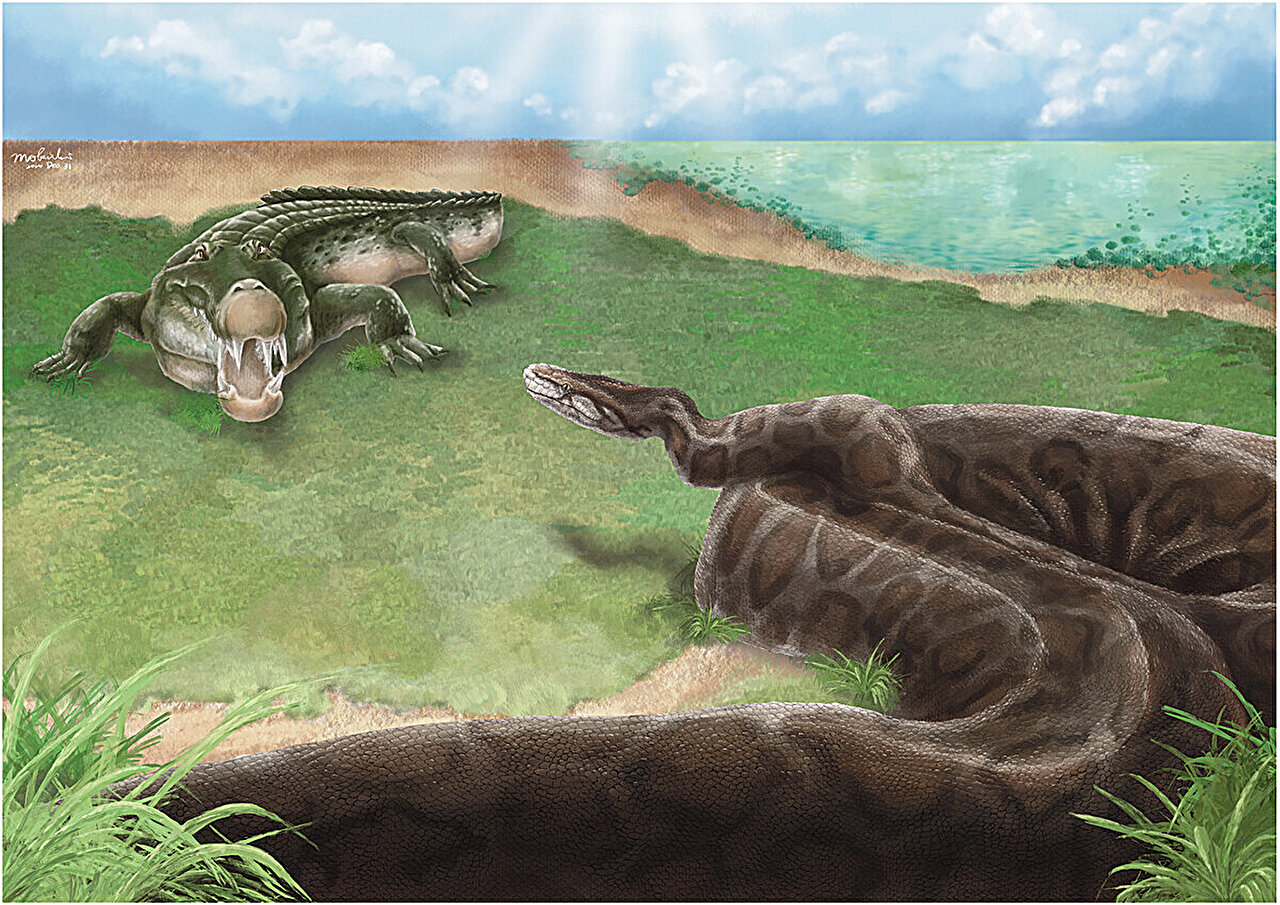
At some point during the Middle Pleistocene, a massive python slithered through Taiwan’s landscapes. It hunted, it fed, it lived out its life as one of the island’s top predators. Then, sometime later, its kind disappeared completely.
The forests that once may have hidden a four-meter-long constrictor now hold no trace of such giants.
The Silence After the Pleistocene
The question naturally follows: what happened?
The researchers suggest that the disappearance of these pythons may be part of the broader wave of extinctions near the end of the Pleistocene, a period when many large animals vanished across different regions. In Taiwan, the precise causes remain uncertain. Climate shifts, environmental upheavals, and other ecological pressures may have played roles, but the fossil record does not offer a simple explanation.
What stands out, however, is not just the extinction itself, but what followed.
Even after climates warmed again, the ecological balance may not have fully restored itself. According to the researchers, the extinction of large predators during the Pleistocene could have triggered a dramatic reshaping of Taiwan’s terrestrial ecosystem.
They describe this as a drastic faunal turnover.
In other words, the cast of ecological characters changed profoundly. And something may never have returned.
An Empty Throne in the Forest
Perhaps the most striking idea in the research is this: when the large python vanished, it may have left behind an ecological niche that has remained vacant ever since.
In ecosystems, every species plays a role. Large predators often sit at the top of the food web, shaping populations below them. Remove a top predator, and the ripple effects can echo through generations.
The researchers propose that the niche once occupied by this giant python has not been refilled in Taiwan’s modern biodiversity. The island today has snakes, certainly, but none matching the size or ecological dominance of that ancient constrictor.
The fossil suggests that Taiwan once supported a top predator very different from anything living there now. Its absence today is not simply a matter of missing bones in the ground. It may represent a long-lasting shift in how the ecosystem functions.
“The vanished top predator, as shown by this large python… in the modern biodiversity of Taiwan, indicates a drastic faunal turnover,” the researchers write. They go further, proposing that “the niche of top predators in the modern ecosystem may have been vacant since the Pleistocene extinction.”
It is a haunting idea. An ecological role left empty for hundreds of thousands of years.
Rewriting an Island’s Story
Before this discovery, Taiwan’s main island appeared to be a place that pythons had simply never reached. Now, the narrative is more complex and more intriguing. Not only did pythons once roam there, but at least one grew to a formidable size, rivaling some of the largest snakes known in the region.
From a single vertebra in the Chiting Formation, scientists have rewritten a chapter of Taiwan’s natural history.
This discovery also highlights the power of paleontology. Sometimes, it does not take a complete skeleton to change our understanding of the past. A single bone, carefully examined, can illuminate an entire ecosystem.
The fossil record is often incomplete. Many stories are fragmented. Yet even fragments can speak volumes.
Why This Research Matters
At first glance, the discovery of one ancient snake bone might seem like a small detail in the vast timeline of Earth’s history. But its implications stretch far beyond that single vertebra.
The fossil confirms that large pythons once lived in Taiwan during the Middle Pleistocene, reshaping our understanding of the island’s prehistoric fauna. It provides concrete evidence of a top predator that no longer exists there. More importantly, it raises profound questions about ecological stability and recovery.
If a major predator disappeared during the Pleistocene extinction, and its ecological role remains unfilled today, what does that say about how ecosystems respond to upheaval? The study suggests that even after climates shift back toward warmer conditions, ecosystems may not simply return to their previous states. Some losses may be permanent.
The idea of a long-vacant ecological niche invites us to rethink how we view extinction. It is not just about species disappearing. It is about relationships unraveling, food webs reshaping, and environments transforming in ways that may endure for hundreds of thousands of years.
In Taiwan’s forests today, there are no four-meter pythons gliding through the undergrowth. But beneath the soil, a single vertebra reminds us that they were once there. It tells a story of presence, disappearance, and an ecological throne left empty.
And it reminds us that the past is never truly silent. Sometimes, it waits patiently in stone, ready to change what we think we know.
Study Details
Yi-Lu Liaw et al, An unexpected snake fossil (Pythonidae,Python) from Taiwan, Historical Biology (2026). DOI: 10.1080/08912963.2025.2610741