Imagine a world where the very flow of your thoughts feels unpredictable, where reality itself seems to sway beneath your mind. For individuals living with schizophrenia or bipolar disorder, this is not imagination—it is a lived experience. Psychotic states can warp thinking, perceptions, and beliefs, making the simplest interactions feel unfamiliar or distorted. Yet, understanding the inner workings of these states has long been a challenge. Symptoms overlap, patterns hide, and until now, the underlying mechanisms have remained elusive.
A team of researchers at Georgia Institute of Technology and Emory University set out to explore the mystery, looking for the subtle rhythms and fractures in the minds experiencing psychosis. Their findings, recently published in Molecular Psychiatry, reveal that the brains of those in psychotic states are not merely different—they are strikingly chaotic, following patterns of randomness that hint at an unstable flow of information.
“The measures of resting-state fMRI spatiotemporal complexity offer a powerful tool for identifying irregularities in brain activity,” Qiang Li, Jingyu Liu, and their colleagues wrote.
Listening to the Brain’s Hidden Conversations
To uncover these patterns, the researchers turned to fMRI, a window into the brain’s inner dialogue. By tracking blood flow and oxygen levels, fMRI allows scientists to see which regions of the brain are active at any moment. But instead of focusing on individual regions, the team looked at the bigger picture: the interactions across the entire brain.
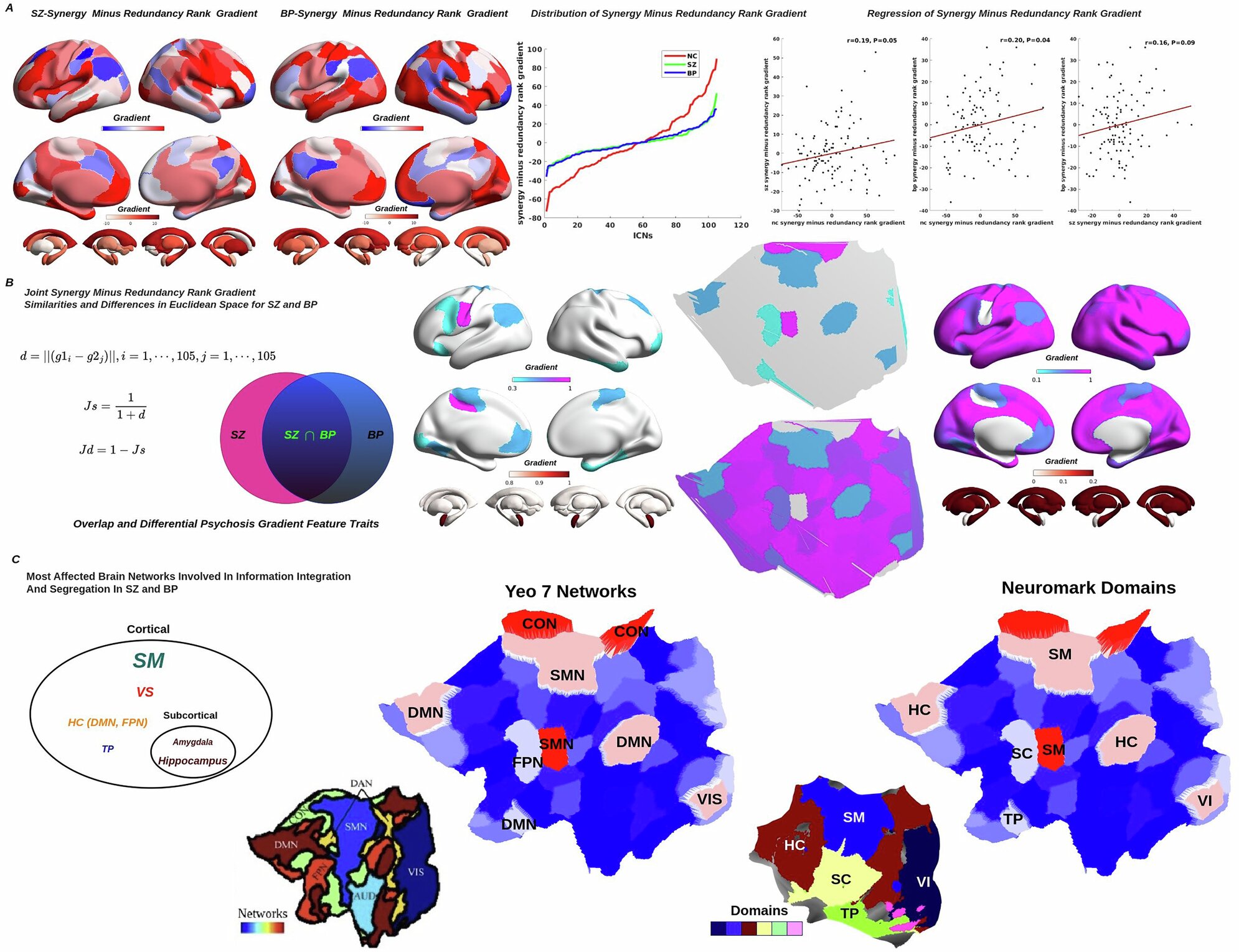
“To capture global brain connectivity, we employed information-theoretic metrics, overcoming the limitations of pairwise correlation analysis approaches. This enables a more comprehensive exploration of higher-order interactions and multiscale intrinsic connectivity networks (ICNs) in the psychotic brain,” the researchers explained.
Rather than treating the brain as a collection of isolated areas, they treated it as a network, a dynamic web where information flows, overlaps, and combines. They measured redundancy—where the same information is echoed across regions—and synergy—where different regions combine information in unique ways. These metrics offered a new lens to understand how psychosis disrupts the delicate balance of communication in the brain.
Brainquake
The term “brainquake” emerges from this work, capturing the instability and disorganization the researchers observed.
“In this study, we provide converging evidence suggesting that the psychotic brain exhibits states of randomness across both spatial and temporal dimensions,” wrote Li, Liu, and their colleagues.
Their scans revealed that several key networks—responsible for processing emotions, sensory information, memory, and higher mental functions—were disrupted. Redundant and synergistic information no longer aligned as they do in healthy brains. Instead, they wobbled and fractured, creating a profound sense of instability across multiple neural networks.
“Our exploration of higher-order topological functional connectivity reveals profound disruptions in brain information integration,” the team noted. “Aberrant information interactions were observed across both cortical and subcortical ICNs. We specifically identified the most easily affected irregularities in the sensorimotor, visual, temporal, default mode, and fronto-parietal networks, as well as in the hippocampal and amygdalar regions, all of which showed disruptions.”
It is a seismic view of the mind, where the very connections that allow for coherent thought and perception tremble unpredictably, leaving reality itself vulnerable to distortion.
Mapping the Chaos
What makes this discovery remarkable is the clarity with which it captures the complexity of psychotic states. Traditional studies often focus on specific symptoms or isolated brain regions. This study, however, paints a holistic portrait, showing how psychosis ripples through the brain, destabilizing multiple networks simultaneously. The “brainquake” metaphor is not mere imagery; it reflects the real, measurable turbulence in neural communication.
By applying advanced information-theoretic tools, the team could quantify these disruptions, revealing patterns of redundancy and synergy that had never been measured before. This approach opens a window into the underlying architecture of psychotic disorders, suggesting that the brain’s organizational balance is not simply altered—it is fundamentally shaken.
Shining Light on Schizophrenia and Bipolar Disorder
The implications of these findings extend beyond curiosity. Understanding the patterns of instability in the psychotic brain could lead to more precise methods of diagnosis. It may help clinicians identify the onset of psychotic states before symptoms become overwhelming. It could also guide the monitoring of treatment, showing whether interventions restore balance to these unstable networks.
“Our findings underscore the severe impact of psychotic states on multiscale critical brain networks, suggesting a profound alteration in the brain’s complexity and organizational states,” the researchers wrote.
In the future, the metrics of “brainquake” could become a standard part of psychiatric assessment, offering objective markers where subjective observation has often been the only tool. By revealing how information flows—or fails to flow—across the brain, this research brings us closer to understanding the inner experience of psychosis, giving both clinicians and patients a clearer map of what is happening inside the mind.
Why This Research Matters
At its heart, this research matters because it brings a hidden world into view. Psychotic states can be terrifying and isolating, not only for those experiencing them but also for their families. By decoding the neural patterns behind these experiences, scientists are beginning to translate chaos into understanding.
This work transforms abstract symptoms into measurable brain dynamics. It promises a future where diagnoses are not guesses, treatments are guided by real-time neural insights, and the lives of individuals with schizophrenia or bipolar disorder are approached with empathy informed by science.
The brainquake may shake the mind, but in doing so, it also illuminates the intricate beauty and complexity of human cognition. In understanding its tremors, we take the first steps toward restoring balance, insight, and hope.
More information: Qiang Li et al, Spatiotemporal complexity in the psychotic brain, Molecular Psychiatry (2025). DOI: 10.1038/s41380-025-03367-5.