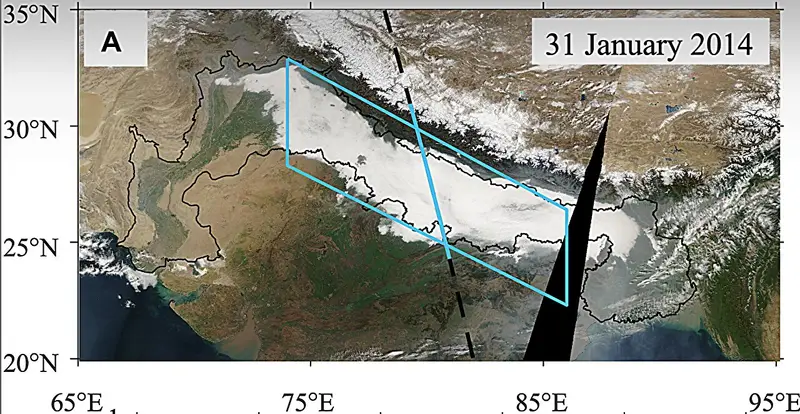
In the cold months, Northern India often wakes beneath a familiar, suffocating blanket. Roads vanish into gray silence. Trains crawl or stop. Flights are delayed or canceled. This is winter fog, thick and stubborn, and it arrives not quietly but with consequences that ripple through daily life and the economy. For years, people have known that air pollution makes these fog events worse, but exactly how polluted air reshapes fog in the sky has remained uncertain.
Now, a new study published in Science Advances offers a clearer picture. It tells a story not just of fog, but of invisible particles, rising warmth, cooling skies, and a subtle but powerful feedback that allows fog to grow taller, denser, and harder to escape.
Following the Fog from Space to Simulation
To understand what was happening above the ground, researchers looked upward, far beyond highways and rooftops. They turned to 15 years of satellite observations, drawing data from the space-based CALIPSO mission and the MODIS instrument. Together, these satellites allowed the team to see both the vertical structure of fog and the amount of aerosols suspended in the air over North India.
But satellite images alone could not explain why fog behaves the way it does. To bridge that gap, the researchers ran high-resolution fog simulations, carefully testing how aerosols and latent heat influence fog growth. These simulations were not meant to predict exact fog thickness on a given morning. Instead, they were designed to uncover the physical mechanisms that make polluted fog so unusually intense.
What emerged was a layered and dynamic portrait of winter fog, shaped from the inside by pollution itself.
A Hidden Layer Where Fog Learns to Grow
The satellites revealed a striking structure. Embedded within a broader aerosol layer stretching from the surface up to about 1.5 kilometers, the fog itself formed a compact but powerful band roughly 0.5 to 0.6 kilometers thick. This fog layer did not float freely. It lived inside polluted air, and that pollution mattered.
When fog contained a higher density of aerosols, the droplets inside it grew larger, especially near the fog’s upper boundary. Scientists refer to this as increased liquid water content, or LWC. More droplets and more liquid water changed how the fog behaved, not just optically but physically.
As droplets formed and grew, they released latent heat, a subtle warmth generated during condensation. This warmth made portions of the fog slightly buoyant, encouraging air parcels to rise. Fog, once thought of as flat and passive, began to move vertically.
The Moment Fog Starts to Stir
As fog parcels lifted upward, they entered cooler and saturated air near the fog top. There, something remarkable happened. The presence of more droplets increased the fog’s ability to emit longwave radiation. In simple terms, longwave radiative cooling became stronger at the fog’s upper edge.
This cooling acted like a gentle pull from above, while latent heat release pushed from below. The fog layer found itself caught between warming and cooling forces, intensifying vertical mixing within the fog. Rising parcels cooled further, encouraging even more droplet growth.
The researchers describe this as a positive feedback loop. Condensation releases heat. Heat drives buoyancy. Buoyancy enhances mixing. Mixing leads to more droplet activation. More droplets increase radiative cooling at the fog top, which feeds back into condensation again. With aerosols acting as catalysts, the fog stretches upward, becoming thicker and more persistent.
When Nightfall Gives Fog the Upper Hand
This process becomes even more powerful after sunset. According to the simulations, fog with high aerosol concentrations thickens by 17 to 25 percent at night. Darkness removes solar heating, allowing other processes to dominate.
At night, a persistent warm layer forms above the fog, creating a strong temperature inversion. This inversion acts like a lid, trapping moisture close to the surface. With nowhere to escape, water vapor condenses more easily, feeding droplet growth within the fog layer.
As condensation increases, buoyancy strengthens. Fog water redistributes vertically, pushing the fog layer higher and making it denser. By morning, the fog can be deep and stubborn. When the sun finally rises, the fog begins to thin, but often only partially, leaving lingering impacts on visibility and air quality.
Seeing the Limits of the Model
The researchers are careful not to overstate their results. They acknowledge that their simulations may underestimate fog thickening. The model resolves vertical mixing explicitly only up to about 700 meters and does not include subgrid-scale parameterization, which could capture smaller turbulent motions.
They suspect that an anomalously strong inversion caused by aerosol-radiative effects in the model, or a highly moist surface layer producing less sensible heat flux, may reduce vertical mixing. Less mixing means fewer activated aerosols and fewer fog droplets, leading to conservative estimates of fog growth.
Despite these limitations, the researchers emphasize that the model succeeds as a mechanistic hypothesis. It explains how aerosols actively reshape fog from within, rather than merely correlating pollution with poor visibility.
Why This Research Matters
Understanding fog is not an academic exercise when millions of lives are affected by disrupted transportation, delayed emergency services, and economic losses. This study reveals that aerosols are not passive bystanders in winter fog. They are active participants that thicken fog, enlarge droplets, and extend fog vertically through tightly coupled physical processes.
By identifying the feedback between aerosol loading, latent heat release, longwave radiative cooling, and vertical mixing, the research provides a foundation for better fog representation in weather and air quality models. Even if current simulations underestimate the effect, the mechanisms are now clearer and testable.
Future work, building on these insights with improved models and richer data, could lead to more accurate fog forecasting and more informed air pollution management strategies. In a region where winter fog routinely slows life to a standstill, understanding how polluted air teaches fog to grow may be a crucial step toward learning how to live with it, or even how to reduce its grip.
Pacific Ocean
N. Arun et al, Widespread fog invigoration due to aerosols over Northern India, Science Advances (2026). DOI: 10.1126/sciadv.adx1662