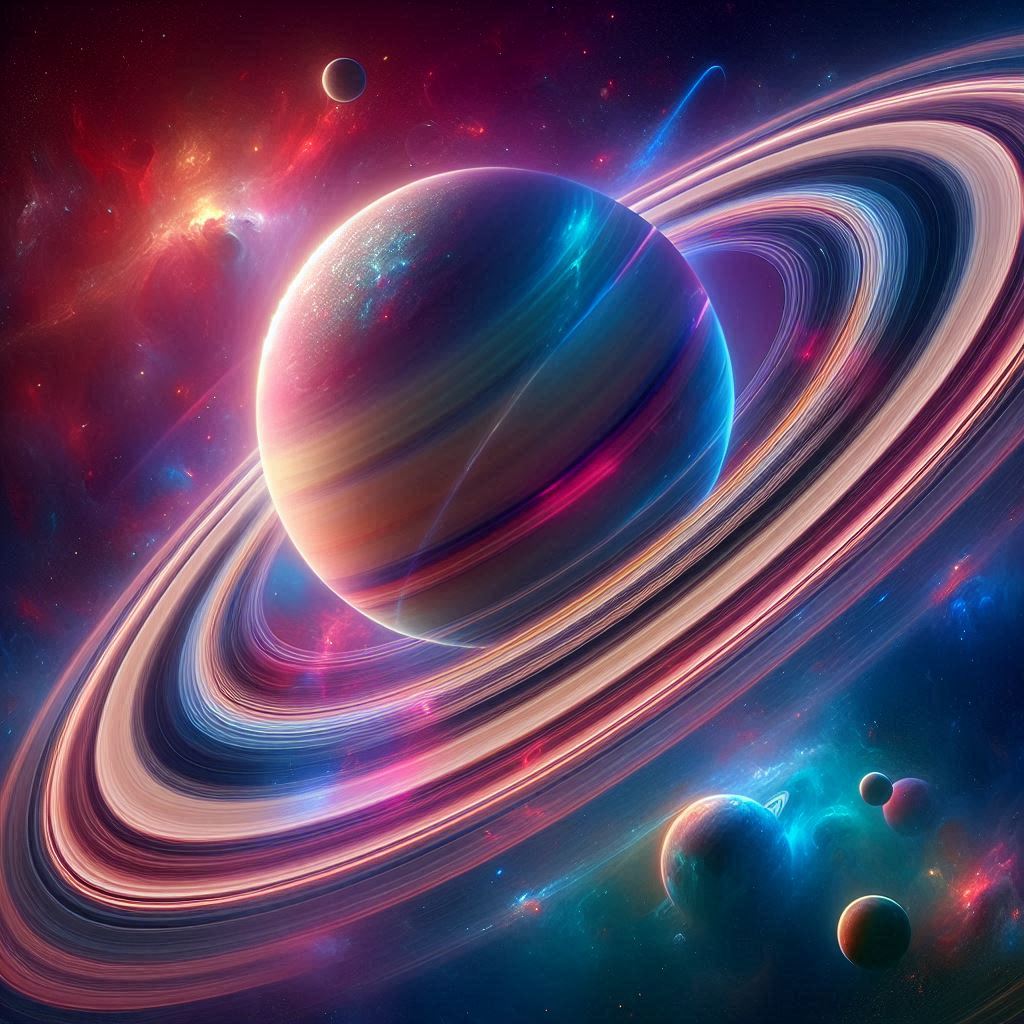
Among the countless wonders scattered across the vastness of space, few sights capture the human imagination as powerfully as the rings of Saturn. Floating like a shimmering halo around the giant planet, these delicate bands of ice and rock form one of the most breathtaking structures in our Solar System. Seen through even a modest telescope, Saturn appears transformed from a distant point of light into a majestic world crowned with luminous rings, a celestial jewel suspended in the darkness of space.
For centuries, these rings have inspired curiosity, awe, and mystery. Astronomers have wondered how such a magnificent structure formed, what it is made of, and how long it will continue to exist. Are the rings ancient relics from the birth of the Solar System, or are they temporary features that will eventually vanish? What invisible forces keep billions of icy particles arranged in perfect harmony around a planet more than a billion kilometers from Earth?
The story of Saturn’s rings is not only a tale of beauty but also a scientific adventure that spans centuries of discovery. From the first telescopic observations to modern spacecraft missions that have flown through the ring system itself, humanity has slowly uncovered the secrets of this extraordinary cosmic phenomenon.
The First Glimpse of a Ringed Planet
Long before powerful telescopes and space probes existed, Saturn appeared to ancient observers as a faint wandering star slowly moving across the night sky. It was known to early civilizations in Babylon, Greece, India, and China, but no one suspected the extraordinary feature surrounding it.
Everything changed in the early seventeenth century with the invention of the telescope. In 1610, the Italian astronomer Galileo Galilei turned his primitive telescope toward Saturn. What he saw confused him deeply. Instead of appearing as a simple spherical planet, Saturn seemed to have two mysterious protrusions on either side.
Galileo described the strange object as looking like a central globe with two smaller companions attached to it. Because his telescope was relatively weak, he could not resolve the rings clearly. He even wondered whether Saturn might be a triple-bodied planet.
A few years later, the appearance changed again. The mysterious side objects disappeared entirely. Galileo was baffled and wrote that Saturn had “swallowed its children.” What he had unknowingly witnessed was the changing angle of Saturn’s rings as seen from Earth. When the thin ring plane aligns edge-on with our viewpoint, the rings nearly vanish.
The true nature of Saturn’s rings remained uncertain until 1655, when the Dutch astronomer Christiaan Huygens used a more advanced telescope to study the planet. Huygens proposed a bold and correct explanation: Saturn was surrounded by a thin, flat ring that did not touch the planet and remained tilted relative to its orbit.
This insight transformed Saturn from a curiosity into one of the most fascinating objects in the Solar System.
The Structure of the Ring System
Although Saturn’s rings appear solid and continuous from a distance, they are actually composed of countless individual particles orbiting the planet. Each piece travels around Saturn under the influence of gravity, much like miniature moons.
The rings extend astonishing distances. From the inner edge of the ring system to the outermost visible bands, they stretch more than 280,000 kilometers across. This is nearly three-quarters of the distance from Earth to the Moon.
Yet despite this enormous width, the rings are remarkably thin. In many places they are only about ten meters thick. If the ring system were scaled to the size of a football field, its thickness would be comparable to a sheet of paper.
The rings are divided into several major sections known as the A ring, B ring, and C ring, along with additional faint rings and gaps. These divisions were first identified in the nineteenth century through telescopic observations.
One of the most prominent gaps within the rings is the Cassini Division, a dark region separating the A and B rings. It was discovered in 1675 by the Italian-French astronomer Giovanni Domenico Cassini. For many years astronomers thought it might be empty space, but later observations revealed that it contains fewer particles rather than being completely vacant.
Beyond these major rings lie additional structures including the faint D ring closer to Saturn and the outer F, G, and E rings. Some of these rings are narrow and dynamic, constantly shaped by gravitational interactions with nearby moons.
The result is a complex and ever-changing system of orbiting material that resembles a vast cosmic disk circling the planet.
What the Rings Are Made Of
One of the most remarkable aspects of Saturn’s rings is their composition. Observations show that the rings are made primarily of water ice. In fact, they are among the brightest objects in the Solar System because ice reflects sunlight so efficiently.
The particles within the rings vary widely in size. Some are tiny grains no larger than dust, while others are massive chunks comparable to houses or even small mountains. Most of the material falls somewhere in between, ranging from pebble-sized fragments to blocks several meters across.
Each particle follows its own orbit around Saturn, colliding and interacting with neighboring pieces. These constant collisions gradually break large chunks into smaller fragments while also causing particles to clump together temporarily.
Despite the countless collisions occurring within the rings, the overall system remains remarkably stable. The reason lies in the balance between gravitational forces, orbital motion, and the mechanical properties of ice.
Because the ring particles orbit Saturn at different speeds depending on their distance from the planet, collisions tend to occur gently rather than violently. This allows the system to persist over long periods without being completely destroyed.
The Dance of Gravity and Motion
The rings of Saturn are governed by the same fundamental laws of physics that control the motion of planets and moons. Gravity is the dominant force shaping the structure and behavior of the ring system.
Every particle in the rings is pulled inward by Saturn’s enormous gravitational field. At the same time, the particle’s orbital motion carries it forward. The balance between these two effects keeps the particle moving in a stable orbit.
Particles closer to Saturn orbit faster than those farther away. This difference in speed creates subtle interactions between neighboring particles. When collisions occur, they exchange energy and momentum, influencing their trajectories.
Another key factor shaping the rings is the gravitational influence of Saturn’s many moons. Some moons orbit just outside or inside the rings and exert periodic gravitational tugs on ring particles. These interactions can create gaps, waves, and ripples within the ring structure.
Certain small moons known as shepherd moons play a particularly important role. These moons orbit near narrow rings and help keep them confined through gravitational interactions. Their presence prevents ring material from spreading outward and dispersing into space.
The result is a delicate gravitational choreography in which countless particles, moons, and forces interact continuously.
The Mystery of Ring Formation
One of the greatest mysteries surrounding Saturn’s rings is how they formed in the first place. Scientists have proposed several possible explanations, each supported by different lines of evidence.
One idea suggests that the rings formed from the remnants of a destroyed moon. If a moon wandered too close to Saturn, the planet’s powerful tidal forces could tear it apart. The fragments would then spread into orbit around the planet, forming a ring system.
Another possibility is that the rings are leftovers from the formation of Saturn itself. When the planet formed billions of years ago, a disk of material may have surrounded it. Some of this material could have remained in orbit rather than coalescing into moons.
A third hypothesis proposes that comets or icy objects from the outer Solar System were captured and broken apart by Saturn’s gravity, contributing material to the rings.
Determining which scenario is correct has proven challenging. Observations indicate that the rings are composed of very pure ice, which suggests they may have formed relatively recently compared to the age of the Solar System.
If the rings were billions of years old, they would likely contain much more dust and debris from meteoroid impacts. Their bright, clean appearance hints that they may be only tens or hundreds of millions of years old, making them surprisingly young in cosmic terms.
However, the debate continues, and the true origin of Saturn’s rings remains an open question.
Waves and Patterns in the Rings
Although the rings may appear smooth and uniform from afar, close-up observations reveal a world filled with intricate structures and patterns.
Gravitational interactions between ring particles and Saturn’s moons generate spiral waves that ripple through the ring system. These waves resemble the patterns seen in spiral galaxies or the ripples spreading across the surface of water.
Density waves occur when gravitational forces periodically compress ring particles into crowded regions, creating bright bands that move through the rings. Other types of waves arise from vertical motions that lift particles above and below the ring plane.
In some regions, the rings form narrow braided strands that weave around one another like threads in a cosmic tapestry. These complex structures are especially visible in the narrow F ring.
The constant motion of particles, combined with gravitational interactions, ensures that the ring system is never static. It is a dynamic environment where patterns emerge, evolve, and disappear over time.
The Role of Saturn’s Moons
Saturn possesses an impressive family of moons, with more than eighty confirmed natural satellites. Many of these moons play a crucial role in shaping the ring system.
Some moons orbit within gaps in the rings, helping maintain these divisions through gravitational interactions. Others orbit near the edges of rings and act as shepherds, confining ring particles within narrow boundaries.
One fascinating example involves the small moons Prometheus and Pandora, which shepherd the F ring. Their gravitational influence keeps the ring material tightly packed while also creating dramatic streamers and clumps.
Another moon, Enceladus, contributes material to Saturn’s outer E ring. This icy moon ejects plumes of water vapor and ice particles from geysers near its south pole. These particles escape into space and spread along Enceladus’s orbit, forming the diffuse E ring.
Through these interactions, Saturn’s moons act as both sculptors and suppliers of ring material.
Spacecraft Exploration of Saturn’s Rings
For centuries, Saturn’s rings could only be studied from Earth using telescopes. That changed dramatically in the late twentieth century with the arrival of robotic spacecraft.
The first spacecraft to visit Saturn was Pioneer 11 in 1979. It provided the first close-up images of the ring system and confirmed many theoretical predictions.
A year later, the Voyager 1 and Voyager 2 spacecraft passed by Saturn during their historic journeys through the outer Solar System. These missions revealed the rings in unprecedented detail, discovering new ringlets, gaps, and intricate structures.
However, the most remarkable exploration of Saturn came with the Cassini mission. Launched in 1997, the Cassini spacecraft entered orbit around Saturn in 2004 and spent more than thirteen years studying the planet and its rings.
Cassini transformed our understanding of the ring system. It captured breathtaking images showing the rings as complex, dynamic structures filled with waves, clumps, and embedded objects.
In the final phase of its mission, Cassini performed daring dives between Saturn and the innermost rings. These close passes allowed scientists to measure the mass of the rings and gather detailed data about their composition and structure.
The mission ended in 2017 when the spacecraft deliberately plunged into Saturn’s atmosphere, ensuring that it would not contaminate potentially habitable moons such as Enceladus.
Are the Rings Temporary?
One of the most surprising discoveries from Cassini’s observations is the possibility that Saturn’s rings may not last forever. Evidence suggests that the rings are gradually losing material.
Micrometeoroid impacts continuously strike the rings, knocking tiny particles out of orbit. In addition, charged particles from Saturn’s magnetosphere interact with ring material, causing some of it to drift toward the planet.
Scientists have detected streams of ring particles slowly raining down into Saturn’s atmosphere in a process known as ring rain. Over millions of years, this gradual loss of material could significantly reduce the mass of the rings.
If this process continues, Saturn’s rings may eventually fade and disappear, leaving the planet without its most famous feature.
This possibility adds a poignant dimension to the beauty of the rings. They may represent a temporary cosmic spectacle, existing during a brief window of time in the Solar System’s history.
The Cultural and Scientific Legacy of Saturn’s Rings
Beyond their scientific importance, Saturn’s rings have left a deep imprint on human culture and imagination. Artists, writers, and dreamers have long been captivated by the image of a ringed world drifting through space.
The rings symbolize both mystery and elegance, reminding us that the universe contains wonders far beyond the boundaries of our everyday experience.
For scientists, Saturn’s rings serve as a natural laboratory for studying the behavior of disks of orbiting material. Similar processes occur in many astrophysical environments, including the disks of gas and dust that surround young stars and give rise to planetary systems.
By studying the rings, researchers gain insights into how planets form, how gravitational interactions shape cosmic structures, and how complex systems evolve over time.
A Jewel in the Cosmic Ocean
Saturn’s rings remain one of the most extraordinary features in our Solar System. Their shimmering bands of ice and rock create a spectacle unlike anything else among the planets.
They remind us that the universe is filled not only with vast distances and powerful forces but also with delicate structures of astonishing beauty.
From the first puzzled observations of Galileo to the breathtaking images returned by spacecraft, humanity’s understanding of Saturn’s rings has grown steadily deeper. Yet even today, many mysteries remain.
How exactly did the rings form? How long will they survive? What new secrets might future missions uncover?
The answers lie waiting among the icy particles that circle Saturn in silent harmony, forming a cosmic jewel that has captivated human curiosity for centuries and will continue to inspire wonder for generations to come.