At the very center of our galaxy lies a monster that, by all rights, should be screaming. This is Sagittarius A*, a supermassive black hole containing millions of times the mass of our sun. In most large galaxies, these gravitational titans are the brightest objects in the cosmos, surrounded by swirling discs of gas that heat up to millions of degrees and blast radiation across the universe. Yet, for as long as humans have had the tools to look, our own central black hole has been strangely quiet. It is famously one of the dimmest black holes known to science, a dormant shadow that barely flickers.
Because it is so close to Earth, we can see its faint glow, but its silence has long puzzled astronomers. It sits there, a pitch-black pit so dense that not even light can escape its grasp, acting more like a ghost than a galactic engine. However, new evidence suggests that this calm is only a recent development. Like a volcano that appears peaceful until one examines the ancient ash on its slopes, Sagittarius A* has a hidden history of violence. Recent observations from a revolutionary new space telescope suggest that just a few centuries ago—perhaps while humans were first peering through primitive glass lenses on Earth—the center of our galaxy erupted in a spectacular, high-energy flare.
Catching the Echoes of a Forgotten Fire
Light travels at a finite speed, which means the universe is a natural time machine. When a black hole flares, that light travels outward in all directions. While the direct flash from an ancient outburst might have passed Earth long ago, some of that radiation strikes giant molecular clouds—massive clumps of gas floating near the galactic center. These clouds act as cosmic mirrors, catching the ancient X-rays and reflecting them toward our telescopes today. Astronomers call this a light echo, a ghostly replay of an event that ended hundreds of years ago.
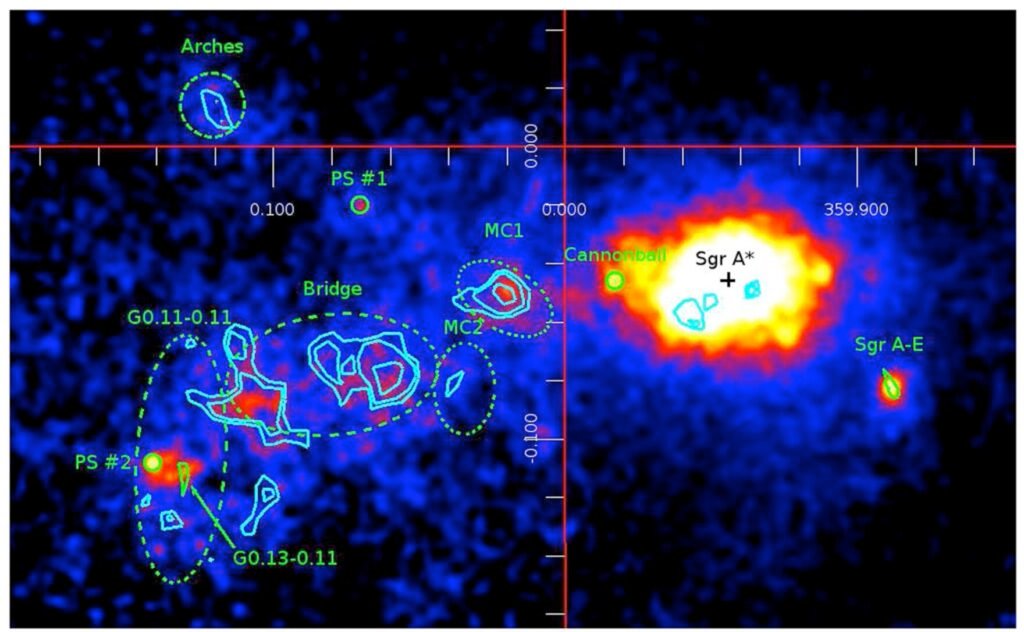
For years, scientists suspected these clouds were glowing because of past outbursts, but the evidence was blurry. Older space telescopes could see the glimmer of X-rays, but they lacked the “eyesight” to see the fine details of the light. They could tell the clouds were bright, but they couldn’t definitively prove why. The signal was messy, leaving room for competing theories. Perhaps the glow wasn’t a reflection at all, but rather the result of cosmic rays—high-speed particles—crashing into the gas. To solve the mystery, researchers needed a way to look at the energy of individual X-ray photons with the precision of a laboratory experiment.
A New Vision for the X-ray Universe
The breakthrough came in 2023 with the launch of XRISM, the X-ray Imaging and Spectroscopy Mission. A collaboration between NASA and the Japan Aerospace Exploration Agency (JAXA), this telescope was designed to change the game of X-ray astronomy. While most previous telescopes could distinguish the energy of a light particle to one part in 100, XRISM can resolve it to one part in 1,000. This jump in technology is the celestial equivalent of moving from a fuzzy, instant Polaroid to a crisp, high-definition technicolor image.
Equipped with this new toolbox, researcher Stephen DiKerby and an international team of scientists turned their attention to the gas clouds surrounding our galaxy’s core. They weren’t just looking for a glow; they were looking for specific “fingerprints” in the light. By zooming in on two extremely narrow X-ray emission lines, the team could measure the energy and shape of the light with unprecedented accuracy. This precision allowed them to perform a cosmic process of elimination. They examined the subtle features of the X-ray spectrum, looking for the telltale signs of how the light was produced.
Decoding the Galactic Timeline
As the team analyzed the data, the story of the galactic center began to shift. The sharp view provided by XRISM allowed DiKerby to measure the motion of the cloud and match it with existing radio observations, ensuring they knew exactly what they were looking at. The high-resolution data finally ruled out the theory of cosmic rays. The evidence was clear: the cloud was glowing because it was being hit by a massive “flashbulb” of radiation from the past.
By studying how different clouds at different distances from the center are reacting, astronomers can now begin to reconstruct a chronological timeline of the black hole’s activity. It is much like standing in a dark, vast cavern and shouting; by listening to how long it takes for the sound to bounce off various walls, you can map the shape and history of the space. The data suggests that Sagittarius A* underwent a dramatic flare-up somewhere between a few hundred and 1,000 years ago. This finding proves that our “dim” black hole is capable of sudden, massive shifts in behavior, transforming from a quiet sleeper into a radiation-spewing giant in a relatively short cosmic timeframe.
Why the Heartbeat of the Galaxy Matters
Understanding these ancient outbursts is about more than just documenting a prehistoric light show; it is about understanding the very life cycle of the place we call home. Every large galaxy has a supermassive black hole at its heart, and these objects play a fundamental role in how galaxies evolve. By resolving iron lines and other chemical signatures with such clarity, scientists are finally reading the diary of the Milky Way’s past.
This research matters because it confirms that Sagittarius A* is not a static object, but a dynamic and changing force. The ability of XRISM to detect these extremely fine features opens a new era of discovery, allowing us to see the “hidden history” of our cosmic neighborhood. It reminds us that the universe is rarely as quiet as it seems. By looking at the reflections in the clouds, we are learning that the dark, silent heart of our galaxy has a much louder story to tell—one that is only now being revealed through the precision of modern science.
More information: Stephen DiKerby et al, Resolving the Fe Kα Doublet of the Galactic Center Molecular Cloud G0.11-0.11 with XRISM, arXiv (2026). DOI: 10.48550/arxiv.2601.02482