Eighty years after the Trinity nuclear explosion, researchers have identified a previously unknown crystal compound inside rare “red trinitite,” a glassy material formed during the blast. The team confirmed the first known clathrate structure ever found among solid products of a nuclear detonation, revealing how extreme, short-lived conditions can produce rare forms of matter.
The Trinity nuclear test didn’t just mark the beginning of the atomic age—it also created a strange geological record that scientists are still decoding. Now, researchers have uncovered an entirely new type of crystal hidden inside one of the blast’s rarest remnants, offering a fresh glimpse into how matter behaves when pushed beyond normal physical limits.
In a new study published in the Proceedings of the National Academy of Sciences, the team reports the discovery of a previously unknown Ca–Cu–Si type-I clathrate, found within material formed during the 1945 Trinity nuclear detonation.
Trinitite is a frozen snapshot of extreme physics
When the Trinity device detonated in New Mexico, the explosion produced temperatures exceeding 1,500 °C (2,730 °F) and pressures tens of thousands of times atmospheric pressure. Those conditions lasted only briefly, but they were intense enough to fuse together sand from the desert floor with debris from the test infrastructure.
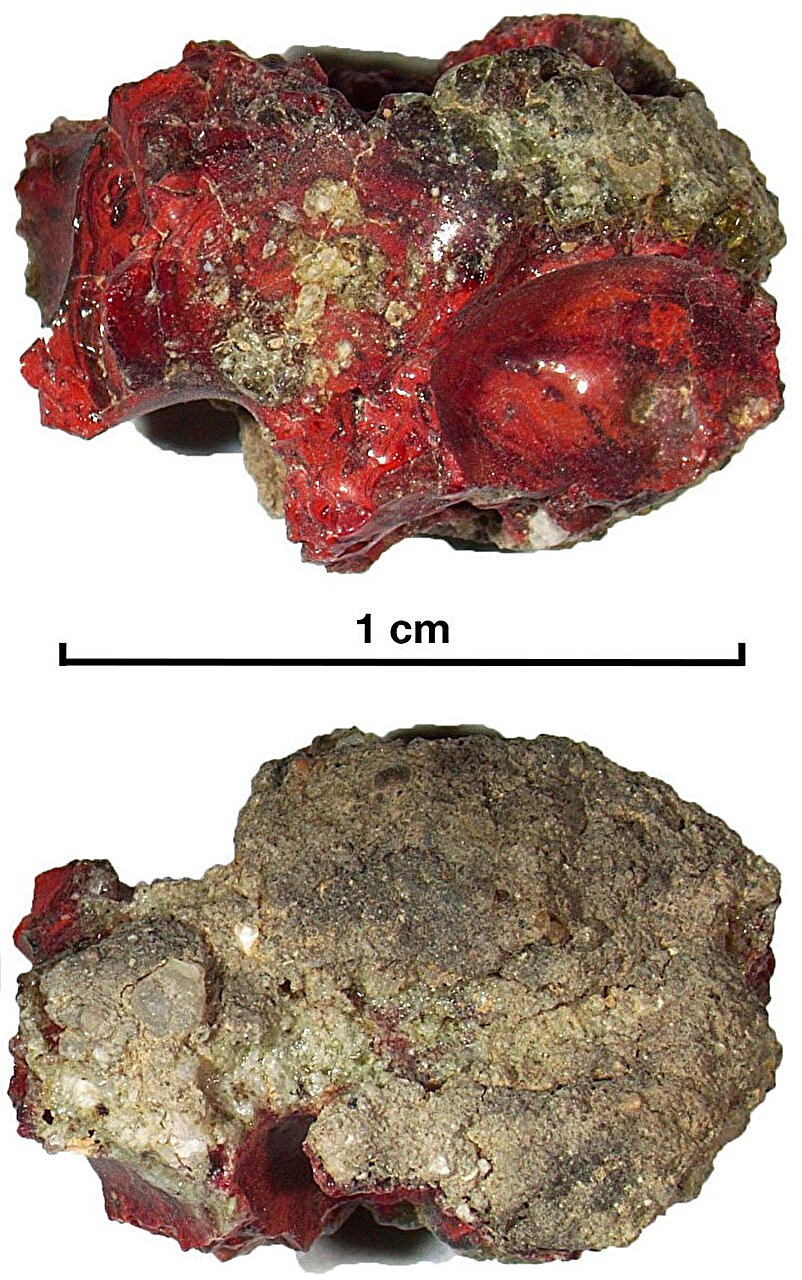
As the fireball cooled rapidly, the melted material solidified into a glass-like substance known as trinitite.
Most trinitite appears green, but scientists have long known about a rarer variety called red trinitite. This red form is enriched in metals that came from the vaporized tower and equipment used in the test, including coaxial cables and recording instruments.
The researchers focused their investigation on metallic droplets trapped inside this red trinitite, which they describe as chemically unusual due to the chaotic environment created during the detonation.
As the authors write, systematic analysis revealed “a range of unusual phases,” reflecting the unique chemistry produced during the explosion.
A clathrate crystal appears where no one expected it
To analyze the red trinitite, the team used electron microprobe analyses and X-ray diffraction, allowing them to study the chemistry and structure of the microscopic phases inside the material.
Inside a copper-rich metal droplet, they detected something unexpected: a small amount of clathrate, a crystal compound defined by a lattice structure that traps atoms or molecules inside cage-like frameworks.
The newly discovered compound contained silicon, calcium, copper, and a small amount of iron, with the measured composition Si85Ca12Cu2Fe1. Structurally, it was identified as a cubic type-I clathrate, with its cage-like framework holding a calcium atom at the center.
The researchers emphasize that this is the first crystallographically confirmed clathrate ever identified among the solid products of a nuclear explosion.
In their words, the clathrate’s “structure, composition, and metastable character” reflect formation under extreme pressure-temperature conditions that are essentially impossible to reproduce through equilibrium laboratory synthesis.
The discovery also sheds light on Trinity’s mysterious quasicrystal
The finding becomes even more intriguing because it connects to an earlier mystery buried in red trinitite.
Previous work had identified a silicon-rich icosahedral quasicrystal in a copper-rich portion of the same material. However, its precise origins and exact structure remained uncertain, partly due to how rare and difficult it is to handle.
The new clathrate discovery immediately raised a key scientific question: could the quasicrystal and the clathrate be structurally related?
The researchers noted several similarities. Both appeared inside Cu-rich metallic droplets, both formed under the same extreme detonation conditions, and both shared a silicon-rich chemistry in the Ca–Cu–Si–(Fe) system.
Because all of these elements are commonly found in desert sand or in the metallic tower infrastructure, the team concluded that both phases were almost certainly formed during the blast itself.
DFT calculations reveal why the clathrate and quasicrystal diverge
To test whether the clathrate could be a structural cousin—or even a foundation—for the Trinity quasicrystal, the researchers ran density functional theory (DFT) calculations. These calculations allowed them to evaluate the stability of different structural models and examine what happens as copper levels increase.
Their results revealed a clear boundary.
The team found that clathrate-derived structures remained stable only when copper levels stayed low, around 10–11%. However, the Trinity quasicrystal appears to contain much higher copper levels, around 21%.
When the models were pushed toward these higher copper concentrations, the clathrate structure became unstable. The simulations showed a breakdown of clathrate topology and a shift toward amorphization, meaning the structure essentially loses its ordered crystalline form.
In short, even though the clathrate and quasicrystal likely formed from similar starting materials in the same detonation environment, their internal atomic architectures diverged because of different copper concentrations.
This finding allowed the researchers to rule out what might have been the simplest explanation—that the quasicrystal could be interpreted as a direct extension of clathrate-type structures.
A rare natural laboratory created a crystal that labs can’t easily replicate
The researchers describe both the clathrate and the quasicrystal as metastable, meaning they form under extreme conditions but are not necessarily stable over long timescales under normal equilibrium processes.
That metastability is one reason these materials are so hard to reproduce experimentally. The Trinity blast created an environment of rapidly changing temperature, pressure, and chemistry—conditions that typical laboratory synthesis methods cannot easily mimic.
Even now, the Trinity quasicrystal remains unresolved in detail, largely because the sample is extremely limited and difficult to study due to its value and handling risks.
Still, the new clathrate discovery offers an important step forward. It helps narrow down which structural models are plausible for the quasicrystal and which are not.
As the researchers conclude, the results “rule out a simple clathrate-based structural interpretation” for the Trinity quasicrystal and reinforce the idea that multiple distinct silicon-rich phases can emerge under detonation-level extremes.
Why This Matters
This discovery confirms that nuclear detonations can generate crystalline structures never before observed in nature or laboratory materials science. The identification of a Ca–Cu–Si type-I clathrate inside Trinity red trinitite expands the known range of matter produced by short-lived high-energy events.
More broadly, the study highlights how rare phenomena—including nuclear detonations, lightning strikes, and hypervelocity impacts—can act as natural laboratories for producing unexpected solid forms. These environments create pressure-temperature conditions beyond what conventional synthesis can achieve, offering scientists rare opportunities to test theories of crystal stability and formation.
Eighty years after Trinity, its remnants are still yielding new scientific insights—showing that even a single extreme event can leave behind physical evidence that challenges what researchers thought was possible in solid-state chemistry.
Study Details
Luca Bindi et al, Extreme nonequilibrium synthesis of a Ca–Cu–Si clathrate during the Trinity nuclear test, Proceedings of the National Academy of Sciences (2026). DOI: 10.1073/pnas.2604165123