Every second of every day, an extraordinary process unfolds inside your body. While you read these words, millions of cells are dividing. Some are replacing worn-out skin cells. Others are repairing tiny injuries you don’t even notice. Deep inside your bones, new blood cells are being produced. Your hair continues to grow, your intestines constantly renew their lining, and your immune system creates fresh defenders to protect you from disease.
Life depends on cell division.
Without it, no plant could grow from a tiny seed, no animal could heal after an injury, and no human baby could develop from a single fertilized egg into a complex body made of trillions of cells.
But not all cell division is the same.
Nature uses two remarkable methods of dividing cells: mitosis and meiosis. At first glance, they seem similar because both involve one cell dividing into new cells. However, their purposes, outcomes, and biological significance are dramatically different.
Mitosis creates cells that are genetically identical to the original cell. It allows organisms to grow, repair damaged tissues, and replace aging cells throughout life.
Meiosis, on the other hand, creates reproductive cells—sperm and eggs in animals, or spores in many plants and fungi. This process does something extraordinary: it cuts the chromosome number in half while creating new genetic combinations that make every individual unique.
Together, mitosis and meiosis make life possible. One keeps organisms alive and healthy. The other allows species to reproduce, evolve, and survive across generations.
Understanding these two processes is one of the foundations of biology. Whether you are learning about genetics, evolution, medicine, agriculture, or biotechnology, mitosis and meiosis explain how living organisms grow, reproduce, and pass on inherited traits.
What Is Cell Division?
Cells are the basic structural and functional units of life. Every living organism is made of cells, from tiny bacteria consisting of just one cell to humans, whose bodies contain tens of trillions of cells.
Cells do not live forever.
They become old, damaged, or simply wear out through normal use. To keep an organism alive, new cells must replace old ones.
The process through which one parent cell divides to produce new cells is called cell division.
Cell division serves several important purposes.
It allows multicellular organisms to grow from a single fertilized egg into fully developed adults. It repairs damaged tissues after injuries. It replaces dead or aging cells. It also enables reproduction in many organisms.
Scientists recognize two major types of cell division in eukaryotic organisms:
Mitosis, which produces body cells.
Meiosis, which produces reproductive cells.
Although both begin with one parent cell, their goals and results are completely different.
Understanding Chromosomes
Before exploring mitosis and meiosis, it is important to understand chromosomes.
Inside nearly every cell is a nucleus containing DNA, the molecule that stores genetic information.
DNA is packaged into thread-like structures called chromosomes.
Chromosomes carry thousands of genes, which contain the instructions for building and maintaining an organism.
Humans normally have 46 chromosomes arranged into 23 pairs.
One chromosome in each pair comes from the mother.
The other comes from the father.
These paired chromosomes are called homologous chromosomes.
Maintaining the correct number of chromosomes is essential.
Too many or too few chromosomes can cause serious developmental disorders or prevent normal development altogether.
One major purpose of cell division is ensuring chromosomes are distributed correctly.
What Is Mitosis?
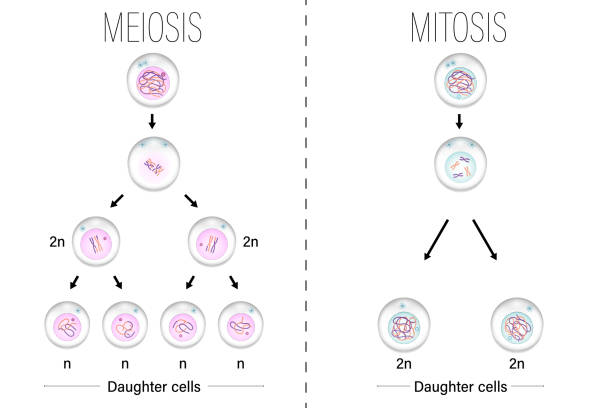
Mitosis is a type of cell division that produces two genetically identical daughter cells.
Each new cell receives an exact copy of the parent cell’s chromosomes.
If the parent cell contains 46 chromosomes, each daughter cell also receives 46 chromosomes.
Mitosis occurs in somatic cells, commonly called body cells.
These include skin cells, muscle cells, liver cells, bone cells, nerve-supporting cells, and countless others.
Because mitosis produces identical cells, it maintains genetic stability throughout the body.
Every new skin cell contains essentially the same genetic instructions as the skin cell from which it came.
Why Mitosis Is Important
Life would be impossible without mitosis.
Human development begins as a single fertilized egg.
That one cell divides repeatedly through mitosis until it forms trillions of specialized cells making up the entire body.
After birth, mitosis continues throughout life.
When you scrape your knee, mitosis replaces damaged skin.
When blood cells wear out, mitosis helps produce replacements.
When your hair grows, mitosis supplies new cells.
When your bones heal after a fracture, mitosis contributes to tissue repair.
Even organs constantly replace many of their cells through mitotic division.
Without mitosis, growth, healing, and maintenance could not occur.
The Cell Cycle Before Mitosis
Cells do not divide continuously.
Instead, they pass through a carefully regulated sequence known as the cell cycle.
Most of a cell’s life occurs during interphase.
Although many people think interphase is a resting stage, the cell is actually extremely active.
During this period, the cell grows larger, carries out normal functions, produces proteins, and duplicates its DNA.
DNA replication is especially important.
Each chromosome makes an identical copy of itself.
These identical copies are called sister chromatids.
They remain attached at a region called the centromere.
Only after DNA replication is complete does mitosis begin.
The Stages of Mitosis
Mitosis occurs through several carefully coordinated stages. Each stage ensures that chromosomes are copied accurately and distributed equally.
Prophase
Prophase marks the beginning of mitosis.
The chromosomes condense, becoming shorter, thicker, and easier to see under a microscope.
Each chromosome now consists of two identical sister chromatids joined together.
The nuclear envelope surrounding the nucleus begins to break down.
Meanwhile, structures called centrosomes move toward opposite ends of the cell.
These organize spindle fibers, tiny protein structures that will guide chromosome movement.
Prometaphase
As the nuclear envelope disappears completely, spindle fibers gain access to the chromosomes.
Special protein structures called kinetochores form at each chromosome’s centromere.
Spindle fibers attach to these kinetochores.
This connection allows the spindle apparatus to move chromosomes precisely.
Metaphase
During metaphase, chromosomes line up along the center of the cell.
This central region is known as the metaphase plate.
Although it appears simple, this alignment is critical.
Each chromosome must attach correctly to spindle fibers extending from opposite poles.
Cells contain surveillance mechanisms that verify proper attachment before division continues.
Anaphase
Anaphase begins when the sister chromatids separate.
Each chromatid becomes an individual chromosome.
Spindle fibers shorten, pulling chromosomes toward opposite ends of the cell.
The movement is highly coordinated, ensuring each new cell receives one complete copy of every chromosome.
Telophase
Once chromosomes reach opposite poles, telophase begins.
New nuclear envelopes form around each chromosome set.
Chromosomes gradually uncoil, returning to their less condensed form.
The spindle apparatus breaks down.
Two new nuclei now exist within one cell.
Cytokinesis
Although technically separate from mitosis itself, cytokinesis usually occurs immediately afterward.
During cytokinesis, the cytoplasm divides.
In animal cells, the cell membrane pinches inward until two separate daughter cells form.
Plant cells cannot pinch inward because of their rigid cell walls.
Instead, they build a new cell wall between the two daughter cells.
The result is two genetically identical cells.
The Outcome of Mitosis
The outcome of mitosis is straightforward.
One parent cell produces two daughter cells.
Each daughter cell contains the same chromosome number as the parent.
In humans:
Parent cell: 46 chromosomes
Daughter cell: 46 chromosomes
Second daughter cell: 46 chromosomes
Genetically, these cells are nearly identical except for occasional mutations that may arise naturally.
What Is Meiosis?
Meiosis is a specialized type of cell division that produces reproductive cells, known as gametes.
In humans, these gametes are sperm and egg cells.
Unlike mitosis, meiosis reduces the chromosome number by half.
Human body cells contain 46 chromosomes.
Human sperm and egg cells contain only 23 chromosomes.
This reduction is essential.
When fertilization occurs, the sperm contributes 23 chromosomes and the egg contributes another 23.
Together they restore the normal chromosome number of 46.
Without meiosis, chromosome numbers would double every generation.
Why Meiosis Is Necessary
Imagine if sperm and egg cells each contained 46 chromosomes.
After fertilization, the embryo would have 92 chromosomes.
The next generation would have 184.
The following generation would have 368.
Within only a few generations, chromosome numbers would become impossibly large.
Meiosis prevents this problem by halving chromosome numbers before fertilization.
Equally important, meiosis generates genetic diversity.
Every sperm and egg is genetically unique.
This variation explains why siblings usually resemble one another yet remain genetically different.
Where Meiosis Occurs
Meiosis occurs only in specialized reproductive organs.
In males, meiosis takes place within the testes, producing sperm.
In females, meiosis occurs within the ovaries, producing eggs.
Most body cells never undergo meiosis.
Instead, they continue dividing through mitosis whenever replacement or repair is needed.
Meiosis Involves Two Divisions
Unlike mitosis, which requires only one division, meiosis includes two successive divisions.
These are called Meiosis I and Meiosis II.
DNA replicates only once before Meiosis I begins.
No DNA replication occurs between Meiosis I and Meiosis II.
This unique arrangement allows chromosome numbers to be reduced by half.
Meiosis I
The first meiotic division is sometimes called the reduction division because chromosome numbers are halved.
Prophase I
Prophase I is the longest and most complex stage of meiosis.
Homologous chromosomes pair together.
This pairing is called synapsis.
While paired, homologous chromosomes exchange segments of DNA through a process called crossing over.
Crossing over creates entirely new genetic combinations.
It is one of the most important sources of genetic diversity.
Metaphase I
Homologous chromosome pairs align at the center of the cell.
Unlike mitosis, chromosomes line up as pairs rather than individually.
The orientation of each pair occurs randomly.
This random arrangement contributes to another source of genetic variation called independent assortment.
Anaphase I
Homologous chromosomes separate and move toward opposite poles.
Unlike mitosis, sister chromatids remain attached.
Only chromosome pairs separate.
This reduces chromosome number by half.
Telophase I and Cytokinesis
New nuclei may briefly form.
The cell divides into two daughter cells.
Each contains half the original chromosome number.
However, every chromosome still consists of two sister chromatids.
Meiosis II
Meiosis II resembles mitosis in several ways.
Its purpose is separating sister chromatids.
Prophase II
Chromosomes condense again if necessary.
Spindle fibers form.
Nuclear envelopes break down.
Metaphase II
Chromosomes line up individually at the cell’s center.
Anaphase II
Sister chromatids separate.
Each chromatid becomes an individual chromosome.
They move toward opposite poles.
Telophase II and Cytokinesis
New nuclei form.
The cytoplasm divides.
Ultimately, four daughter cells are produced.
Each contains half the chromosome number of the original parent cell.
The Outcome of Meiosis
The final result differs dramatically from mitosis.
One parent cell produces four daughter cells.
Each daughter cell contains half the original chromosome number.
In humans:
Parent cell: 46 chromosomes
Four daughter cells: 23 chromosomes each
Unlike mitosis, these cells are genetically different from one another.
Crossing Over
Crossing over is one of meiosis’ most remarkable features.
During Prophase I, paired homologous chromosomes exchange DNA segments.
Imagine two similar instruction books exchanging chapters.
The resulting chromosomes contain new combinations of genetic information.
Crossing over greatly increases genetic diversity.
Every human carries unique combinations of genes inherited from both parents because of this process.
Independent Assortment
Independent assortment creates even more diversity.
When chromosome pairs line up during Metaphase I, each pair’s orientation is random.
Humans possess 23 chromosome pairs.
This random arrangement alone allows over eight million possible chromosome combinations before crossing over is even considered.
When crossing over is included, the number of possible genetic combinations becomes astronomically large.
Genetic Diversity
Genetic diversity is one of biology’s greatest strengths.
Because every reproductive cell differs genetically, offspring inherit unique gene combinations.
Some individuals inherit traits that improve survival under changing environmental conditions.
Natural selection acts upon this diversity.
Without meiosis creating genetic variation, evolution would occur much more slowly.
Every unique human face, fingerprint, personality, and combination of inherited traits ultimately depends upon meiosis.
Comparing Mitosis and Meiosis
Although mitosis and meiosis share certain similarities, they differ fundamentally.
Both begin with DNA replication.
Both use spindle fibers.
Both move chromosomes carefully.
Both require precise regulation.
However, their purposes differ completely.
Mitosis supports growth, repair, and maintenance.
Meiosis supports reproduction and genetic diversity.
Mitosis produces two identical cells.
Meiosis produces four genetically unique cells.
Mitosis maintains chromosome number.
Meiosis halves chromosome number.
These differences make each process essential for life.
Errors During Cell Division
Cell division is remarkably accurate but not perfect.
Mistakes occasionally occur.
During mitosis, errors may produce abnormal cells.
Most are corrected or eliminated by the body’s quality-control systems.
If mistakes escape detection, they may contribute to diseases such as cancer.
Cancer develops when cells divide uncontrollably due to accumulated genetic changes affecting cell-cycle regulation.
Errors during meiosis can also occur.
Sometimes chromosomes fail to separate correctly.
This problem, called nondisjunction, produces reproductive cells containing abnormal chromosome numbers.
If such cells participate in fertilization, genetic disorders may result.
For example, Down syndrome usually results from an extra copy of chromosome 21 caused by nondisjunction during meiosis.
Mitosis in Plants
Plants rely heavily on mitosis.
Growth occurs primarily in specialized tissues called meristems.
Root tips lengthen through continuous mitotic division.
Shoot tips produce stems, leaves, flowers, and branches.
Many plants also reproduce asexually through mitosis.
A cutting taken from one plant can develop into an entirely new genetically identical individual.
This remarkable ability allows gardeners and farmers to propagate valuable plant varieties.
Meiosis in Plants
Plants also undergo meiosis, although their life cycle differs somewhat from that of animals.
Meiosis produces spores rather than sperm and eggs directly.
These spores eventually develop into structures producing reproductive cells.
Despite these differences, meiosis still reduces chromosome numbers and creates genetic diversity.
Why Scientists Study Mitosis and Meiosis
Understanding cell division has transformed medicine and biology.
Cancer treatments often target rapidly dividing cells.
Genetic counseling relies upon knowledge of meiosis.
Plant breeders develop improved crops using principles of heredity.
Biotechnology uses cell division in tissue culture, cloning, and genetic research.
Stem cell research depends upon understanding mitotic control.
Modern genetics, reproductive medicine, developmental biology, and evolutionary biology all rely upon the principles established by studying these two forms of cell division.
Common Misconceptions
One common misconception is that mitosis and meiosis are nearly identical.
Although they share certain mechanisms, their biological purposes are entirely different.
Another misconception is that meiosis occurs throughout the body.
In reality, it is limited to specialized reproductive tissues.
Some people also believe mitosis always creates perfect copies.
While it is highly accurate, occasional mutations naturally occur during DNA replication.
Finally, some assume genetic diversity results only from mutations.
In fact, meiosis itself generates enormous diversity through crossing over and independent assortment even without new mutations.
Conclusion
Mitosis and meiosis are two of the most important biological processes on Earth. Every multicellular organism depends on them, yet each serves a completely different purpose. Mitosis allows organisms to grow, repair damaged tissues, replace aging cells, and maintain healthy bodies throughout life. By producing two genetically identical daughter cells, it preserves the stability of an organism’s genetic information and ensures that every new body cell carries the instructions needed to perform its specific functions.
Meiosis, in contrast, makes sexual reproduction possible. Through two carefully coordinated rounds of cell division, it reduces the chromosome number by half and creates four genetically unique reproductive cells. Its remarkable processes of crossing over and independent assortment generate the genetic diversity that makes every individual unique and provides the variation on which evolution depends. Without meiosis, species could not reproduce normally, adapt to changing environments, or evolve over time.
Although they differ in purpose, outcome, and complexity, mitosis and meiosis work together to sustain life across generations. Mitosis keeps individuals alive, healthy, and growing. Meiosis ensures that life continues beyond one generation while constantly introducing new combinations of genetic traits. Together, they represent one of nature’s most elegant solutions to the challenges of growth, repair, reproduction, and survival.
Every scar that heals, every child that is born, every flower that blooms, and every living organism on Earth exists because these two extraordinary forms of cell division have been faithfully carrying out their work for hundreds of millions of years. Understanding mitosis and meiosis not only reveals how life functions at the cellular level but also helps us appreciate the incredible precision, complexity, and beauty of the biological world.