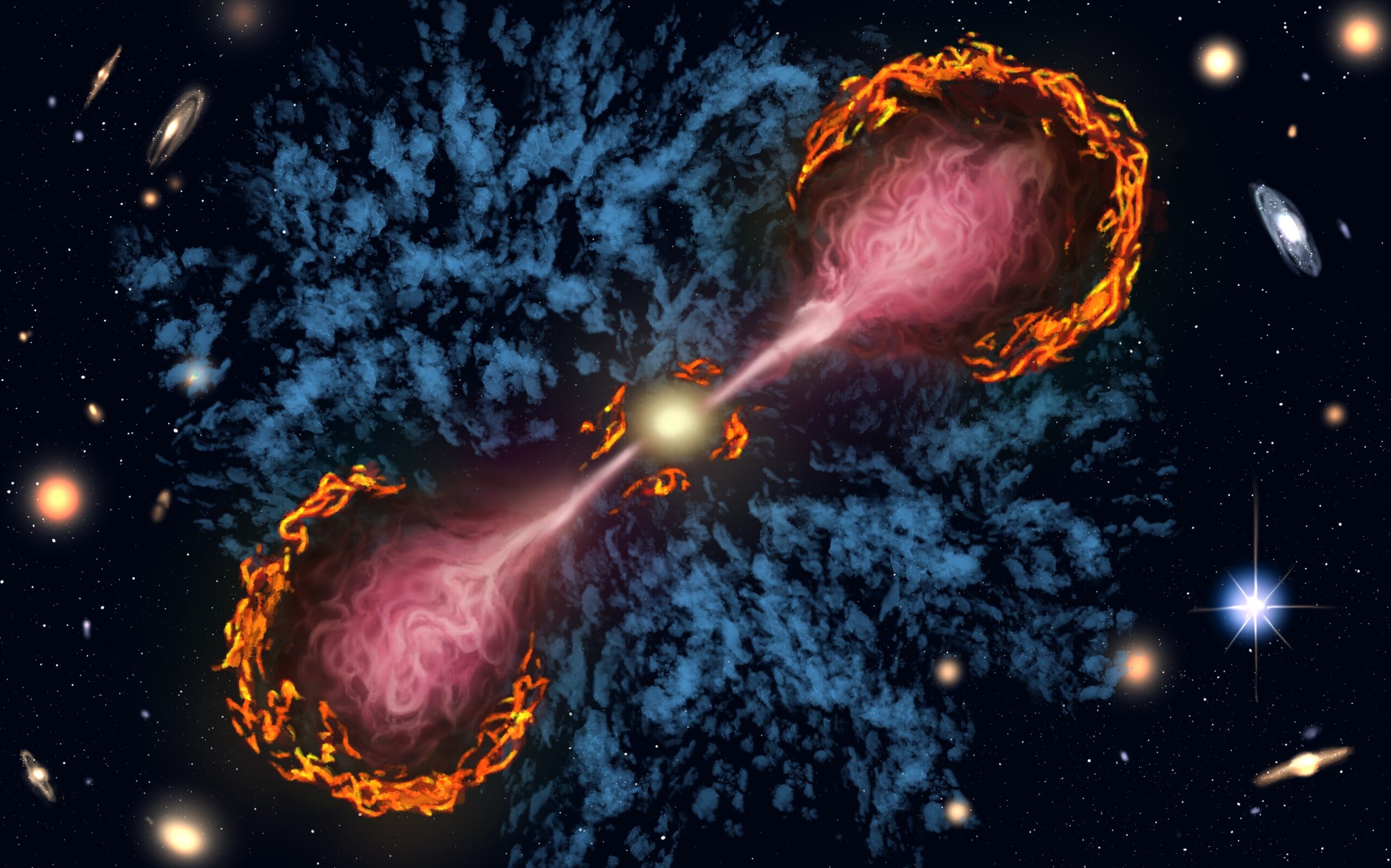
Gas surrounding radio galaxies does not glow evenly across their halos. Instead, faint Hα emission from cool, ionized gas becomes dramatically stronger along the narrow directions traced by the galaxies’ radio jets, while the same gas leaves little detectable Hα signal when viewed across all directions.
The result comes from a search for extremely faint emission from the circumgalactic medium, or CGM, the gas surrounding galaxies. The study focused on radio galaxies, whose central supermassive black holes launch large-scale radio jets that can extend far beyond the host galaxy.
The researchers wanted to determine whether those jets affect the relatively cool component of the CGM, with temperatures around 10,000 kelvin. Previous observations have established that radio jets can deposit energy into much hotter gas, particularly in galaxy groups and clusters, but it has been less clear how that energy interacts with cool gas farther from the galaxy.
To look for the faint signal, the researchers combined optical spectra from the Dark Energy Spectroscopic Instrument, or DESI, with radio images from the LOFAR Two-meter Sky Survey. They identified background quasars whose sight lines pass through the projected halos of foreground radio galaxies. Because each quasar provides a spectrum along a different line of sight, the collection of spectra can be used to search statistically for extremely faint emission or absorption associated with the foreground galaxies.
The final sample contained 324 radio galaxy–quasar pairs. The foreground radio galaxies span redshifts from 0.05 to 1.64, with projected quasar sight lines ranging from roughly 20 to 800 kiloparsecs from the galaxy centers.
Crucially, the researchers did not simply combine all of the spectra together. They measured the angle between each quasar sight line and the projected radio-jet axis of its foreground galaxy.
That allowed them to ask whether the CGM behaves differently along the direction in which the jet travels.
Of the 324 sight lines, 74 lay within 20 degrees of the projected radio axis. Those jet-aligned sight lines produced a strong Hα signal, with a mean integrated flux of 1.19 × 10⁻¹⁷ erg cm⁻² s⁻¹. The signal exceeded the noise baseline by more than 5 standard deviations.
The result changed sharply with angle. Sight lines 20 to 40 degrees from the radio axis, and those more than 40 degrees away, did not show a comparable Hα feature.
The contrast became even more striking when all 324 sight lines were combined without regard to their angle. In that azimuthally averaged stack, the Hα signal was not statistically significant, with an integrated significance below 2σ.
In other words, averaging over the entire halo largely erased the signal that was obvious when the spectra were restricted to the jet direction.
The emission peaks in two regions along the jets
The Hα emission was not distributed uniformly even among the jet-aligned sight lines.
The researchers divided the 74 near-axis sight lines according to their projected distance from the galaxy, scaled to the half-length of the radio structure. The strongest emission occurred relatively close to the host, beyond the galaxy’s optical half-light radius. There, the integrated Hα flux reached 3.46 × 10⁻¹⁷ erg cm⁻² s⁻¹, with a detection significance greater than 7σ.
The signal became weaker at intermediate distances.
Farther out, near the projected radio-lobe region, the Hα emission rose again. Sight lines beyond the radio half-size had a mean integrated flux of 1.31 × 10⁻¹⁷ erg cm⁻² s⁻¹.
The authors interpret these two regions as possible locations where the jet couples particularly strongly to surrounding gas. Close to the galaxy, the jet encounters material near the transition between the interstellar medium and the inner CGM. Farther out, the rising emission could come from gas near the interface between the expanding radio lobe or cocoon and the surrounding halo.
The observations themselves establish the radial pattern, but not the precise physical process producing it.
The authors consider several possibilities. A jet could compress pre-existing cool clouds, ionize them through shocks, create turbulent mixing layers, or alter their density and pressure. Some gas could also be carried outward by the flow rather than simply being illuminated or compressed in place.
The Hα emission alone cannot distinguish among these mechanisms.
The jet-aligned signal stands out from ordinary galaxy halos
The researchers also compared their measurements with previous stacked Hα observations of non-AGN, star-forming galaxies and galaxy systems.
When the radio-galaxy sight lines were averaged over all directions, the resulting Hα level was consistent with the range measured for normal massive galaxy halos. Because the all-angle radio-galaxy stack was formally a nondetection, that measurement is treated as an upper limit.
The picture changed when only sight lines within 20 degrees of the radio axis were considered. Their Hα surface brightness was elevated by roughly one to two orders of magnitude relative to the comparison measurements at similar stellar masses.
The authors therefore argue that the result does not indicate that radio galaxies simply contain a globally larger reservoir of Hα-emitting gas. Instead, the enhancement is concentrated in particular directions.
That distinction is important because Hα emission depends strongly on the physical state of the gas. The authors note that recombination-line emissivity scales approximately with the square of the electron density. A relatively small number of clouds that become denser or more highly ionized can therefore become much brighter in Hα without requiring a corresponding increase in the total amount of cool gas throughout the halo.
The observations provide a way to test whether that interpretation is consistent with another tracer of cool halo gas.
Mg II tells a different story
For the same background-quasar sight lines, the researchers searched for absorption from singly ionized magnesium, Mg II. Unlike Hα emission, which is sensitive to the emissivity of ionized gas, Mg II absorption provides information about cool, metal-enriched clouds along the line of sight.
The Mg II analysis used the subset of galaxy–quasar pairs at redshifts between 0.30 and 0.49, with a median foreground-galaxy redshift of 0.38. An absorber was counted when the Mg II λ2796 line had a rest-frame equivalent width of at least 0.3 angstrom at approximately 3σ significance.
The incidence of Mg II absorption was 21.6% along jet-aligned sight lines and 16.0% along off-axis sight lines. A two-sided proportion test gave p = 0.24 and z = 1.17, so the difference was not statistically significant.
The individual absorbers also did not show a clear distinction between the two directions. Their equivalent widths, apparent-optical-depth column densities and fitted line widths were broadly similar for jet-aligned and off-axis sight lines. The study likewise found no clear systematic change in those quantities with normalized distance along the radio structures.
That contrast with Hα is central to the authors’ interpretation.
If the radio jets were simply creating an entirely separate population of cool gas concentrated along their paths, a stronger directional difference might also be expected in Mg II absorption. Instead, Mg II-bearing clouds appear across a broad range of directions.
Individual Mg II absorbers occur at projected distances extending beyond about 100 kiloparsecs. Yet the stacked Mg II signal is weak, with several radial bins producing only upper limits. The authors describe the resulting cool phase as extended and clumpy, with a low covering fraction rather than a smooth, uniformly filled halo.
The combination of the two tracers suggests a more specific picture: cool clouds may already be distributed throughout the halo, while the radio jet makes a subset of those clouds much brighter in Hα.
The authors propose that the jet could increase the density, pressure or ionization state of clouds in its path. Because Hα emissivity is highly sensitive to density, that local change could produce a large emission signal without substantially changing the overall incidence of Mg II absorption.
The paper also leaves open the possibility that some gas is entrained outward from the inner galaxy or CGM. However, the lack of a clear enhancement in Mg II velocity widths or velocity offsets along the jet direction is described as favoring local brightening or ionization of pre-existing clouds over a picture dominated entirely by entrained material.
The signal survives several tests for artifacts
Because the Hα emission is so faint, the researchers performed several checks to determine whether the directional signal could result from a small number of unusual spectra or from residual problems in the quasar data.
Removing individual high-weight spectra one at a time changed the integrated flux by only about 4%–7%, while the detection significance remained above 4.7σ.
The signal was also absent when the same procedure was applied to randomized foreground-galaxy redshifts. It could not be reproduced by stacking nearby blank spectral regions.
For the main measurement, each quasar spectrum was shifted into the rest frame of its foreground radio galaxy. The researchers extracted a 300-angstrom-wide window around Hα, removed a locally fitted second-order continuum, masked projected quasar emission lines and combined the spectra using inverse-variance weighting.
They measured Hα within 500 km s⁻¹ of the expected line center. This narrower window was chosen in part to reduce contamination from nearby [N II] emission.
The shape of the full stacked feature requires more caution than its integrated flux. The profile has a broad, asymmetric extension toward positive velocities. In particular, [N II] λ6583 lies about 941 km s⁻¹ to the red of Hα and can remain blended with the signal.
The apparent velocity width of more than 2,000 km s⁻¹ could also result from combining sight lines with different velocity offsets, uncertainties in foreground-galaxy redshifts and differing cloud motions. Physical broadening caused by disturbed gas is another possibility, but the authors say that detailed kinematic characterization requires further observations.
A relatively small energy requirement
The measured Hα emission corresponds to a characteristic luminosity of about 2.2 × 10⁴⁰ erg s⁻¹ for the jet-aligned sample.
Using Case B recombination and an assumed electron density of 10⁻² cm⁻³, the authors estimate an ionized-gas mass of about 7 × 10⁹ solar masses. That density is motivated by approximate pressure balance between 10⁴-kelvin cool clouds and a hotter halo at around 10⁶ K.
The mass estimate is therefore dependent on the assumed density rather than being a direct measurement of the total cool-gas mass.
The radio galaxies have inferred jet mechanical powers ranging from about 10⁴².² to 10⁴⁵.⁵ erg s⁻¹. For a characteristic jet power of about 10⁴³.⁵ erg s⁻¹, the Hα luminosity represents only about 6 × 10⁻⁴ of the available mechanical power.
That means the observed Hα radiation could be produced if only a small fraction of the jet’s mechanical energy ultimately emerges through this particular cool, ionized phase.
The authors stress that Hα traces only gas around 10⁴ K. Other portions of the jet’s energy may reside as kinetic or thermal energy in other phases, including much hotter gas.
The energetics therefore support a jet-powered interpretation, but they do not by themselves identify the mechanism responsible for the Hα emission. The authors explicitly list AGN photoionization, shock ionization, turbulent mixing and collisional excitation in cooling gas as possible contributors.
A simulated galaxy shows a similar pattern
The study also examines a representative jet-mode galaxy from the SIMBA cosmological hydrodynamic simulation.
The simulated galaxy has a stellar mass of log(M*/M☉) = 10.6, a black-hole mass of log(MBH/M☉) = 7.6 and a virial radius of 208 kiloparsecs. The researchers constructed a mock Hα surface-brightness map using gas properties from the simulation and a CLOUDY photoionization-plus-recombination calculation.
Viewed edge-on to its jet, the simulated galaxy also produced an anisotropic Hα distribution. The area-averaged surface brightness was highest within 20 degrees of the projected jet axis and declined toward larger angles. The values were approximately 2.5, 2.2 and 1.6 × 10⁻²⁰ erg s⁻¹ cm⁻² arcsec⁻² in the three angular bins.
The simulated emission was highly uneven from pixel to pixel. The mean surface brightness exceeded the median, indicating that a relatively small number of bright regions contributed disproportionately to the average.
That behavior qualitatively resembles the observational result, in which a small fraction of sight lines aligned with the jet produce a strong mean Hα signal while the all-angle stack remains undetected.
But the simulation is not a quantitative reproduction of the observed galaxies. The simulated Hα surface brightness is approximately three orders of magnitude lower than the observed values. The authors interpret this discrepancy as evidence that photoionization by the metagalactic ultraviolet background alone cannot account for the observed emission and that an additional energetic source associated with the radio activity is required.
They also emphasize that the simulation contains only one representative jet-mode galaxy for this comparison. It is intended as an example of the qualitative behavior rather than a one-to-one model of the observed sample.
The study ultimately leaves the detailed mechanism unresolved. The observations establish a strong directional association between radio-jet geometry and Hα emission from cool halo gas, while the Mg II measurements indicate that cool clouds themselves are more broadly distributed. The authors favor a picture in which radio jets locally alter a subset of those pre-existing clouds, but distinguishing compression, ionization, shocks, turbulent mixing and entrainment will require more detailed observations and simulations.
The study was published in The Astrophysical Journal Letters.