Ancient people traveled by walking, riding animals, driving carts, sailing rivers, and crossing seas in boats and ships. Their journeys depended on the landscape, available technology, weather, and purpose of travel. A farmer might walk to a nearby market, a merchant might transport goods by donkey across a dry plateau, and a sailor might carry cargo between distant ports using seasonal winds. Long-distance travel was possible long before engines, railways, or paved highways, but it required careful planning and a practical understanding of the natural world.
Transportation in the ancient world was not simply a matter of getting from one place to another. It shaped the growth of cities, the spread of ideas, the movement of armies, and the exchange of food, metals, textiles, and other resources. Roads connected communities across land, ships linked distant coastlines, horses made certain journeys faster, and trade routes created networks that tied entire regions together.
Walking was the foundation of ancient travel
For most people in the ancient world, walking was the most common form of transportation. Human beings could travel across a wide range of environments without specialized equipment, making walking especially useful for short journeys, seasonal migrations, hunting, gathering, and trips to nearby settlements.
The distance a person could cover depended on terrain, climate, physical condition, and the weight of any belongings. A traveler carrying food, water, tools, or merchandise moved differently from someone traveling without a load. Mountains, dense forests, deserts, and flooded plains could turn an otherwise manageable journey into a serious challenge.
People often followed familiar paths rather than traveling in straight lines. Routes developed around rivers, valleys, natural passes, and reliable sources of water. A longer route through level terrain might be safer and faster than a shorter one over steep mountains or through thick vegetation.
Walking also allowed people to transport modest amounts of goods using baskets, bundles, and simple carrying frames. For larger loads, however, humans increasingly relied on domesticated animals and wheeled vehicles. These alternatives reduced some physical demands, although they introduced new requirements for food, water, equipment, and suitable terrain.
Rivers and coastlines provided natural transportation corridors
Waterways were among the most useful transportation routes in the ancient world. Rivers could connect inland communities with fertile agricultural regions, coastal settlements, and major trading centers. Boats often carried heavier loads more efficiently than people or pack animals traveling over rough ground.
Rivers offered particular advantages because moving goods by water generally required less effort per unit of cargo than hauling them overland. Timber, grain, stone, pottery, and other heavy materials could be transported in quantities that would have been difficult to move using human labor alone.
However, rivers were not simple, uninterrupted highways. Currents, rapids, shallow stretches, seasonal flooding, and changing water levels affected navigation. Traveling downstream could be easier than moving upstream, sometimes requiring paddling, rowing, towing from the bank, or sailing where conditions permitted. Boats also needed suitable places to load, unload, and shelter.
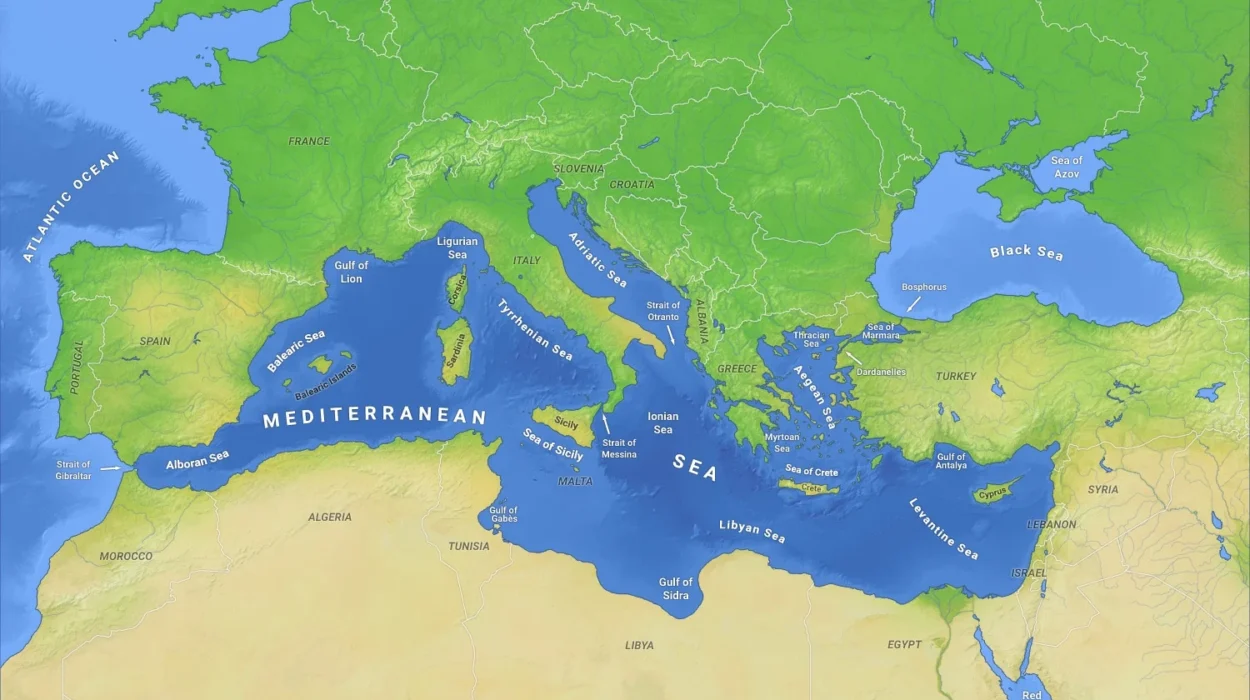
Coastlines created another set of opportunities. Communities separated by difficult land routes could exchange goods by traveling along the shore. Coastal navigation allowed sailors to move between ports while keeping land within sight, reducing some of the risks associated with crossing open water.
Water transportation helped cities grow because it made it possible to bring in food, building materials, and other supplies from beyond their immediate surroundings. Settlements with access to navigable rivers or protected harbors could develop into important centers of commerce and political power.
Ancient ships used wind, muscle, and practical knowledge
Ancient ships ranged from small wooden boats to large cargo vessels capable of carrying substantial loads across the sea. Their designs varied according to the waters they traveled, the materials available to shipbuilders, and the tasks they needed to perform.
Many early boats were constructed from reeds, hollowed logs, or simple wooden frameworks. As woodworking and shipbuilding developed, builders created stronger hulls that could carry heavier cargo and survive longer voyages. The shape of a hull influenced how a vessel moved through water, how much it could carry, and how it responded to waves.
Ships were propelled by paddles, oars, sails, or combinations of these methods. Oars provided direct control over movement, making them useful when winds were weak, when maneuvering near shore, or when precise movement was necessary. Sails harnessed wind energy and could propel a vessel over long distances without requiring a large rowing crew.
A sail does not simply push a ship forward whenever the wind blows. Its effectiveness depends on wind direction, sail design, and the vessel’s ability to move through the water. Sailors could use favorable winds to travel in a desired direction, but sailing directly into the wind was not generally possible. Some vessels could make progress toward the wind by traveling at an angle and changing direction through a maneuver known as tacking.
Navigation relied on observation and experience. Sailors watched the Sun, stars, coastlines, winds, currents, and familiar landmarks. They learned how local weather patterns affected their journeys and how particular routes changed with the seasons. Knowledge of these conditions was often passed from one generation of sailors to the next.
Open-sea voyages nevertheless remained risky. Storms, reefs, equipment failures, and navigational errors could cause ships to be damaged or lost. Travelers reduced these risks by choosing suitable seasons, following known routes, seeking shelter when necessary, and using coastal stops to replenish supplies.
Seasonal winds connected distant civilizations
In some parts of the world, recurring wind patterns made long-distance sea travel more predictable. Sailors who understood these patterns could plan voyages around the changing direction and strength of the wind.
The Indian Ocean provides a particularly important example. Monsoon winds change direction seasonally, creating conditions that can favor travel in one direction during part of the year and the opposite direction during another. Ancient sailors learned to use these recurring patterns to connect the Red Sea, East Africa, Arabia, India, and other parts of the Indian Ocean world.
Such voyages required more than a suitable ship. Merchants and sailors needed knowledge of departure times, likely weather conditions, ports, water supplies, and opportunities to obtain food or repair equipment. Waiting for a favorable season could be an essential part of a journey.
Seasonal winds also influenced trade itself. Goods did not always move continuously between distant regions. They might pass through several ports, change hands among different merchant communities, or remain in storage until transportation conditions improved.
These systems demonstrate that ancient long-distance travel depended on environmental knowledge as much as on engineering. Understanding predictable patterns in nature could make journeys faster, safer, and more commercially worthwhile.
Roads made overland travel more reliable
People had used paths and tracks for thousands of years before large states began constructing extensive road networks. Some paths developed naturally through repeated use, while others were deliberately improved to support trade, administration, military movement, or communication.
Ancient roads differed considerably in quality. Some were little more than compacted earth, while others included gravel, stone paving, drainage channels, bridges, and carefully prepared foundations. The best construction methods depended on local materials, terrain, climate, and the resources available to the builders.
A well-built road could improve travel by providing a more stable surface and reducing obstacles. Drainage was especially important because water could soften soil, wash away road material, and make routes difficult to use. In wet regions, raised roadbeds and drainage structures helped keep routes passable.
Roads were also useful for moving people and goods between places that lacked convenient waterways. They connected farms with markets, mines with workshops, and provincial settlements with political centers. Where bridges or ferries were available, roads could extend across rivers and other natural barriers.
Yet roads did not eliminate the difficulties of overland travel. Mud, snow, heat, steep slopes, damaged bridges, and insecure areas could slow or stop a journey. Travelers also needed food, water, shelter, and places to rest animals. The usefulness of a road depended on the broader network of routes and facilities surrounding it.
The Roman road network supported a large empire
The Roman Empire became particularly well known for its extensive road system. Roman authorities constructed and maintained routes that connected major cities, military installations, ports, and administrative centers across territories in Europe, North Africa, and western Asia.
Roman roads were not all identical, but important routes were often engineered with prepared foundations and layered construction. Builders used locally available stone, gravel, and other materials to create durable surfaces. Drainage and attention to the roadbed helped some routes remain usable for centuries.
These roads served several purposes. Soldiers could move between strategic locations, officials could travel to provincial centers, and government communications could reach distant parts of the empire. Merchants also benefited from more dependable connections between markets.
The Roman road system illustrates how transportation infrastructure could strengthen political control. A government able to move people, supplies, and information more reliably had an advantage in administering distant territories and responding to military threats.
However, Roman roads did not make every journey easy or equally fast. Travel times varied with weather, terrain, traffic, the condition of the road, and the means of transportation. A traveler on foot, a mounted messenger, and a heavily loaded wagon could cover very different distances in the same period.
Nor were Roman roads the first major road networks in history. Earlier societies had developed important routes for commerce and government, and other civilizations independently built sophisticated transportation systems suited to their own environments.
Horses increased speed and mobility
The domestication of horses transformed transportation in many regions, although horses did not immediately become the primary means of travel everywhere. Their value depended on the environment, the availability of suitable animals, the cost of feeding and maintaining them, and the development of effective riding equipment.
A horse could carry a rider faster than a person could walk and could help transport messages, equipment, or supplies. Mounted travel was especially useful for messengers, scouts, officials, and travelers who needed to cover long distances without hauling a heavy load themselves.
Horses also changed warfare by increasing the speed at which mounted forces could move. Over time, developments in riding techniques, horse breeding, equipment, and military organization made mounted troops important in many societies. Yet horses required substantial care. They needed feed, water, rest, and protection from injury, and their performance could decline when food or suitable grazing was scarce.
Other animals were equally important in different environments. Donkeys and mules carried loads along narrow paths and through rugged terrain. Oxen provided the pulling power needed for many agricultural and transport tasks, although they generally moved more slowly than horses. Camels were especially valuable in arid regions because they could travel through dry environments while tolerating conditions that made other pack animals less suitable.
No single animal was best for every journey. Transportation systems developed around the animals that could survive and work effectively under local conditions.
Wheeled vehicles moved heavy goods
Wheels and carts helped ancient societies transport goods that would have been difficult to carry by hand. Wheeled vehicles could move agricultural produce, building materials, tools, and commercial cargo, especially along routes with reasonably firm and level surfaces.
The effectiveness of a cart depended on its design and the road beneath it. Wheels, axles, frames, and harnesses had to withstand repeated stress, while the animals pulling the vehicle needed enough strength to overcome friction and climb slopes. Heavy loads were particularly difficult to move through mud, loose sand, rocky terrain, and steep mountain passes.
Wheeled transportation therefore worked best in places where the terrain and infrastructure supported it. In some rugged regions, pack animals were more practical than carts because they could negotiate narrow paths and uneven ground. On flatter land, carts pulled by oxen or horses could carry large quantities of goods with fewer trips.
The relationship between roads and vehicles was mutually reinforcing. Better roads made carts more useful, while the demand for moving heavy goods encouraged communities and governments to improve roads, bridges, and loading areas.
Wheeled transport also required maintenance. Wheels could break, axles could wear down, and harnesses could fail. Travelers needed tools, spare parts, or access to people capable of repairing their equipment. Like ships, carts made long-distance movement more efficient but also created new practical demands.
Trade routes linked distant regions
Ancient trade routes were not usually single roads stretching uninterrupted from one destination to another. They were networks of paths, rivers, ports, caravan stops, and commercial centers. Goods often traveled through several communities before reaching their final buyers.
Merchants moved products that were unavailable locally or that could be obtained more efficiently elsewhere. These included metals, salt, grain, textiles, ceramics, timber, spices, precious stones, and other valuable materials. The exact goods exchanged depended on geography, demand, political relationships, and the capabilities of local producers.
Overland trade frequently relied on pack animals. Donkeys, mules, camels, and other animals could carry goods between settlements that were not connected by navigable rivers or coastal shipping. Caravan travel allowed merchants to organize animals, supplies, and people into groups, making it possible to cross challenging terrain together.
Maritime trade offered a different advantage: ships could transport heavy cargo over long distances with relatively little energy compared with moving equivalent loads overland. Coastal and ocean-going networks connected markets that might otherwise have been separated by mountains, deserts, or vast stretches of land.
Trade routes also depended on intermediate services. Merchants needed places to obtain food and water, exchange currencies or goods, negotiate transactions, store merchandise, and repair equipment. Inns, markets, ports, and caravan stops became important parts of transportation networks.
Because these routes linked many communities, goods could travel much farther than the individuals who originally produced or sold them. A product found in one region might have passed through several merchants and trading centers before arriving at its destination.
The Silk Roads connected Asia, the Middle East, and Europe
The Silk Roads were a broad network of overland and maritime trade routes that connected parts of East Asia, Central Asia, South Asia, the Middle East, and Europe at different times in history. The name can be misleading because silk was only one of many commodities transported through these networks.
Merchants used routes that crossed deserts, mountain passes, grasslands, and settled agricultural regions. Different branches offered different advantages, and political conditions could make one route safer or more practical than another. Travelers often relied on local guides and intermediaries who understood the terrain, languages, customs, and trading opportunities of a particular region.
Caravans were especially useful in areas where settlements and water sources were widely separated. Camels could carry substantial loads across arid terrain, although they still required water, food, and careful management. In mountainous regions, pack animals and human porters could be more practical than wheeled vehicles.
Trade along these routes did more than distribute merchandise. Travelers, religious teachers, diplomats, craftspeople, and other migrants carried knowledge and cultural practices between societies. Technologies, artistic styles, religious traditions, and scientific ideas could spread through repeated contact among communities.
The exchange was not always peaceful or voluntary. Trade routes could also be affected by warfare, taxation, political rivalry, and the movement of armies. Their history reflects both the opportunities created by long-distance connections and the difficulties of maintaining them across diverse territories.
Travel required food, water, shelter, and planning
Regardless of transportation method, ancient journeys depended on basic resources. People needed enough food and water for the trip, while animals required suitable feed and access to water. Ships needed supplies for their crews, and travelers crossing cold or exposed terrain needed protection from the weather.
Planning became particularly important on long journeys. Travelers had to estimate how far they could move in a day, identify places to rest, and determine where supplies could be obtained. A route that passed through several settlements offered different advantages from one that crossed a sparsely populated desert.
Weather influenced nearly every form of transportation. Heavy rain could make roads impassable, floods could disrupt river crossings, storms could endanger ships, and snow could close mountain passes. Heat increased the need for water, while cold conditions could threaten both people and animals.
Political conditions mattered as well. Borders, tolls, local laws, conflicts, and the availability of safe stopping places could determine whether a route was practical. Merchants and travelers often depended on agreements with local authorities or communities to pass through certain territories.
Travel also carried economic costs. Ships, carts, animals, food, equipment, hired labor, and fees all required resources. Consequently, the fastest route was not always the most affordable, and the shortest route was not always the most efficient. Travelers balanced speed, safety, cost, cargo capacity, and the likelihood of reaching their destination.
Ancient travel spread ideas as well as goods
Transportation connected people who might otherwise have remained separated by distance and geography. As merchants, migrants, soldiers, pilgrims, and officials moved between communities, they carried languages, beliefs, practical skills, stories, and technical knowledge.
The spread of ideas did not require every traveler to cross an entire continent. Information could pass from one person to another through a chain of markets, ports, workshops, and settlements. A craft technique developed in one place might be adopted elsewhere after contact with visiting artisans or imported objects.
Food crops and domesticated animals also moved through networks of human exchange. When plants or animals reached new environments, people sometimes adapted their farming methods, diets, and settlement patterns to accommodate them. These changes could have long-lasting effects on local economies and daily life.
Transportation could also spread disease. Increased movement between communities created more opportunities for infectious organisms to travel with people, animals, or transported goods. The consequences depended on the disease, the conditions of transmission, and the susceptibility of the populations involved.
The effects of ancient travel were therefore complex. Connections encouraged commerce, cultural exchange, and technological development, but they could also facilitate conquest, exploitation, environmental change, and the spread of illness.
Why ancient transportation systems differed across regions
Ancient societies did not all develop the same transportation methods because geography created different opportunities and constraints. A community living beside a navigable river could rely heavily on boats, while a settlement in a mountainous region might depend on pack animals and narrow paths.
Forests provided timber for boats, carts, and bridges, while open grasslands could support animals used for riding and transport. Deserts favored routes linking dependable water sources, and coastal regions offered opportunities for maritime exchange. These environmental differences influenced where settlements developed and which routes became economically important.
Technology and social organization also mattered. Building a substantial road required labor, materials, planning, and often the authority to coordinate construction across large areas. Operating a trading network required knowledge, commercial relationships, access to supplies, and some way of managing risk.
Different methods frequently worked together. Goods might be carried by cart to a river port, loaded onto a boat, transferred to a seagoing ship, and then transported inland by pack animals. Each stage used the method best suited to the terrain and the type of cargo.
Ancient travel was thus not a competition between ships, roads, horses, and trade routes. These systems complemented one another, forming interconnected networks that allowed people and goods to move across regions and between civilizations.
How ancient travel shaped the modern world
Many principles that governed ancient transportation remain relevant today. Waterways are efficient for heavy cargo, roads connect inland communities, and transport networks become more useful when different routes and modes of travel work together.
Ancient societies also demonstrated that transportation depends on more than vehicles. Reliable infrastructure, access to supplies, environmental knowledge, maintenance, and cooperation are all essential to keeping people and goods moving.
Modern engines and navigation technologies have dramatically increased speed, carrying capacity, and reliability, but they have not eliminated geography or weather as constraints. Mountains still require routes through or around them, ships still respond to wind and water conditions, and long-distance supply chains still depend on functioning connections between different places.
By walking familiar paths, building roads, riding animals, navigating rivers, and learning to sail across seas, ancient people gradually created transportation networks that connected distant societies. Their journeys helped transform local communities into regional and international centers of trade, communication, and cultural exchange. The systems they developed laid important foundations for the interconnected world that followed.