Ancient civilizations measured time by observing the natural world. They tracked the Sun’s movement across the sky, watched the changing phases of the Moon, studied the positions of stars, and developed calendars to organize days, seasons, religious ceremonies, and agricultural work. Over time, they transformed these observations into practical instruments, mathematical systems, and astronomical traditions that made timekeeping increasingly precise.
Unlike modern societies, which rely on standardized clocks and atomic time, ancient people had no single universal method for measuring time. Their approaches varied according to geography, climate, technology, and cultural needs. Some used shadows to estimate the hour, others divided daylight and darkness into measured intervals, and many relied on calendars that combined observations of the Moon and Sun.
These methods were more than ways to keep track of passing hours. They helped communities predict seasonal changes, coordinate farming, plan public events, navigate unfamiliar waters, and understand their place in the natural world.
Why ancient civilizations needed to measure time
For early human communities, recognizing recurring patterns in nature was essential to survival. The length of daylight changed throughout the year, temperatures followed seasonal cycles, and plants and animals responded to predictable environmental changes. Observing these patterns helped people determine when to plant crops, harvest food, migrate, or prepare for colder weather.
As settlements grew into cities, timekeeping acquired additional purposes. Governments needed to coordinate labor and collect taxes, religious institutions scheduled ceremonies according to sacred calendars, and merchants needed reliable ways to organize markets and trade. Irrigation systems and large construction projects also required people to coordinate activities over extended periods.
Different needs called for different measures of time. A farmer might need to know which part of the year was approaching, while a traveler wanted to estimate the length of a journey. A temple official might need to identify a particular festival date, and a night watchman needed to distinguish one part of the night from another.
Ancient timekeeping therefore developed along several related paths. Calendars tracked longer cycles, sundials and other instruments divided the day into smaller intervals, and astronomy connected these measurements to recurring celestial events.
How astronomy provided the first natural clocks
The sky offered ancient observers a remarkably dependable collection of timekeeping signals. Although individual weather events were unpredictable, the movements of the Sun, Moon, and stars followed regular patterns that people could observe without sophisticated equipment.
The most obvious cycle was the apparent daily movement of the Sun. Earth rotates on its axis, making the Sun appear to travel from east to west across the sky. Its position changes continuously, reaching its highest point above the horizon near local solar noon. By tracking this movement, people could estimate the time of day.
The Sun also follows a longer annual pattern. Because Earth orbits the Sun while its axis remains tilted relative to its orbital plane, the Sun’s apparent path and the length of daylight change throughout the year. These changes produce the seasons and create recognizable annual milestones, including the solstices and equinoxes.
The solstices mark the times when the Sun reaches its northernmost or southernmost apparent position relative to the celestial equator. They correspond approximately to the longest and shortest days of the year, depending on the hemisphere. The equinoxes occur when the Sun crosses the celestial equator, and day and night are approximately equal in length worldwide.
The Moon provided a different kind of clock. Its appearance changes through a repeating sequence of phases, from new Moon to crescent, first quarter, full Moon, last quarter, and back again. One complete cycle of phases, called a synodic month, averages about 29.53 days.
Stars offered additional clues, especially for tracking the seasons and measuring the passage of the night. Particular stars and constellations appeared at different times of the year, while their positions in the night sky changed predictably over the course of a night. Ancient astronomers could use these patterns to develop calendars and estimate time even when the Sun was below the horizon.
Astronomy was especially valuable because it connected short-term measurements with longer cycles. Shadows could indicate the approximate hour, the Moon could help mark the month, and the changing sky could signal the progression of the year.
How ancient calendars tracked days, months, and years
A calendar organizes time into units that people can use for planning. The challenge for ancient calendar makers was that the main astronomical cycles do not fit together into simple whole numbers.
A day, a lunar month, and a solar year are based on different natural cycles. A lunar month lasts about 29.53 days, while a solar year lasts approximately 365.24 days. Twelve lunar months add up to about 354.37 days, leaving a difference of roughly 11 days compared with the solar year.
This mismatch created a fundamental problem. A calendar based strictly on lunar months gradually shifts relative to the seasons. A calendar based on the solar year can maintain the seasonal relationship but does not follow the Moon’s phases from month to month.
Ancient societies addressed this problem in different ways. Some used lunar calendars, others relied on solar calendars, and some combined lunar months with adjustments intended to keep the calendar aligned with the seasons.
Lunar calendars
Lunar calendars use the Moon’s phases to define months. Because the cycle from one new Moon to the next lasts about 29.53 days, a lunar month must generally be 29 or 30 days long in a calendar that uses whole days.
Twelve such months make a year of approximately 354 days. Without adjustments, the calendar moves through the seasons over time because the lunar year is shorter than the solar year.
Lunar calendars were useful because the Moon’s phases are visible and relatively easy to track. A new Moon or full Moon provided a recognizable marker for the beginning or middle of a month, although the visibility of the first thin crescent could depend on weather, location, and observing conditions.
Ancient Mesopotamian societies developed sophisticated lunar calendar traditions. In some systems, observers used the appearance of the new crescent to establish the start of a month, while authorities could add an extra month when necessary to keep the calendar reasonably aligned with the agricultural year.
Solar calendars
Solar calendars are designed to keep the calendar year aligned with the seasons. This was particularly important for agricultural societies because the timing of planting and harvesting depends on seasonal conditions rather than the Moon’s phases.
The ancient Egyptians developed a civil calendar with 12 months of 30 days each, followed by five additional days, producing a 365-day year. This system was convenient for administration and recordkeeping, but it did not fully match the solar year of approximately 365.24 days.
As a result, the Egyptian civil calendar gradually shifted relative to the seasons. Over long periods, calendar dates moved through different seasonal positions before returning to a similar alignment.
The Egyptians also paid close attention to astronomical events associated with the annual cycle of the Nile River. The heliacal rising of Sirius, the star that appears shortly before sunrise after a period of being hidden by the Sun’s glare, was an important seasonal marker. Its relationship to the Nile’s flooding helped connect celestial observations with agricultural planning, although the timing and usefulness of the relationship varied.
Solar calendars offered a major practical advantage: they could preserve the relationship between dates and the agricultural seasons more consistently than an unadjusted lunar calendar.
Lunisolar calendars
Lunisolar calendars attempt to reconcile the Moon’s monthly cycle with the Sun’s annual cycle. They use lunar months but occasionally add an extra month to prevent the calendar from drifting too far away from the seasons.
This additional month is called an intercalary month. Its insertion allows a calendar to follow the Moon’s phases while remaining broadly synchronized with the solar year.
Ancient Mesopotamian calendar makers developed methods for adjusting lunar calendars, and lunisolar traditions also became important in ancient Greek societies. Different communities used different rules and observation practices, so their calendars were not all identical.
The challenge required careful observation and, increasingly, mathematical prediction. A calendar maker had to determine not only when a new month began but also when an extra month was needed to maintain seasonal alignment.
Lunisolar calendars demonstrate that ancient timekeeping was not simply a matter of counting days. It required understanding how several natural cycles interacted over many years.
How sundials used shadows to measure time
Sundials were among the most recognizable instruments of ancient timekeeping. They used the Sun’s apparent movement to indicate the time of day through the position of a shadow.
A basic sundial consists of a projecting piece, called a gnomon, and a surface on which its shadow falls. As Earth rotates, the Sun appears to move across the sky, causing the shadow to change direction and length. Markings on the dial correspond to different times, allowing an observer to estimate the hour.
The principle is straightforward, but accurate sundial design requires an understanding of the Sun’s changing position. A shadow does not move at a perfectly uniform rate across an ordinary horizontal surface throughout the year. The Sun’s daily path changes with the seasons, and its apparent motion is affected by Earth’s orbit and axial tilt.
Sundials therefore had to be designed for their intended use and location. Some used simple arrangements of markings, while more sophisticated examples accounted for the Sun’s changing path. A dial designed for one latitude might not provide accurate readings at another.
Ancient Egyptians used shadow clocks and sundial-like instruments to divide daylight into intervals. Such devices helped observers estimate time during the day, although their precision depended on the design, season, and observing conditions.
The Greeks later developed and refined sundial designs, drawing on mathematical and astronomical knowledge. Sundials became useful public instruments as well as tools for individual timekeeping.
A sundial had an important limitation: it needed sunlight. Clouds could obscure the shadow, and the instrument could not function as a conventional solar timekeeper after sunset. It also indicated local solar time rather than a standardized time shared across distant cities.
Despite these limitations, sundials offered a practical way to translate astronomical motion into an observable measurement. They made the daily movement of the Sun useful for organizing activities within a community.
How ancient people measured time after sunset
Nighttime timekeeping required different methods because the Sun was no longer available as a direct reference. Ancient societies used water clocks, star observations, and other devices to measure intervals or estimate the progression of the night.
Water clocks were especially valuable because they could operate in darkness and did not depend on clear skies. Their basic principle involved the controlled movement of water into or out of a vessel.
In an outflow water clock, water drained through a small opening from a container marked with graduated lines. As the water level fell, its position indicated how much time had passed. In an inflow design, water entered a vessel at a controlled rate, and the rising level provided the measurement.
Water clocks were used in ancient Egypt, Mesopotamia, Greece, and other societies, with designs and purposes varying by place and period. They could help time speeches, religious activities, night watches, and other events that required an interval longer than a brief observation.
However, water did not always flow at a perfectly constant rate. In a simple draining vessel, the pressure pushing water through an opening decreases as the water level falls, causing the flow rate to change. Vessel shape, opening size, temperature, and other conditions could also affect performance.
More sophisticated designs attempted to reduce these problems, but water clocks still required maintenance and careful construction. Their readings also depended on how the device had been calibrated.
Ancient observers could supplement such instruments with astronomy. The rising or setting of particular stars provided recognizable nighttime markers, and the apparent rotation of the night sky offered a broad indication of the passing hours.
Some ancient Egyptian systems divided both daylight and nighttime into 12 parts. Because daylight and darkness change in length throughout the year, these seasonal hours were not always equal in duration. An hour of daylight in summer could last longer than an hour of daylight in winter.
This arrangement reflects an important distinction between ancient and modern timekeeping. Many ancient systems divided the natural day into context-dependent intervals rather than assigning every hour the same fixed duration.
How ancient Mesopotamia advanced timekeeping mathematics
Ancient Mesopotamia, a region centered on the Tigris and Euphrates river systems, became an important center of astronomical observation and mathematical recordkeeping. Its scholars recorded celestial events, tracked lunar cycles, and developed numerical methods that supported increasingly systematic timekeeping.
One influential Mesopotamian mathematical tradition used a base-60, or sexagesimal, number system. Instead of grouping quantities primarily by tens, this system organized numbers around powers of 60. Its flexibility for dividing quantities into fractions made it useful for calculations involving astronomical cycles and angular measurements.
The modern division of an hour into 60 minutes and a minute into 60 seconds reflects the historical influence of sexagesimal mathematics. The full development of these conventions took place over time, and the modern second is now defined by atomic physics rather than by direct observation of the sky.
The number 60 has many divisors, including 2, 3, 4, 5, 6, 10, 12, 15, 20, and 30. This makes it convenient for dividing a quantity into a wide range of equal parts. A unit of 60 can be split into halves, thirds, quarters, fifths, or sixths without requiring repeating fractions.
Mesopotamian astronomers also compiled records of recurring celestial events. Long-term observations helped them recognize patterns in lunar and planetary movements and improve their ability to anticipate astronomical phenomena.
These practices connected mathematics with practical observation. Rather than relying exclusively on the appearance of the sky on a particular evening, scholars could compare records from different periods and use recurring patterns to make predictions.
The resulting tradition influenced later astronomical work in the ancient Mediterranean. It also helped establish a lasting connection between numerical systems, angular measurement, and the way people divide time.
How ancient Greek astronomy refined the measurement of time
Ancient Greek thinkers developed mathematical models to explain celestial movements and inherited knowledge from earlier astronomical traditions. Their work helped connect observations of the sky with geometry, prediction, and more systematic accounts of time.
Greek astronomers recognized that the motions of celestial bodies could be studied quantitatively. By comparing observations over time, they could investigate the changing positions of the Sun, Moon, planets, and stars.
Astronomical instruments supported these efforts. The gnomon helped observers study the Sun’s position and the changing length of shadows, while other devices could measure angles or represent celestial movements. The precise capabilities of these instruments varied, but their purpose was increasingly to turn visual observations into quantities that could be compared and calculated.
Greek scholars also investigated the geometry of the celestial sphere, an imaginary sphere surrounding Earth onto which the stars appear to be projected. This model offered a convenient way to describe positions and motions in the sky without requiring observers to understand the modern physical structure of the universe.
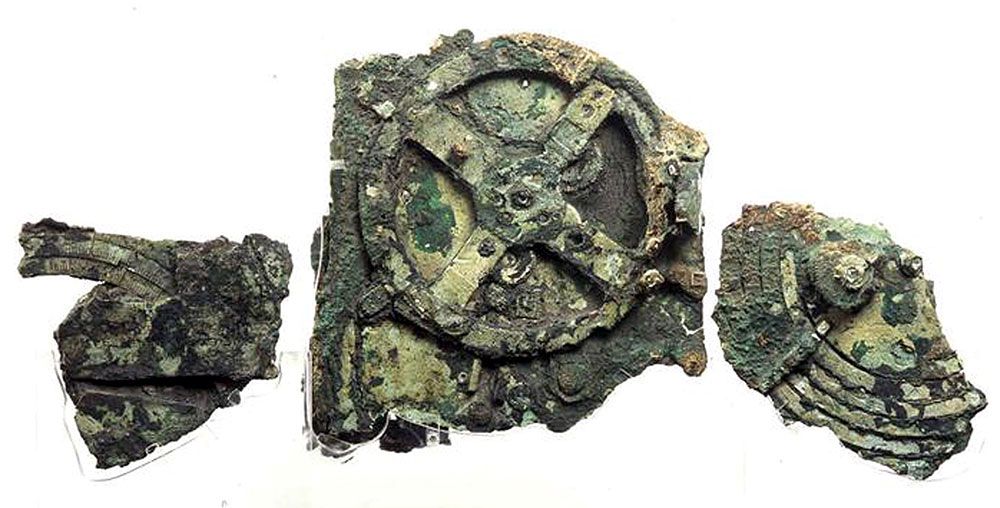
The Antikythera mechanism, an ancient Greek geared device recovered from a shipwreck, provides a striking example of how astronomical cycles could be represented mechanically. Its surviving components and inscriptions indicate that it modeled astronomical relationships, including cycles associated with the Sun and Moon and the prediction of eclipses.
The mechanism was not a modern clock that continuously displayed equal hours. Instead, it was a sophisticated calculating device that represented recurring astronomical cycles through interconnected gears and indicators.
Its existence shows that some ancient craftsmen combined mechanical engineering, mathematical knowledge, and astronomy in remarkably complex ways. Timekeeping was not limited to reading shadows or watching the Moon; it could also involve constructing devices that represented and predicted celestial patterns.
How ancient civilizations connected calendars to agriculture and religion
Calendars were closely tied to the organization of social life. Because seasonal changes influenced food production, a calendar could help communities anticipate the approximate timing of planting, flooding, harvesting, and other recurring activities.
In ancient Egypt, the annual behavior of the Nile was central to agricultural planning. Observations of the river and the sky helped people identify seasonal transitions, while the civil calendar provided a framework for administration and organized labor.
In Mesopotamia, lunar calendars supported the scheduling of religious observances, civic activities, and administrative duties. The observation of the new Moon could mark the beginning of a month, linking the calendar to a visible astronomical event.
In ancient Greece, communities used calendars that reflected local traditions, religious festivals, and civic requirements. Months and festival dates could differ among city-states, illustrating that calendars were not merely scientific instruments. They were also social systems shaped by cultural priorities.
The Maya of Mesoamerica developed an especially sophisticated approach to calendrical time. Their calendar traditions included the 260-day ritual calendar and a 365-day calendar known as the Haab’. These systems could be combined to identify dates within a repeating cycle of 18,980 days, commonly called the Calendar Round.
Maya astronomers and calendar specialists also tracked longer spans of time through systems that recorded dates over extended periods. Their observations of the Sun, Moon, and planets formed part of a wider intellectual tradition that connected astronomy, ritual, political authority, and historical recordkeeping.
These examples show that ancient civilizations did not all measure time in the same way. Their calendars reflected local environments, available observations, mathematical practices, and beliefs about the relationship between human activity and the cosmos.
Why ancient timekeeping was not always precise
Ancient timekeeping could be remarkably sophisticated, but its accuracy varied according to the method and the purpose for which it was used.
A sundial could provide a useful estimate of local solar time on a clear day, but clouds, seasonal changes, and differences in latitude affected its usefulness. A water clock could measure an interval after sunset, but its performance depended on the stability of the water flow and the construction of the vessel.
Calendars faced a different challenge. The solar year is not an exact whole number of days, and the lunar month does not contain an exact whole number of days either. A calendar that ignored these fractional differences would gradually drift away from the astronomical events it was intended to track.
Calendar makers therefore needed rules for adjusting the relationship between days, months, and years. Some systems relied on observation, while others increasingly used mathematical cycles and established conventions. The methods differed across cultures and historical periods.
Local solar time also created a problem for coordination across distance. When the Sun reaches its highest point at one location, it may be higher or lower in the sky elsewhere because Earth is curved and rotates. Two distant cities could therefore have different local solar times even when their residents used similar sundials.
Modern standardized time zones were developed much later to address the growing need for coordinated time across large regions. Ancient communities generally relied on local observations and local conventions rather than a single worldwide time standard.
It is important, however, not to equate the absence of modern clocks with a lack of astronomical sophistication. Ancient observers could identify long-term patterns, predict certain celestial events, and maintain useful calendars through repeated observation and careful calculation. Their instruments were limited by physical conditions and available technology, but their achievements reflected systematic reasoning rather than guesswork alone.
How ancient methods shaped modern timekeeping
Many features of modern timekeeping developed through a long history of astronomical observation, mathematical innovation, mechanical engineering, and social standardization.
The division of the hour into 60 minutes and the minute into 60 seconds preserves the influence of ancient sexagesimal mathematics. The use of the solar year to organize the calendar reflects the importance of keeping dates aligned with the seasons, while the seven-day week and the names and structures of many calendar traditions emerged through additional cultural and historical developments.
Modern clocks eventually made it possible to measure intervals without depending directly on the Sun’s visible position. Mechanical clocks provided a more regular way to track hours, while later technologies improved precision and reliability.
Today, atomic clocks measure time using highly stable transitions in atoms. The modern second is defined through a specified frequency associated with cesium-133 atoms, making it far more precise than measurements based on shadows or flowing water. Astronomical observations nevertheless remain essential for understanding Earth’s rotation, orbital motion, and the relationship between clock time and the natural cycles of the planet.
The underlying problem remains recognizable across the centuries: people need a consistent way to describe when events occur and how long they last. Ancient civilizations approached that problem by observing recurring patterns in nature and turning them into practical systems.
Their calendars organized the year, sundials translated sunlight into daily measurements, water clocks measured intervals after dark, and astronomy connected these tools to the wider rhythms of the cosmos. Together, these innovations laid important foundations for the ways societies continue to organize and measure time.