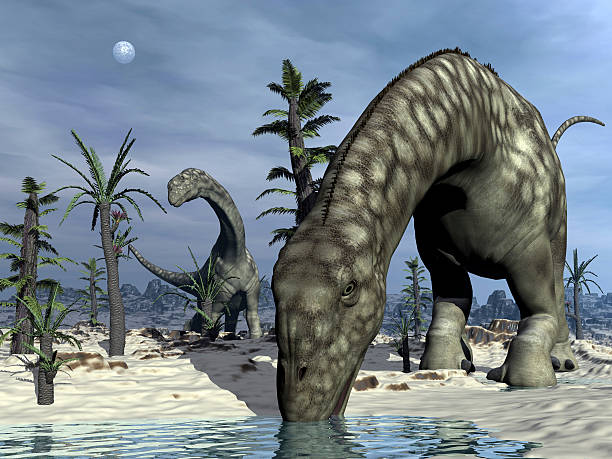
Brachiosaurus and Diplodocus were two enormous, long-necked dinosaurs that lived during the Jurassic Period, yet they were built quite differently. Both belonged to a group of plant-eating dinosaurs called sauropods, known for their long necks, small heads, massive bodies, and long tails. The most noticeable difference was their body shape: Brachiosaurus had longer front legs and a high, sloping back, while Diplodocus had shorter front legs, a more level body, and an exceptionally long, whip-like tail.
These differences affected how the dinosaurs held their bodies, reached vegetation, and distributed their weight. Although both were enormous herbivores, they were not simply two versions of the same animal. Their contrasting anatomy reveals how sauropods evolved different ways of making a living in the same broad prehistoric world.
Brachiosaurus and Diplodocus belonged to different sauropod groups
Both dinosaurs were sauropods, a major group of long-necked, four-legged herbivores that included some of the largest land animals in Earth’s history. Sauropods generally had column-like limbs to support their heavy bodies, long necks for reaching vegetation, and relatively small skulls compared with the rest of their bodies.
However, Brachiosaurus and Diplodocus belonged to different branches of sauropod evolution. Brachiosaurus was a brachiosaurid, a member of a group distinguished in part by its unusually long forelimbs. Diplodocus belonged to the diplodocids, a group characterized by elongated bodies and tails, relatively short forelimbs, and distinctive skull and tooth features.
These differences were more than superficial. The dinosaurs’ skeletons show that sauropods could develop markedly different body proportions while retaining the same basic four-legged, plant-eating body plan.
Both lived during the Late Jurassic, roughly 150 million years ago. Their fossils are associated with western North America, where ancient floodplains, river systems, and seasonally changing environments supported a diverse community of dinosaurs and other animals.
The name Brachiosaurus means “arm lizard,” referring to its long forelimbs. Diplodocus means “double beam,” a reference to distinctive bones on the underside of its tail vertebrae. Their scientific names reflect anatomical features that help paleontologists distinguish the animals.
Their body shapes were dramatically different
The clearest way to distinguish these dinosaurs is to compare the proportions of their limbs, backs, necks, and tails.
Brachiosaurus had forelimbs that were longer than its hind limbs. This arrangement raised its shoulders above its hips, giving its back a distinctive upward slope toward the front. Its neck rose from the elevated shoulder region, creating a body plan well suited to reaching vegetation at considerable heights.
Diplodocus had shorter forelimbs relative to its hind limbs. Its body was more horizontally oriented, with a long, relatively low neck extending forward and an extraordinarily elongated tail trailing behind. Rather than emphasizing height, its proportions created a stretched-out silhouette.
These contrasting forms also influenced how the animals carried their weight. Brachiosaurus’s long front legs supported an elevated front half, while Diplodocus’s more evenly aligned body and limbs supported a different distribution of mass along its length.
Both animals walked on four sturdy legs. Their feet helped distribute the weight of their bodies across the ground, although their exact footprints and limb mechanics varied with their anatomy. Neither dinosaur was built for the rapid, agile movement associated with smaller animals.
Brachiosaurus was built to reach higher vegetation
Brachiosaurus is particularly notable for its long neck and elevated shoulders. Its forelimbs gave it a greater overall reach than a similarly proportioned sauropod with shorter front legs, making access to higher vegetation a plausible advantage.
Its neck contained numerous elongated vertebrae, and its skull was relatively small compared with its body. Like other sauropods, it could reach plant material without having to move its entire body to every feeding location.
However, a long neck did not necessarily mean that Brachiosaurus fed exclusively in treetops. Its neck could be positioned at different angles, and the available feeding range depended on more than neck length alone. Body posture, neck flexibility, plant height, and the distribution of vegetation all mattered.
The familiar image of Brachiosaurus standing upright with its neck held nearly vertical is a simplification. Its skeleton supports an elevated feeding posture, but the precise range of neck movement and the frequency with which it adopted particular positions remain difficult to establish from fossils alone.
Its anatomy nevertheless points to an important distinction: Brachiosaurus was relatively high at the shoulder, giving it a feeding profile different from that of Diplodocus.
Diplodocus had a remarkably long, flexible body
Diplodocus is famous for its elongated shape. Its neck stretched forward from a relatively low shoulder region, while its tail extended far behind its body. The combined length of these structures made the animal exceptionally long without requiring it to stand as high as Brachiosaurus.
Its tail was not simply a heavy counterweight. Diplodocus had numerous tail vertebrae, with elongated portions of the vertebrae and associated supporting structures that contributed to its distinctive construction. The tail tapered toward the end and could move in complex ways.
The tail’s precise functions remain an area of scientific investigation. It may have contributed to balance, communication, and defensive behavior, but the relative importance of these possibilities is uncertain. Its structure also suggests that at least the distal portion could move rapidly under some conditions, although claims about the exact speed or force of a tail strike should be treated cautiously.
Diplodocus also had a long neck, but its neck and body proportions differed from those of Brachiosaurus. Its feeding strategy may have emphasized reaching across a broad area of vegetation, including plants at lower and moderate heights, rather than concentrating on the highest available foliage.
That does not mean Diplodocus was restricted to ground-level feeding. Its neck provided considerable reach, and it could probably adjust its head position to exploit vegetation at different elevations.
Their teeth reveal differences in feeding mechanics
Both dinosaurs were herbivores, but their teeth were not identical.
Brachiosaurus had relatively spoon-shaped teeth suited to cropping vegetation. These teeth were adapted for removing plant material rather than slicing meat or chewing food in the way mammals do. As in other sauropods, much of the processing of plant material took place after the food was swallowed.
Diplodocus had a different dental arrangement. Its teeth were slender and pencil-like, concentrated toward the front of the jaws. They were well suited to stripping leaves and other plant material from branches or stems.
The placement and shape of Diplodocus’s teeth suggest that it gathered vegetation differently from Brachiosaurus. Rather than using broad, grinding teeth to chew thoroughly, it likely removed plant material with repeated cropping motions and swallowed it with limited oral processing.
This distinction helps explain why sauropod teeth are useful to paleontologists. Tooth shape, wear, and placement can provide evidence about how an animal obtained food, even when its daily feeding behavior cannot be observed directly.
It is important, however, not to turn these differences into overly rigid dietary categories. Fossils rarely reveal every plant an animal ate, and the diets of both dinosaurs likely varied according to the vegetation available in their habitats.
How their feeding strategies may have differed
The different proportions of Brachiosaurus and Diplodocus suggest that they could exploit vegetation in somewhat different ways.
Brachiosaurus’s elevated shoulders and long forelimbs gave it an advantage in reaching higher feeding zones. Diplodocus’s long, relatively low neck and horizontally oriented body allowed it to extend its head across a broad feeding area. These differences may have reduced competition between the animals by allowing them to make use of different portions of the same landscape.
This possibility is an example of ecological niche differentiation. An ecological niche is the combination of resources an organism uses and the role it plays in its environment. Two large herbivores can share a habitat without eating precisely the same plants or feeding at the same heights.
The idea is plausible, but it should not be mistaken for a complete reconstruction of their behavior. Neck posture, plant availability, seasonal changes, and the ability to feed at multiple heights complicate any simple division into separate feeding zones.
Nor is it necessary to assume that each dinosaur occupied an exclusive feeding niche. Their diets could overlap substantially, and both likely consumed a variety of plant material. Their anatomical differences suggest different capabilities, not absolute boundaries.
Which dinosaur was bigger?
Comparing the sizes of Brachiosaurus and Diplodocus is more complicated than choosing a winner based on length alone.
Diplodocus could reach an extraordinary total length because of its elongated neck and tail. Brachiosaurus was more heavily built in some respects and stood higher at the shoulder. As a result, the longest animal was not necessarily the tallest or heaviest.
Fossil measurements also vary among specimens, and estimates depend on how much of a skeleton survives and how researchers reconstruct missing bones. Different species and individual animals within a genus could also differ in size.
Brachiosaurus is often portrayed as a particularly massive, high-shouldered sauropod. Diplodocus, meanwhile, is widely recognized for its great length and relatively slender proportions. These are more reliable general distinctions than any single size ranking.
It is also worth distinguishing Brachiosaurus from Giraffatitan, a closely related brachiosaurid whose fossils were found in Tanzania. Many older illustrations and popular accounts used the name Brachiosaurus for the African animal, but it is now generally classified separately. Confusion between the two can complicate comparisons of size and appearance.
The safest conclusion is that both were enormous sauropods, but they achieved their imposing dimensions in different ways. Brachiosaurus emphasized height and a high front body, whereas Diplodocus emphasized length and an elongated, relatively low profile.
How did their skeletons support such enormous bodies?
Growing to enormous sizes required more than long necks and powerful legs. Sauropod skeletons combined strength with structural features that helped reduce the burden of carrying a massive body.
Many sauropod vertebrae contained internal spaces and cavities that reduced bone weight without eliminating the support the skeleton needed. In living birds, air-filled spaces connected to the respiratory system extend into parts of the skeleton; fossil evidence indicates that similar air-sac systems contributed to skeletal lightening in sauropods.
This feature was particularly important in animals with long necks. A neck made entirely of solid, heavy bone would have required substantially more muscle and energy to support and move. Lightweight skeletal structures helped make great neck length more practical.
The vertebrae also had complex shapes and supporting projections that helped resist bending and distribute mechanical forces. Their limbs were positioned to carry large loads, and their relatively straight, pillar-like arrangement reduced the need to support the body through continuously bent joints.
Brachiosaurus and Diplodocus shared these broad sauropod adaptations, but their different proportions changed how the supporting structures were arranged. The elevated front body of Brachiosaurus differed mechanically from the long, low arrangement of Diplodocus.
Neither dinosaur’s skeleton can reveal every detail of its movement. Soft tissues, cartilage, muscles, and ligaments rarely fossilize, so paleontologists must reconstruct their functions by combining bone anatomy with comparisons to living animals and mechanical principles.
Did Brachiosaurus and Diplodocus live together?
Both dinosaurs are associated with the Late Jurassic ecosystems of western North America, particularly the region represented by the Morrison Formation. This extensive sequence of sedimentary rocks preserves fossils from ancient environments that included floodplains, rivers, and other lowland habitats.
The Morrison Formation contains remains of numerous sauropods, as well as predatory dinosaurs and many other animals. Its fossils provide evidence that several kinds of enormous plant-eaters inhabited the same broad region.
However, finding fossils of two species within the same geological formation does not prove that they lived in precisely the same place at precisely the same time. A rock formation can preserve sediments deposited over a long period and across a large area. Establishing direct coexistence requires more specific geological and chronological evidence.
The broader ecological picture is nevertheless revealing. Sauropods were not a single uniform group occupying one narrow feeding role. Their diversity in body proportions, tooth shape, neck structure, and overall size suggests that different species could exploit different resources within complex ecosystems.
Brachiosaurus and Diplodocus illustrate this diversity particularly well. Their differences show how closely related groups of giant herbivores could evolve distinct anatomical solutions to the challenges of obtaining food and supporting an enormous body.
What the differences tell us about sauropod evolution
The contrast between Brachiosaurus and Diplodocus demonstrates that there was no single ideal body shape for a giant herbivorous dinosaur.
Brachiosaurus’s long forelimbs and elevated shoulders contributed to a high-reaching feeding profile. Diplodocus’s elongated neck, relatively short forelimbs, and exceptionally long tail produced a different combination of reach, body balance, and movement.
These traits evolved within separate sauropod lineages. Natural selection can favor different anatomical features when populations face different ecological opportunities, although the precise evolutionary pressures behind each feature are not always clear from the fossil record.
Their differences also challenge the assumption that all long-necked dinosaurs fed in the same way. A long neck could contribute to feeding reach, but the value of that reach depended on the animal’s entire body plan, including its shoulder height, limb proportions, skull, and teeth.
The most useful comparison, therefore, is not simply which dinosaur was larger or had the longer neck. It is how each animal’s anatomy worked as a whole.
Brachiosaurus was adapted for a taller feeding profile, with long forelimbs that raised its shoulders and front body. Diplodocus had a more elongated, lower-slung body, a long neck, and an exceptionally extended tail. Both were successful sauropods, but their contrasting proportions reveal the remarkable range of forms that giant plant-eating dinosaurs developed during the Jurassic Period.