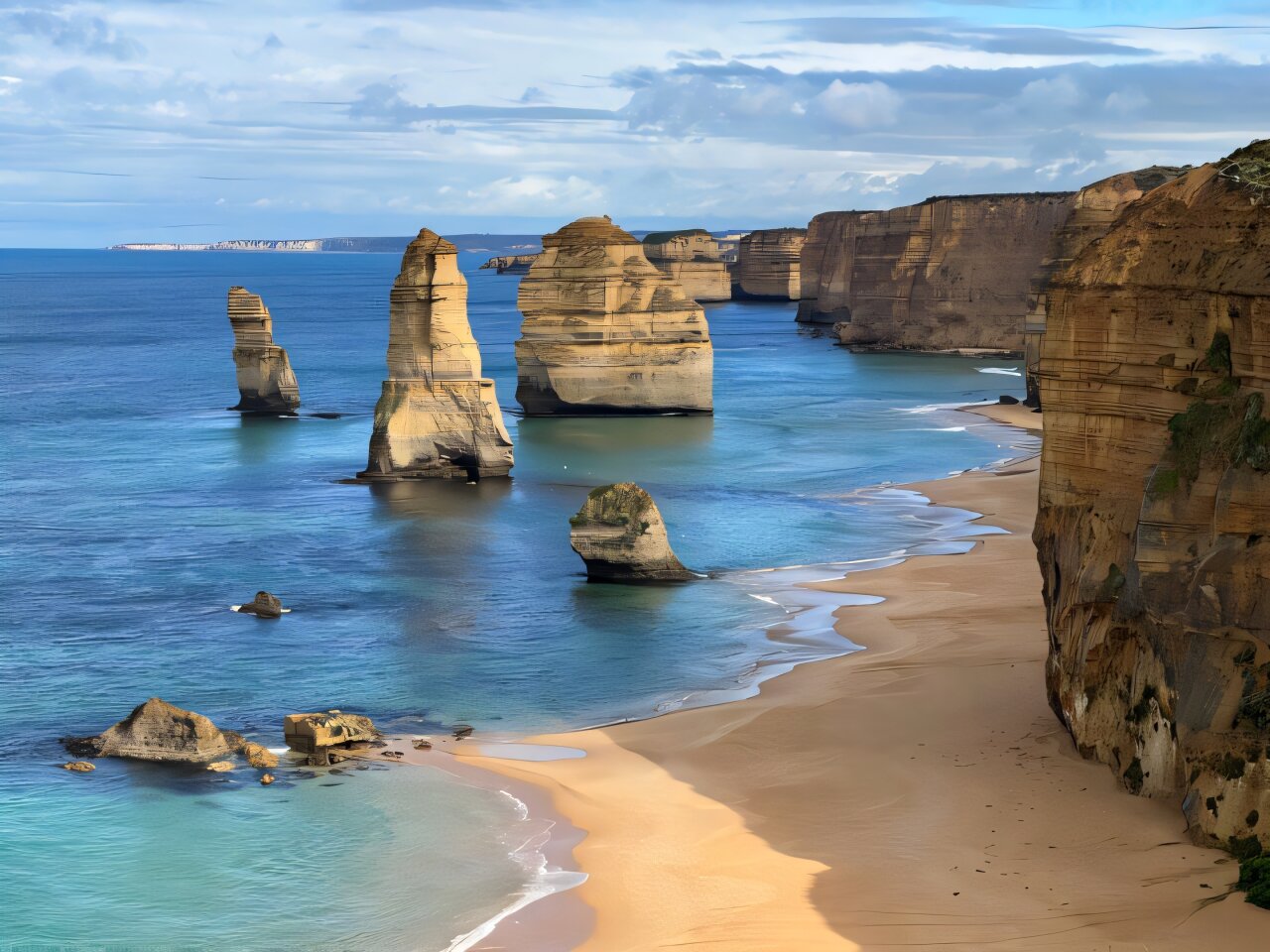
University of Melbourne researchers have discovered that the Twelve Apostles were formed by millions of years of tectonic plate movements that lifted and tilted the giant limestone structures out of the ocean. This geological event has turned the pillars into a world-class “environmental time capsule,” revealing that the formations are younger than previously thought and provide a critical record of ancient climate shifts.
For decades, the towering limestone pillars known as the Twelve Apostles have stood as silent sentinels along Australia’s rugged coastline, their origin story largely shrouded in mystery. While millions of tourists visit the site to witness the dramatic erosion of the Great Ocean Road, the deep-time history of how these massive structures actually came to be has remained a scientific puzzle. New research has finally cracked the code, revealing that these icons were not merely carved by the waves, but were actively hoisted from the seabed by the restless shifting of the Earth’s crust.
The Tectonic Engine Behind the Apostles
The landmark study, led by Associate Professor Stephen Gallagher from the University of Melbourne’s School of Geography, Earth and Atmospheric Sciences, clarifies the long-term evolution of the site. The team found that the Twelve Apostles are the result of massive tectonic plate movements occurring over millions of years. These forces acted like a slow-motion elevator, lifting and tilting the giant structures upward and out of the sea.
This tectonic activity did not happen uniformly. Associate Professor Gallagher noted that the movements forced the limestone layers to tilt and break as they rose. This is still visible to the naked eye today; if observers look closely at the cliffs surrounding the remaining pillars, they can see that the limestone layers are not perfectly flat. Instead, they are tilted by a few degrees, and the rock faces are scarred with small fault lines—permanent physical records of ancient earthquakes that shook the region during its formative stages.
A Revised Geological Timeline
Beyond identifying the forces that raised the pillars, the researchers were able to pinpoint exactly when these layers were formed. For years, preliminary data suggested a broad age range for the limestone, placing it anywhere between 7 to 15 million years old. However, by analyzing microscopic fossils embedded within the rock, the Melbourne team established a far more precise and accurate timeline.
The findings, published in the Australian Journal of Earth Sciences, indicate that the layers are actually between 8.6 to 14 million years old. This makes the formations younger than previously understood by the scientific community. These layers act much like the rings of a tree, with each distinct band of sediment providing a snapshot of the environmental conditions present at the moment the rock was deposited on the ancient seafloor.
From Deep Sea to Coastal Icons
While the tectonic lifting provided the raw material and the elevation, the “Apostles” as we recognize them today are a much more recent phenomenon. The study clarifies that while the lifting process took millions of years, the final shaping of the pillars occurred only within the last few thousand years. Following the last Ice Age, rising sea levels and intense coastal erosion began to hammer away at the newly exposed limestone cliffs.
This persistent erosion isolated the pillars from the mainland, carving them into the dramatic vertical structures that define the Victoria coastline. It is a process of constant change; while the tectonic plates provided the foundation millions of years ago, the ocean continues to be the primary architect of their current—and temporary—aesthetic. This dual history of deep-time plate tectonics and relatively recent weather patterns highlights the complexity of Australia’s coastal evolution.
A Window into Ancient Climates
One of the most significant aspects of this discovery is the realization that the Twelve Apostles represent one of the world’s best-preserved records of ancient climates. Because the tectonic uplift “poured” these layers out of the sea and into the open air, scientists now have easy access to information that is usually buried deep beneath the ocean floor.
Associate Professor Gallagher describes the site as a “window back in time,” specifically highlighting a period roughly 13.8 million years ago. During this era, the Earth’s climate was significantly warmer than it is in the modern day. By studying these specific layers, researchers can reconstruct ancient ocean conditions and sea levels, providing a baseline for how the planet responded to higher temperatures in the past.
Why This Matters
The Twelve Apostles are far more than just a photography backdrop; they are a critical tool for predicting the future of our planet. As the global climate changes, understanding how sea levels and temperatures shifted during the Miocene epoch provides scientists with a roadmap for where our current environment may be heading.
The urgency of this research is underscored by the fragility of the site itself. Only eight of the original twelve Apostles remain standing, as the same erosive forces that created them eventually claim them. By studying these structures now, researchers can learn how ancient geological processes continue to influence modern coastal erosion, helping us better understand the stability of our coastlines in a warming world. This “environmental time capsule” offers a rare opportunity to read the Earth’s past in order to better prepare for its future.
Study Details
The geology of the Twelve Apostles in the Port Campbell Embayment in southeast Australia, Australian Journal of Earth Sciences (2026). DOI: 10.1080/08120099.2026.2638817