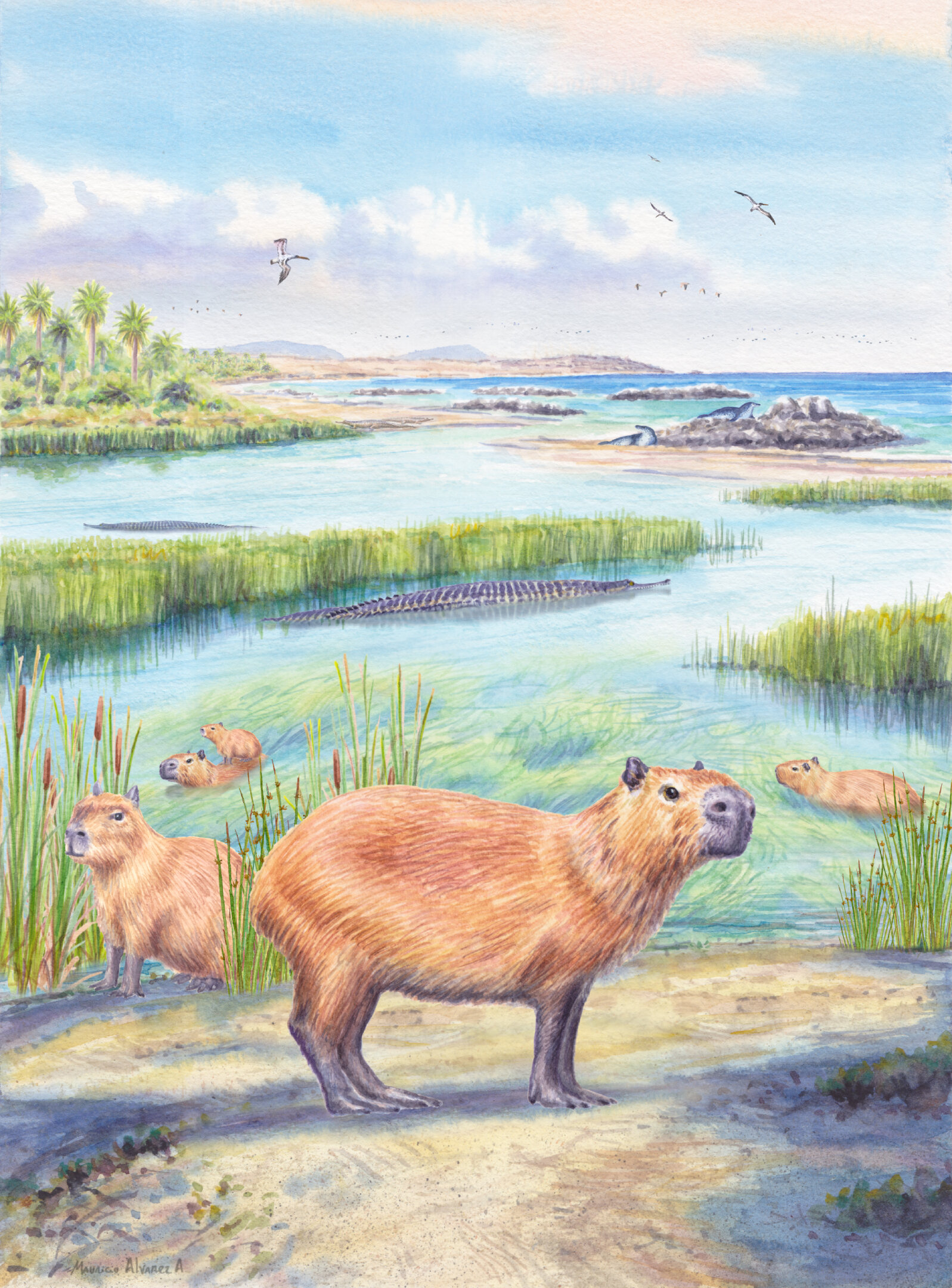
Nearly 9 million years ago, capybaras lived in what is now one of the driest places on Earth. A fossil tooth found in northern Chile suggests that parts of the modern Atacama Desert once supported wetlands, freshwater animals and vegetation capable of sustaining capybara populations for long periods. The finding also raises questions about the long-standing view that the region has remained continuously dry for tens of millions of years.
The tooth was discovered at El Morro, a site within Chile’s Bahía Inglesa Formation. The sediments there were deposited in a shallow marine environment between 10 million and 7 million years ago.
The find is notable because no capybaras live in Chile today, and this is the first and oldest known record of the animals in coastal Chile. The fossil is also about 9 million years old.
“Finding a capybara tooth in a marine deposit in what today is one of the driest regions on Earth is just freakish,” said Priscilla Martinez, the study’s lead author and a doctoral student at the University of Arizona Department of Geosciences.
Capybaras are the largest living rodents. They are semiaquatic herbivores native to South America and today live mainly east of the Andes, where they depend closely on surface water, wetland vegetation and river or creek corridors.
That raised an immediate question for the researchers: how did an animal so closely tied to wet environments end up in a region that is now extremely dry?
The animals may have traveled around the Andes
The Andes would have been a major obstacle. According to geological estimates, the mountain chain had risen to about 18,000 feet by the time these capybaras lived in the region, creating a barrier between the Atacama area and the lowlands farther east.
But the researchers propose that the capybaras did not cross the mountains.
Instead, they may have moved along low-elevation wetlands around the northern part of South America. The proposed route would have taken them from what is now Venezuela through Colombia, Ecuador and Peru, eventually reaching northern Chile.
The fossil evidence from El Morro provides clues that such a wet route and environment could have existed.
“We have multiple lines of evidence indicative of really wet conditions that are typically associated with capybaras today,” said Mark Clementz, a paleobiology expert and one of the study’s co-authors. The same deposits contain fossils of freshwater fish and gavials, which are freshwater crocodiles.
The researchers also found phytoliths. These are microscopic silica structures that form inside plant tissues as plants take up dissolved silica from groundwater through their roots. Analysis indicated that palms and other flowering plants, including dicots, were present.
Those plants would not be expected in the Atacama Desert today.
“Think sunny Southern California full of palm trees,” Martinez said. “You don’t really expect the Atacama Desert to have palms, and we’re not sure if they were blooming extensively there, but they were definitely there.”
One tooth became the key evidence
The capybara evidence came down to a single tooth. No other capybara remains this old have been found in Chile so far.
The tooth was preserved in a bed of sediment about 3 feet, or 0.9 meters, thick. Its presence alongside freshwater fish, gavials and plant evidence provided the researchers with multiple indications of an environment unlike the modern Atacama.
“All this supports the idea that there was enough of an ecological community to support capybara populations long term,” Clementz said.
The fossil’s discovery was also connected to the complicated history of fossil collecting at the site. Local people had dug for fossils and, in some cases, sold them to collectors. Many fossils found there were subsequently lost, while some were donated to local scientists by merchants who wanted them better understood.
Carolina Gutstein, the study’s first author, is head of paleontology at Chilean mining company Fosfatos de Caldera and a professor at Universidad Santo Tomás in Santiago. She has longstanding relationships with local fossil experts in the area.
The finding raises questions about when the desert became dry
The capybara tooth does not by itself establish exactly when the Atacama became the desert it is today. But the researchers say it challenges the long-standing picture of the region as one of Earth’s oldest continuously dry areas, with extreme aridity extending back an estimated 40 million years.
The other fossils and plant remains add evidence that conditions at the site were substantially different in the past.
Clementz said the findings challenge assumptions about the Atacama’s history, particularly because earlier fossil discoveries had already suggested that the region’s past was different from its present environment.
The researchers also point to the value of understanding how desert environments changed naturally in the past. Martinez noted that deserts are highly sensitive to climate changes, including shifts in monsoon intensity, and said records of past climate changes unrelated to humans can provide a baseline for understanding how climate changes over time.
The study was published in Scientific Reports.