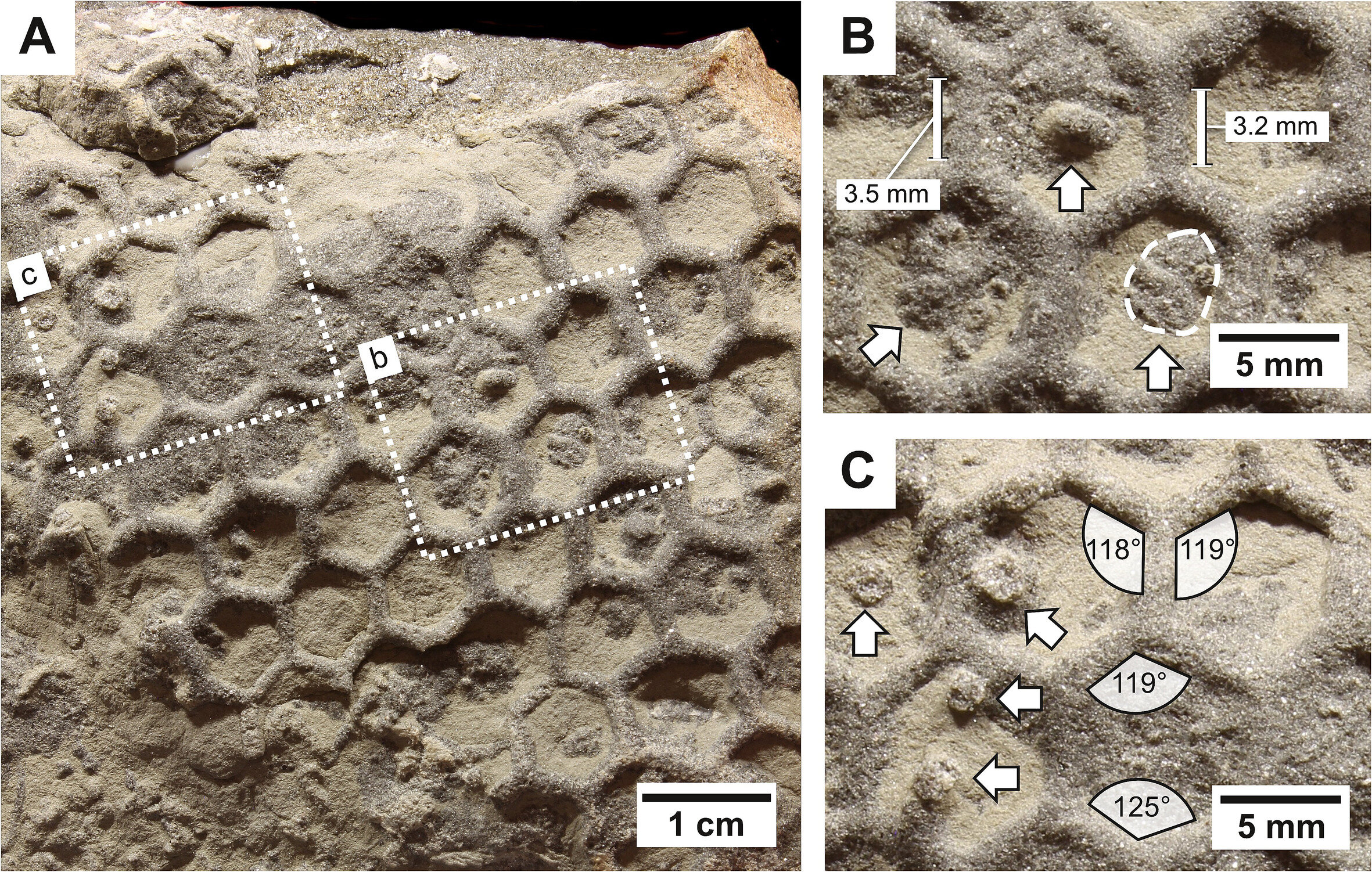
For more than 170 years, paleontologists have puzzled over a distinctive fossil pattern made of tiny, remarkably regular hexagonal tunnels. A new review of fossil specimens and modern burrows argues that small arthropods, probably crustaceans, are the most likely builders, although the evidence remains indirect.
The structure, known as paleodictyon, appears in marine rocks dating back to the early Cambrian, more than 500 million years ago. It has been found around the world at different depths, and similar structures still occur on the modern deep seafloor.
Paleodictyon consists of a horizontal network of hexagonal tunnels connected to vertical outlets. The tunnels are tiny, ranging from a few millimeters to less than 1 millimeter across.
Yet the animal that made them has never been found inside one of the fossil networks or directly observed creating a modern one. Proposed builders have included worms, single-celled organisms, sponges and crustaceans.
The authors of the new study note that speculation about the pattern may extend back to Leonardo da Vinci. A drawing attributed to him may depict paleodictyon, although whether da Vinci specifically interpreted it as a structure made by a worm-like animal is uncertain. The idea that worm-like organisms produced the tunnels gained substantial support in the 1970s and remains an established hypothesis.
The new analysis points in a different direction.
The shape of the tunnels favors arthropods
The researchers examined fossil specimens from Italy, Portugal and Poland covering geological periods from the Cambrian to more recent times. They used high-resolution photographs and three-dimensional models to measure the geometry of the tunnel networks and compared those measurements with burrows made by living arthropods.
Arthropods include animals with segmented bodies, hard outer coverings and jointed legs. The group includes crustaceans, insects, spiders and centipedes.
The researchers found that paleodictyon’s straight tunnels and sharp corners fit an animal with a rigid outer skeleton and jointed limbs better than a soft-bodied worm. Arthropods can use their appendages to excavate by scraping material from the front wall of a burrow and moving it elsewhere.
That kind of excavation could account for the unusually precise geometry of paleodictyon. Worms, by contrast, tend to move along paths of least resistance, producing burrows with more irregular shapes and rounded corners.
The measurements provided another clue. Tunnel widths and lengths were remarkably consistent, while the angles were close to 120 degrees, the angle expected in a regular hexagonal pattern.
According to the researchers, this suggests that the builder could correct small errors while constructing the network. They interpret that as evidence of strong navigation and distance-sensing abilities, which they say are consistent with arthropods.
The timing and habitat also fit
The geological record provides another piece of evidence. The earliest known paleodictyon appears around the same period as the first arthropod trace fossils in the Cambrian.
Modern paleodictyon occurs in deep-sea environments that also contain arthropods capable of fitting through the tiny tunnel openings. The study places the depth range of modern paleodictyon tracemakers at roughly 1,300 to 5,000 meters.
Within that range, the researchers identify several groups of small infaunal arthropods, including isopods, amphipods, copepods and decapods, whose body widths are compatible with the openings.
Together, the tunnel geometry, inferred excavation behavior, timing and modern habitat are presented as evidence favoring an arthropod builder, probably a small crustacean.
What the tunnels were used for is still unclear
Identifying the possible builder does not settle another question: why the animal or animals constructed such elaborate networks.
Previous interpretations have included grazing, trapping, bacterial farming and brooding. The researchers say these possibilities could be compatible with an arthropod maker.
They also propose another possibility. The tunnels could have functioned as a communication network for colonial organisms, allowing acoustic, hydraulic or chemical signals to travel through the structure.
That idea remains a proposed function rather than an established explanation.
Direct evidence is still missing
The case for arthropods rests on indirect evidence. The researchers are connecting the physical form of the tunnels with the known abilities and habitats of different animal groups. That does not completely eliminate worms, other possible burrowers or inorganic processes.
A modern animal caught making paleodictyon, or a fossilized maker preserved inside one of the tunnels, would provide more direct evidence.
The researchers propose long-term monitoring of modern sites to look for it. One approach would use autonomous time-lapse systems such as Bathysnap to record the seafloor hourly. They also suggest collecting environmental DNA in place and comparing DNA associated with both modern and ancient paleodictyon to distinguish the organisms that made the structures from animals that later colonized them.
Another proposed approach would use Sediment Profile Imagery on newly formed paleodictyon to observe activity inside the burrows.
Until such evidence is obtained, the arthropod explanation remains a conclusion based on the structure, behavior and environmental setting of the tunnels rather than direct observation of their maker.
The study was published in Earth Science Reviews.