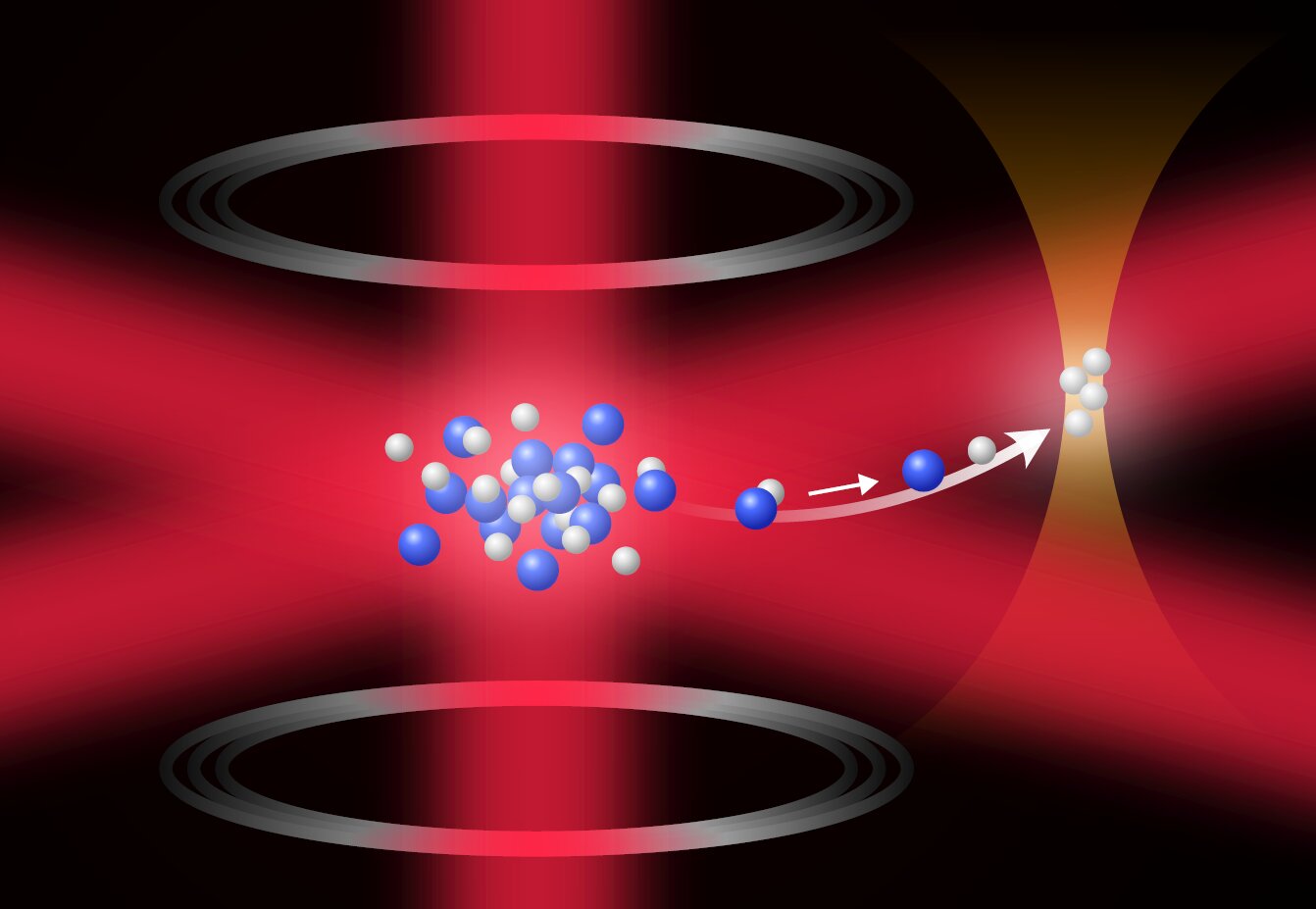
Laser cooling has reached an important new milestone with the successful trapping of calcium monohydride (CaH) molecules at temperatures below 1 millikelvin. The achievement demonstrates that metal hydride molecules can be cooled and confined in a three-dimensional magneto-optical trap (MOT), laying the foundation for future studies of ultracold hydrogen, quantum chemistry, and high-precision tests of fundamental physics.
For decades, physicists have mastered the art of cooling individual atoms with lasers. Molecules, however, have remained a far greater challenge. Their internal vibrations and rotations create additional complexity, making them much harder to slow down, cool, and hold in place.
Now, researchers at Columbia University and Indiana University Bloomington have overcome part of that challenge by successfully cooling and trapping calcium monohydride (CaH) molecules inside a three-dimensional magneto-optical trap (MOT). Their findings, published in Physical Review Letters, mark an important step toward producing ultracold hydrogen atoms for precision scientific experiments.
Why Molecules Are So Difficult to Trap
Unlike single atoms, molecules contain two or more chemically bonded atoms. These bonds allow molecules to vibrate and rotate in many different ways, creating additional energy states that complicate laser cooling.
Because of this complexity, techniques that work well for atoms often struggle when applied to molecules. Researchers have spent years refining methods that can slow molecular beams enough to capture them at ultracold temperatures.
According to first author Jinyu Dai, the team’s primary goal was not simply to trap molecules but to create a pathway toward producing ultracold hydrogen atoms.
“As nature’s simplest atom, hydrogen provides an ideal platform that could enable some of the most precise tests of fundamental physics,” Dai explained. The researchers aim to eventually produce ultracold hydrogen by dissociating ultracold metal hydride molecules.
Building a Better Way to Cool Calcium Monohydride
The experiment began by generating a beam of CaH molecules. The researchers then used a direct laser-cooling method that has become widely used in ultracold molecule research over the past decade to slow the fast-moving molecules nearly to a standstill.
For calcium monohydride specifically, the team introduced important improvements to the experimental setup.
They developed a new cryogenic buffer-gas beam source and redesigned the laser-cooling strategy to suppress a unique predissociative loss channel that would otherwise reduce the number of molecules available for trapping.
Dai explained that laser cooling remains one of the most powerful tools in modern atomic, molecular, and optical physics because it allows scientists to precisely control both the internal and external motion of molecules. By carefully applying this technique, the researchers were able to reduce the speed of the CaH molecules until they could be confined inside the magnetic and laser fields of the trap.
Trapping Hundreds of Molecules at Ultracold Temperatures
Using their improved experimental approach, the researchers successfully trapped approximately 230 CaH molecules inside the 3D magneto-optical trap.
Even more importantly, the trapped molecules reached temperatures below 1 millikelvin (mK).
Reaching such low temperatures dramatically reduces molecular motion, making it possible to study chemical and physical processes with exceptional precision. The successful demonstration also confirms that even metal hydride molecules, despite their added complexity, can be cooled into the ultracold regime.
A New Platform for Ultracold Quantum Chemistry
The achievement extends beyond a single molecular species.
The researchers say their work establishes metal hydrides as a promising new platform for ultracold quantum chemistry. Although these molecules present additional challenges—including predissociative loss channels and the difficulty of producing bright molecular beams—they have now been shown to be compatible with laser cooling and trapping techniques.
This opens opportunities to investigate chemical reactions under ultracold conditions, where molecular motion is minimized and quantum effects become much easier to observe.
One particularly promising direction involves photodissociation, a process in which a molecule is broken apart using light. By dissociating ultracold metal hydride molecules, researchers hope to generate ultracold atomic hydrogen.
According to Dai, ultracold hydrogen could become an ideal system for performing highly precise tests of the Standard Model and for measuring fundamental physical constants.
The Next Stage of the Research
The work is far from complete.
The researchers are already working to further cool and trap calcium monohydride molecules to achieve higher phase-space densities, a key requirement for many advanced ultracold experiments.
Dai also pointed to dissociation spectroscopy as an exciting next step. This technique could enable detailed studies of ultracold chemistry while simultaneously providing a route to producing ultracold hydrogen atoms.
If successful, these developments would expand the range of molecular systems that scientists can manipulate with precision while supporting increasingly accurate measurements in fundamental physics.
Why This Matters
Successfully trapping calcium monohydride molecules below 1 millikelvin demonstrates that even relatively challenging metal hydride molecules can be controlled using laser cooling techniques. That achievement establishes a new experimental platform with applications extending beyond molecule trapping itself.
The work lays the groundwork for producing ultracold hydrogen, a long-standing goal because hydrogen offers one of the cleanest systems for testing the laws of physics with extraordinary precision. At the same time, the methods developed in this study could be adapted to other complex molecules, expanding opportunities in ultracold quantum chemistry, precision measurement, and the development of highly controllable molecular systems for future fundamental physics research.