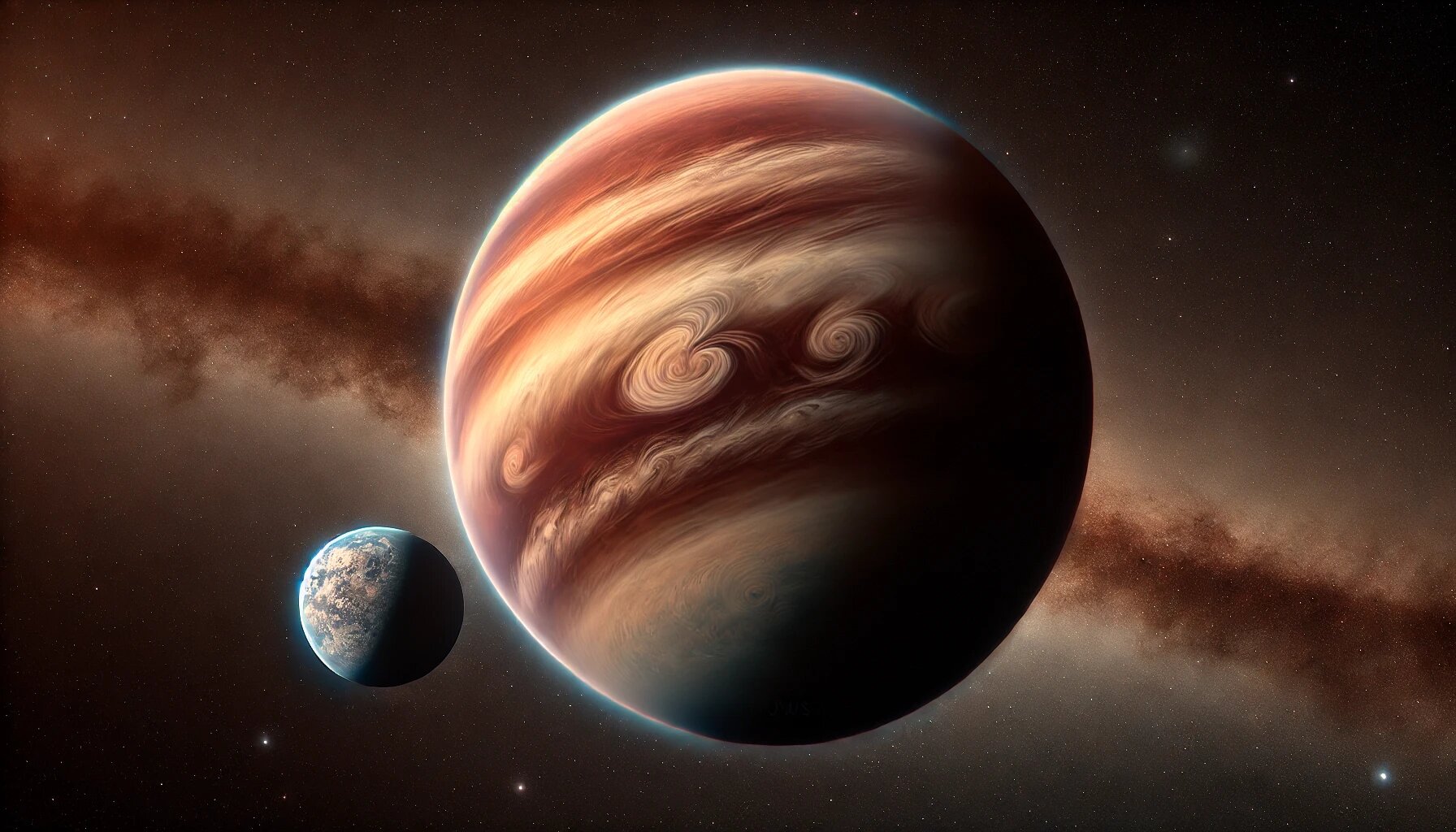
Imagine a world adrift in the eternal night of interstellar space, far from the warming glow of any sun. It is a lonely, “rogue” planet, cast out from its original home by the violent gravitational tug-of-war of its youth. For a long time, astronomers assumed these nomadic giants were nothing more than frozen tombs, wandering the void in absolute stillness. But a new study suggests that if these planets carried moons with them into the dark, those moons might not just be warm—they might be cradles for life that last for billions of years.
The Violent Birth of a Lonely Wanderer
The story begins with a cosmic catastrophe. In the chaotic early days of a solar system, massive planets often dance too close to one another. One is pushed, the other is pulled, and occasionally, a planet is flung entirely out of its orbit, destined to roam the galaxy as a free-floating exoplanet. While the planet itself loses its star, it often manages to keep its moons in tow.
However, the process of being kicked out of a solar system is messy. The gravitational trauma of ejection often leaves a moon’s orbit highly elongated—a long, oval path rather than a neat circle. As the moon travels this eccentric route, it is repeatedly stretched and squeezed by the massive gravity of its host planet. This isn’t a gentle nudge; it is a powerful physical distortion that generates friction deep within the moon’s rocky core.
This process, known as tidal forces, creates a massive amount of internal heat. We see this today in our own solar system with moons like Europa and Enceladus, which remain geologically active despite being far from the Sun. But for a rogue moon in the freezing vacuum of deep space, keeping that heat is a life-or-death struggle. Without an insulating blanket, that precious warmth would simply leak away into the void, leaving the surface a wasteland of ice.
A Blanket Made of the Lightest Air
This is where the research led by David Dahlbüdding and Giulia Roccetti changes the narrative. They discovered that the secret to a moon’s survival lies in its atmosphere—specifically, an atmosphere dominated by hydrogen.
On Earth, hydrogen is a simple molecule that doesn’t do much to keep us warm. But the researchers found that under the crushing weight of a high-pressure atmosphere—up to 100 times Earth’s surface pressure—hydrogen undergoes a remarkable transformation. When hydrogen molecules are packed tightly together, they begin to bump into one another with such frequency that they form temporary, fragile structures called supramolecular complexes.
This phenomenon is known as collision-induced absorption (CIA). These fleeting assemblies of molecules are far more effective at trapping heat than single molecules of hydrogen. In fact, under these extreme pressures, hydrogen becomes a greenhouse gas that can rival the potency of carbon dioxide or methane. It creates a thermal seal that prevents the moon’s internal tidal heat from escaping.
Unlike other gases that might freeze and fall as snow when things get chilly, hydrogen remains a gas. This stability allows the atmosphere to stay thick and insulating without the large-scale condensation that has caused previous atmospheric models to fail. Within this pressurized cocoon, other gases like ammonia, methane, and water vapor can also linger, adding their own layers of insulation to the mix.
The Long Endurance of Dark Oceans
The implications of this “hydrogen blanket” are staggering. By combining calculations of atmospheric temperature with the way chemical compositions change through condensation, the team created the most realistic simulations to date of these dark worlds. They even factored in how a moon’s orbit eventually settles and circularizes over time, which slowly reduces the amount of tidal heat available.
Even with that gradual cooling, the results showed that these moons could retain liquid water on their surfaces for an incredible length of time. In the most robust scenarios, a moon could remain habitable for up to 4.3 billion years. To put that in perspective, that is roughly the same age as the Earth.
In the pitch-black silence between stars, a moon could host a stable, liquid ocean for long enough for life to not only emerge but to evolve through its own biological eras. These worlds would be “sunless” but far from dead, fueled by the rhythmic gravitational heartbeat of the planet they orbit.
A Bridge Between the Stars and Our Own Origins
While the idea of life on a rogue moon sounds like science fiction, the researchers believe this study actually helps us understand our own history. There is a growing theory that the early Earth may have had an atmosphere much richer in hydrogen than it does today. Frequent asteroid impacts in our planet’s youth could have periodically pressurized the air, potentially triggering the same collision-induced absorption seen in the simulations.
Such high-pressure, hydrogen-rich environments are of great interest to biologists because they may have provided the perfect conditions for RNA molecules to form and replicate. By studying how these alien moons trap heat, scientists are building a bridge between astrophysics and biology, helping us understand the chemical “kickstart” that led to the first living cells on our own world.
Why This Research Matters
This study fundamentally changes our understanding of where life might exist in the universe. For decades, the search for life has been focused on the “Goldilocks Zone”—the specific distance from a star where it is neither too hot nor too cold for liquid water.
This research breaks that boundary. It suggests that the habitable zone is not just a circle around a star; it can be a portable environment carried by a rogue planet into the darkest corners of the galaxy. By showing that tidal forces and hydrogen atmospheres can sustain liquid water for billions of years, the study proves that the potential for life is far more widespread than we ever imagined. Even if we cannot yet confirm these atmospheres with our telescopes, we now know that billions of “invisible” habitable worlds could be drifting through the dark, waiting to be discovered.
Study Details
David Dahlbüdding et al, Habitability of Tidally Heated H2-Dominated Exomoons around Free-Floating Planets, Monthly Notices of the Royal Astronomical Society (2026). DOI: 10.1093/mnras/stag243. On arXiv: DOI: 10.48550/arxiv.2602.05378