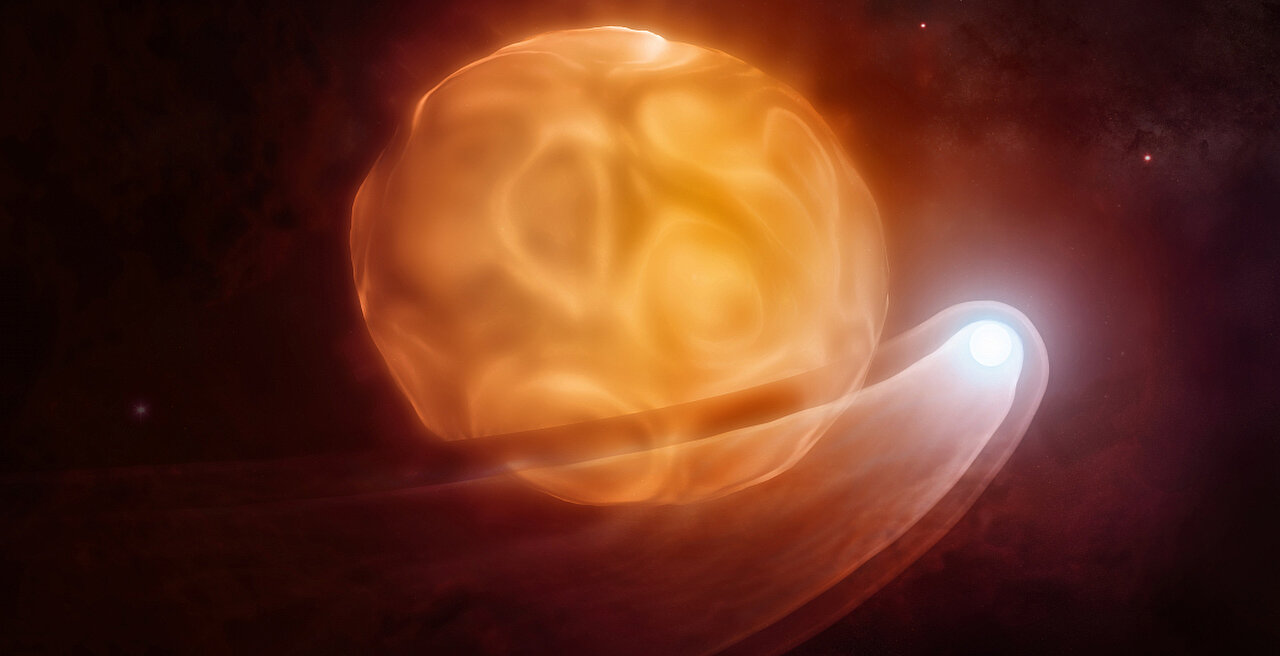
A companion star buried deep inside Betelgeuse’s enormous atmosphere appears to be disturbing the gas around it, leaving measurable changes in the red supergiant’s shape. Although astronomers cannot see the smaller star directly in their radio observations, they have found evidence of its presence by tracking how Betelgeuse’s atmosphere changes as the companion moves through its orbit.
The companion, named Siwarha, orbits so close to Betelgeuse that it passes through the giant star’s extended atmosphere. New observations suggest that its movement is responsible for subtle but detectable distortions in the surrounding gas.
The findings also offer a detailed look at Betelgeuse’s atmosphere following its dramatic dimming in 2019 and early 2020. The observations show that the atmosphere has largely returned to more typical temperature levels, while revealing a previously difficult-to-study cool layer closer to the star’s visible surface.
The research, led by Lynn D. Matthews of MIT Haystack Observatory, combines observations from the U.S. National Science Foundation’s Karl G. Jansky Very Large Array (NSF VLA) and the Atacama Large Millimeter/submillimeter Array (ALMA).
Radio observations reveal changes at different atmospheric depths
Betelgeuse, the bright red supergiant that marks one of Orion’s shoulders, attracted widespread attention when it became unusually faint in late 2019 and early 2020. The event, known as the Great Dimming, followed a major ejection of material from the star that helped produce dust and partially blocked its light.
The latest research examines what happened to the star’s extended atmosphere after that episode. The team collected observations between 2021 and 2026 at seven radio frequencies, ranging from 22 to 485 gigahertz.
Different radio frequencies can reveal different depths within a star’s atmosphere. By combining measurements from the two observatories, the researchers reconstructed conditions in several atmospheric layers, extending from just above Betelgeuse’s visible surface to several times its radius.
The results show that the atmosphere has largely recovered from the unusual conditions observed before the Great Dimming.
In a 2019 study led by Matthews, researchers had detected unusually cool atmospheric gas at radio wavelengths. They proposed that a shock wave, triggered by convection deep inside the star, had disturbed its outer layers and helped set the stage for the material ejection and subsequent dust formation.
The newer measurements show that atmospheric temperatures at those same radio wavelengths have risen back toward more typical levels. At a distance of about 2.7 times the star’s radius, the gas now has a temperature of roughly 3,500 kelvin, comparable to the temperature of Betelgeuse’s visible surface.
A surprisingly cool layer sits above the star’s surface
The observations also provide evidence for a temperature minimum in Betelgeuse’s atmosphere. This is a relatively cool region located between the visible surface, known as the photosphere, and the hotter atmospheric layer above it, called the chromosphere.
Using ALMA’s highest-frequency measurements, the team was able to examine regions closer to the star’s surface than previous radio observations had reached.
There, temperatures fell to approximately 2,200 kelvin. That is more than 1,000 degrees cooler than the photosphere.
The cool region overlaps with a structure known as the MOLsphere, a shell of molecular gas that astronomers have long inferred from infrared observations but have rarely examined so directly using radio measurements.
Together, these observations provide a more detailed picture of how temperature varies across Betelgeuse’s extended atmosphere.
Siwarha appears to distort Betelgeuse as it moves through its atmosphere
The most intriguing evidence concerns Siwarha, the companion star whose existence was proposed in 2024 to explain a mysterious brightness cycle lasting about 2,100 days.
Subsequent direct-imaging and spectroscopic studies have supported the companion’s existence. Its name means “her bracelet” in Arabic, a reference to Betelgeuse’s name, which means “the hand of al-Jawza.”
Siwarha is thought to orbit at a distance of only about twice Betelgeuse’s radius. That places it inside the giant star’s extended atmosphere rather than safely beyond its outer boundary.
As the smaller star travels along its orbit, it is expected to disturb the surrounding gas, much as a moving boat leaves a wake in water.
The new observations provide evidence consistent with that effect.
The researchers could not detect Siwarha directly in their radio measurements. Their calculations indicate that the companion would be tens to hundreds of times too faint to appear in the observations.
Instead, they looked for changes in the shape of Betelgeuse’s radio-emitting atmosphere. By measuring its slight oval-like distortion, known as ellipticity, across observations taken at different times, they found a pattern associated with the companion’s expected orbital position.
Betelgeuse appeared more elongated when Siwarha was expected to be at its greatest apparent separation from the giant star. It appeared rounder when the companion was expected to pass in front of or behind Betelgeuse.
This changing shape provides an indirect way to investigate the smaller star’s influence. Although Siwarha remains too faint to observe directly at radio wavelengths, its apparent effect on the surrounding atmosphere can be measured.
The pattern suggests that the companion’s movement is actively disturbing the gas around Betelgeuse.
More observations are needed to confirm the orbital effects
The researchers say additional observations will be needed to confirm and refine the findings. In particular, they want measurements covering more of Siwarha’s orbit, including observations at radio frequencies that have not yet been sampled extensively.
A future instrument, the Next Generation Very Large Array, is currently in development and is expected to make detailed studies of nearby stars more routine.
Such observations could provide a sharper view of the atmospheric changes around red supergiants, including how nearby companions influence the movement of gas around them.
The study was published in The Astronomical Journal.