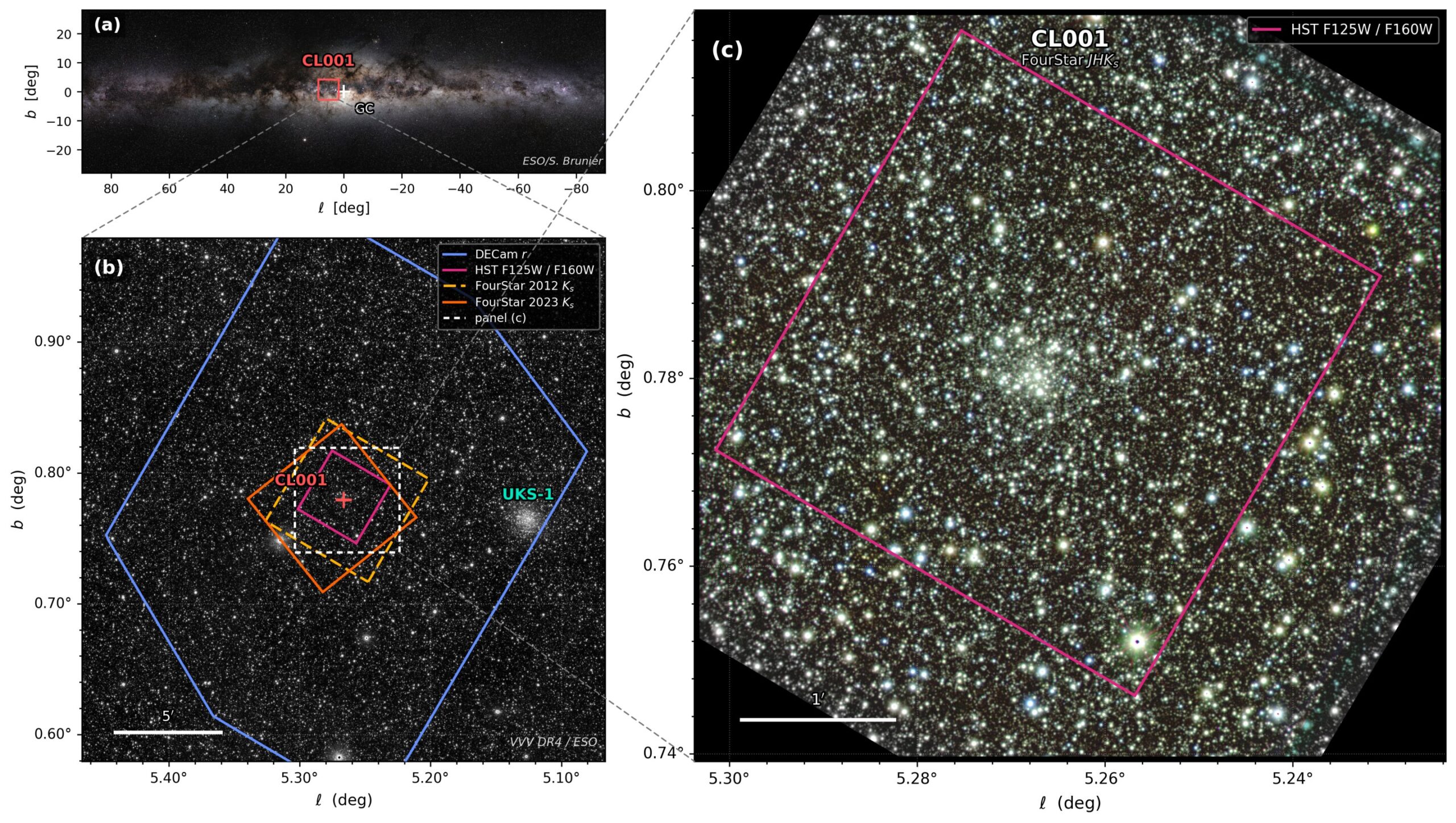
Hidden behind thick clouds of interstellar dust near the center of the Milky Way, a faint star cluster called VVV CL001 may be as old as 13.4 billion years. That would make it one of the oldest known globular clusters in the galaxy, and possibly the oldest. Astronomers reached this estimate by identifying previously unseen cluster members and studying two distinct stages of stellar evolution, allowing them to measure the cluster’s distance and age more precisely.
Globular clusters are tightly grouped collections of stars that preserve clues about the early history of the Milky Way. Their stars can be between 10 billion and 13 billion years old, making these clusters valuable records of the conditions in which the galaxy first assembled.
Astronomers pay particular attention to metal-poor globular clusters. These contain relatively small amounts of elements heavier than hydrogen and helium and can help researchers estimate how old the galaxy is.
VVV CL001 is one such cluster. It was first spotted in 2010 by the VISTA Variables in the Vía Láctea Survey and confirmed as a globular cluster in 2019. Observations initially identified it as a faint, low-mass group of stars in the Milky Way’s inner bulge.
Its apparent location raised questions about its history. Although VVV CL001 appears close to the galactic center, its motion toward Earth differs from that of other stars in the same region. Astronomers therefore questioned whether it actually belonged to that part of the galaxy.
Working out its orbit required a reliable distance measurement. But previous studies used different distance estimates and consequently arrived at different orbital paths.
Several obstacles made the measurement difficult. Interstellar dust blocks some of the cluster’s light, while the crowded surroundings make it harder to distinguish its stars from unrelated objects. The cluster is also small and faint, and earlier observations did not capture enough stars for a detailed analysis.
Another usual tool was missing. Astronomers often use variable stars called RR Lyrae to estimate distances, but none have been identified in VVV CL001.
Two stages of stellar evolution provide the missing clues
To overcome these problems, a team led by J. Olivares Carvajal of the INAF Capodimonte Astronomical Observatory combined deep near-infrared observations with images from the Hubble Space Telescope.
The near-infrared observations came from the FourStar Infrared Camera on the 6.5-meter Magellan Baade Telescope. The researchers also used measurements of how stars move across the sky, together with a machine learning algorithm, to identify which stars genuinely belonged to the cluster.
They identified about 155 cluster members, including stars in two evolutionary stages that earlier studies had not revealed in VVV CL001: the main-sequence turnoff and the horizontal branch.
These stages provide different kinds of information.
The main-sequence turnoff marks the point at which a star stops steadily burning hydrogen in its core. It then expands into a red giant before eventually settling into a stage in which it burns helium in its core. Stars in this later phase belong to the horizontal branch.
The distinction matters because the turnoff point changes with a star population’s age, making it a useful marker for estimating the age of a cluster.
Horizontal-branch stars offer another advantage. Their brightness is relatively steady, allowing astronomers to use them as reference points when measuring distance.
Finding both groups gave the researchers additional evidence to work with, helping them address the two main questions surrounding VVV CL001.
A more precise distance places the cluster inside the galactic bulge
By comparing the observed stars with a theoretical model of stellar evolution, the team calculated that VVV CL001 is about 7.34 kiloparsecs from Earth, or roughly 24,000 light-years.
That distance places the cluster within the Milky Way’s central bulge.
The researchers also reported that their measurement has the smallest distance uncertainty reported for the cluster in previous studies. They expect additional optical observations to help refine the result further.
Establishing the distance is important because it affects how astronomers reconstruct the cluster’s movement around the galaxy. The new estimate therefore provides a more reliable basis for studying its orbital history and possible origins.
An age estimate close to the universe’s limit
The researchers used Hubble Space Telescope images to estimate the cluster’s age. These observations are less affected by interstellar dust, making them useful for examining its stars.
They also calculated its age using the main-sequence turnoff stars. Both approaches produced a similar result of 13.4 billion years, with an uncertainty of 0.4 billion years.
The agreement between the two methods supports the age estimate, although the researchers have not yet established that VVV CL001 is definitively the oldest globular cluster in the Milky Way.
The result places the cluster among an especially ancient group of stellar systems. It may be the oldest globular cluster in the galactic bulge and perhaps the entire galaxy.
There is, however, an important limit to consider. The universe is estimated to be roughly 13.8 billion years old, so the cluster’s estimated age lies relatively close to the maximum possible age allowed by the universe’s own age.
The researchers suggest that if VVV CL001 formed in the galactic bulge and its estimated age is confirmed, the result could raise questions about estimates of the Milky Way’s age and potentially the age of the universe.
To investigate further, the team plans high-resolution spectroscopic observations. By examining the cluster’s chemical composition, astronomers hope to obtain additional evidence to confirm its properties and age.
The study was posted on the arXiv preprint server.