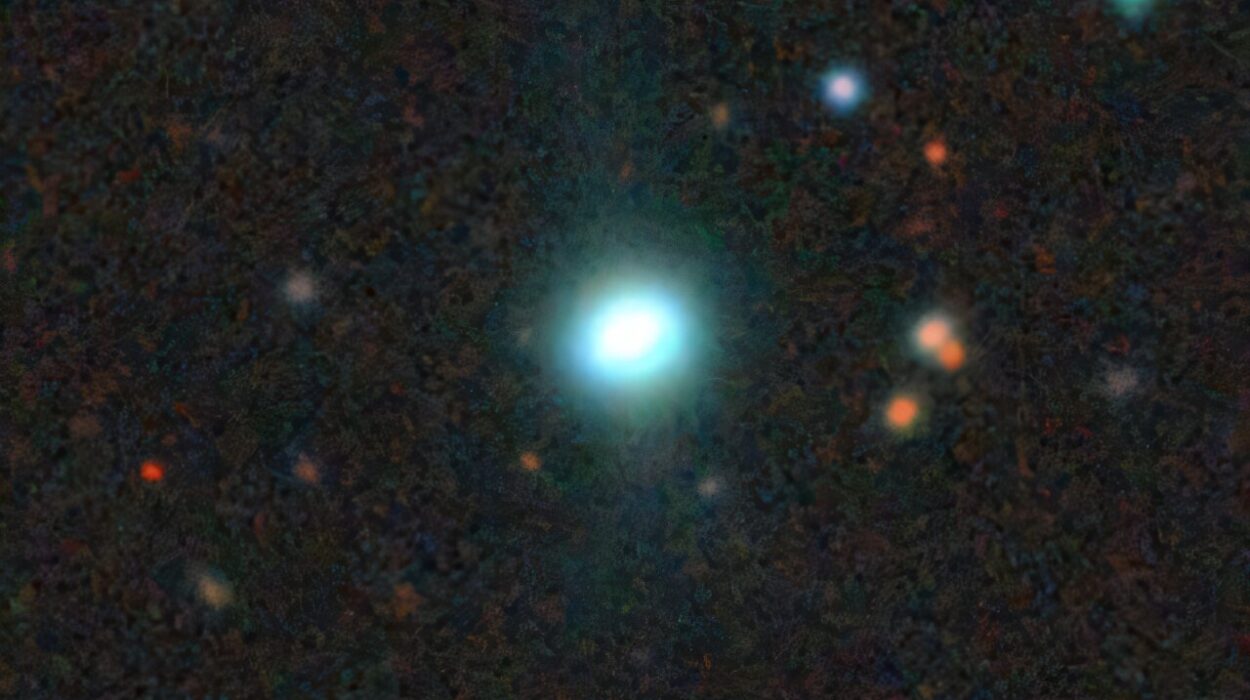
Imagine gazing across the vast, dark ocean of the cosmos, looking so far back in time that the light you see began its journey when the universe was still in its infancy. For years, astronomers have peered into this ancient fog, searching for the first signs of order among the chaotic birth of stars. Recently, a team led by Daniel Ivanov, a physics and astronomy researcher at the University of Pittsburgh, spotted something remarkable hidden within the light of a distant island of stars. They found a stellar bar—a straight, glowing line of material cutting through the heart of a spiral galaxy known as COSMOS-74706.
This discovery is not just a matter of spotting a pretty shape in the dark; it is like finding a sophisticated piece of machinery in an era where scientists expected only raw materials. The Milky Way, our own home in the universe, possesses a similar stellar bar, but we have long viewed our galaxy as a mature, evolved structure. Finding such a feature in COSMOS-74706 suggests that the complex “skeletons” of galaxies were being built much earlier than many once thought possible. By capturing the light of this galaxy, the team has effectively taken a snapshot of a cosmic milestone, placing this structured beauty at a staggering 11.5 billion years in the past.
The Architecture of an Ancient Giant
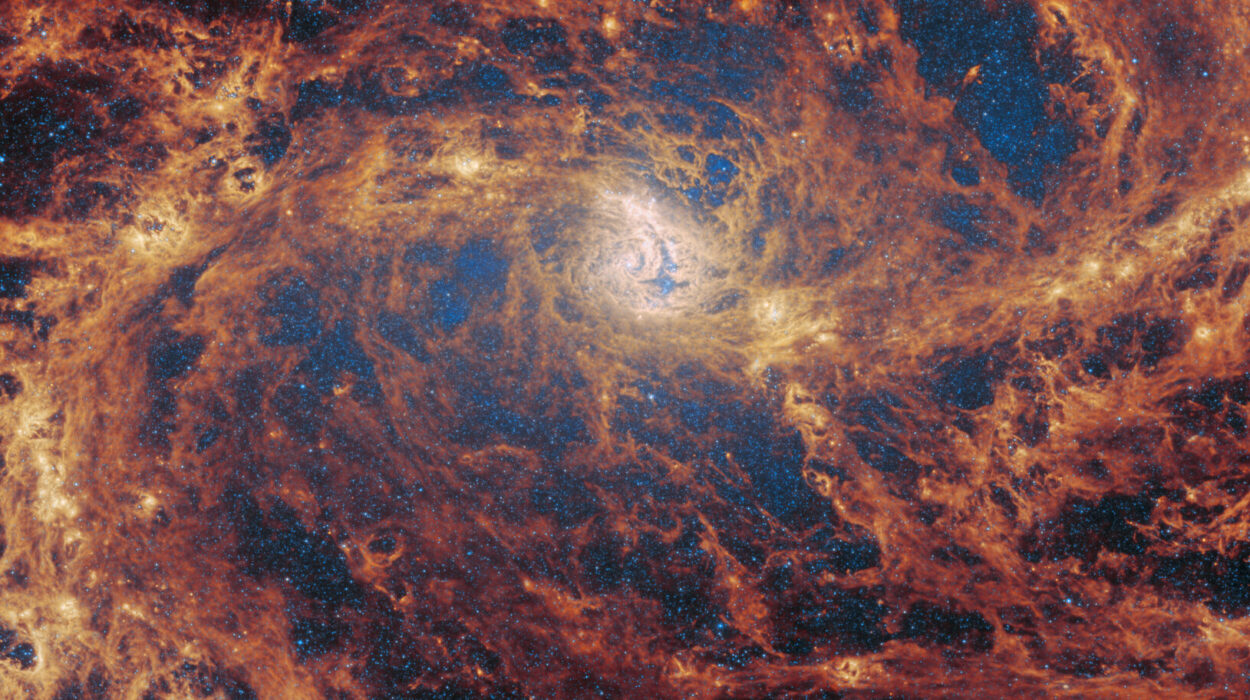
To understand why this discovery is so captivating, one must first understand what a stellar bar actually is. Despite the name, it isn’t a solid, singular object like a rod of iron. Instead, it is a dense, linear feature composed of a massive collection of stars and gas. When we look at a galaxy from above—perpendicular to its flat plane—the orbits of these stars align so perfectly that they create the illusion of a bright, bisecting line cutting through the center. It is a masterpiece of gravitational choreography, where billions of individual suns dance in a synchronized, elongated loop.
The presence of this bar in COSMOS-74706 tells a story of a galaxy that was rapidly growing up. According to Ivanov, this galaxy was already developing its bar only 2 billion years after the Big Bang. In the grand timeline of the universe, which stretches back nearly 14 billion years, this is an incredibly early appearance. It suggests that even in the turbulent, high-energy environment of the early universe, gravity was already capable of corralling gas and stars into the rigid, organized patterns we see in the modern cosmos today.
Sifting Truth from the Cosmic Fog
In the hunt for the universe’s first barred spiral galaxies, many researchers have claimed to find even older examples, but the hunt is fraught with optical illusions and technical hurdles. Some previous candidates were found using methods to measure redshift—the stretching of light as the universe expands—that were not entirely definitive. Others were viewed through the “funhouse mirror” of gravitational lensing, a phenomenon where the light from a distant galaxy is warped and distorted as it passes by a massive object in the foreground. While beautiful, gravitational lensing can make it difficult to tell if a galaxy truly has a bar or if the light is simply being stretched by gravity.
This is where the study of COSMOS-74706 stands apart. Ivanov’s team utilized spectroscopy, a method of breaking down light into its constituent parts to get a precise, undeniable measurement of its age and distance. Because this galaxy is unlensed, meaning its light traveled to us in a straight, undistorted path, the researchers can be confident in what they are seeing. It is, as Ivanov notes, the highest redshift, spectroscopically confirmed, and unlensed barred spiral galaxy ever identified. It provides a clean, clear window into the deep past, free from the visual artifacts that have clouded earlier discoveries.
The Great Engine of Galactic Change
Finding a bar in a galaxy so early in time is more than just a record-breaking feat of observation; it reveals the engine that drives how galaxies live and die. A stellar bar acts as a powerful cosmic funnel. Because of its gravitational pull, it drags gas from the outer edges of the galaxy and pushes it toward the center. This influx of fuel does two major things: it feeds the supermassive black hole lurking at the galactic core, and it can eventually lead to the dampening of star formation throughout the rest of the stellar disk.
By moving gas around so efficiently, the bar dictates how many new stars a galaxy can give birth to and how active its central black hole will become. Finding this “engine” active in COSMOS-74706 means that the processes that shape a galaxy’s evolution were already in full swing during a period when the universe was supposed to be a much more chaotic place. While some computer simulations suggested that bars could form as early as 12.5 billion years ago (a redshift of 5), seeing a confirmed, physical example at 11.5 billion years ago provides the hard data scientists need to constrain their theories.
Why This Ancient Light Matters
The discovery of COSMOS-74706 is a vital piece of the puzzle in understanding our own origins. Because our Milky Way is also a barred spiral, learning when and how these features first emerged helps us understand the life story of our own corner of the woods. This research, which will be presented at the 247th meeting of the American Astronomical Society, forces us to reconsider the “childhood” of the universe. It proves that the era 2 billion years after the Big Bang was not just a time of random collisions, but an epoch where the sophisticated structures of the modern universe were already taking shape. It reminds us that even in the distant past, the laws of physics were already hard at work, carving out the beautiful, orderly patterns that would one day lead to galaxies like our own.