Astronomers have identified an extraordinary stellar explosion that may represent one of the clearest examples yet of a long-sought pair-instability supernova—a rare event capable of completely destroying a massive star. Observations of SN 2023vbw reveal an explosion far more energetic than typical supernovae, with evidence pointing to the self-destruction of a star hundreds of times more massive than the Sun.
Some stellar explosions leave behind neutron stars. Others create black holes. But one rare class of cosmic catastrophe is predicted to erase a star entirely.
That may be exactly what astronomers have found in SN 2023vbw, an unusual explosion discovered in 2023 that refuses to fit neatly into established categories of supernovae. Detailed observations now suggest the event could be a rare pair-instability supernova, a theoretically predicted type of explosion so violent that it completely consumes the star that created it.
The findings, described in a paper posted to the arXiv preprint server on May 15, offer a potentially valuable glimpse into how some of the universe’s most massive stars end their lives.
An Explosion That Did Not Behave Like a Normal Supernova
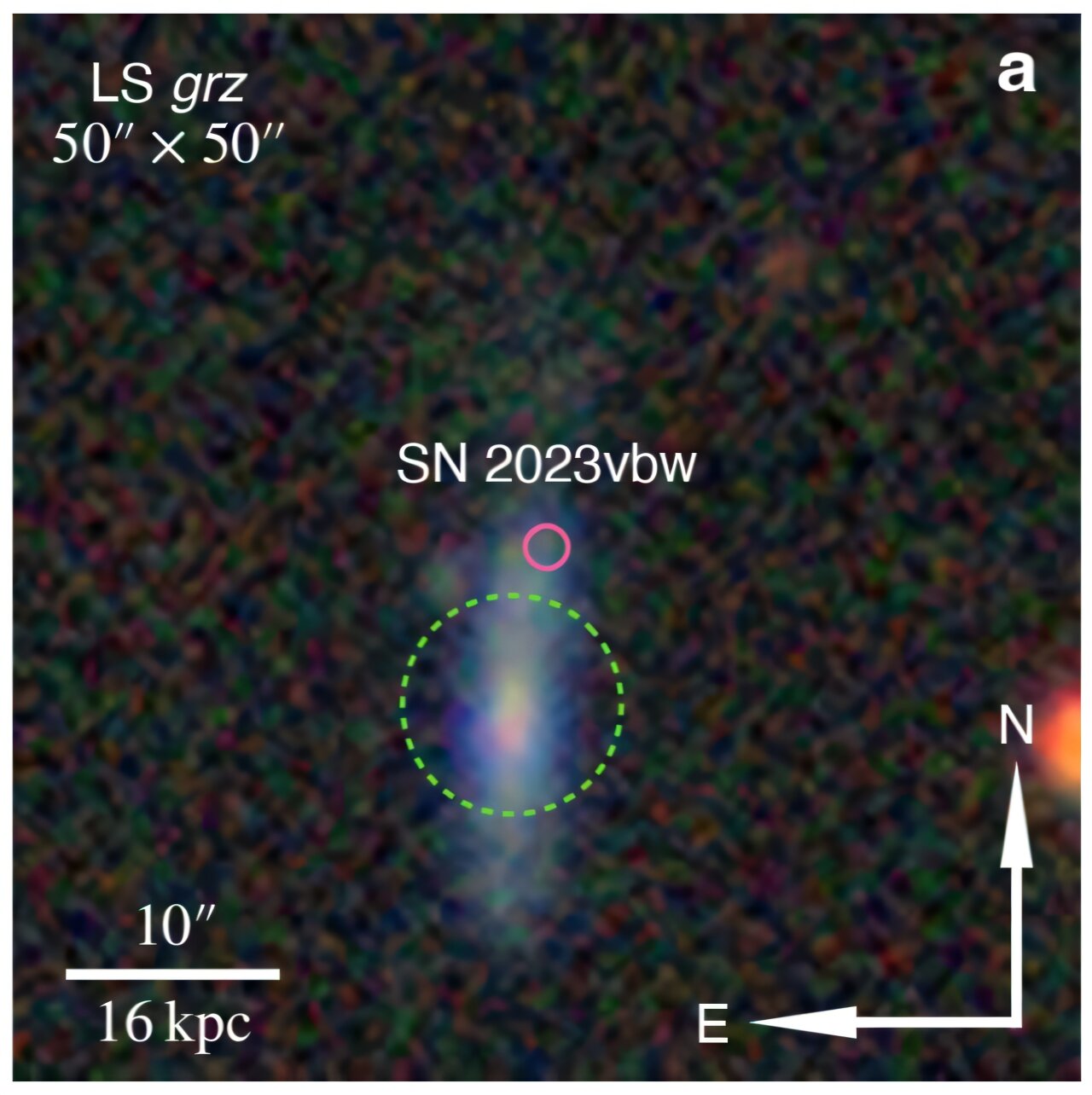
SN 2023vbw was first detected by the Zwicky Transient Facility in October 2023. The explosion occurred on the outskirts of a small, metal-poor dwarf galaxy located about 1.3 billion light-years from Earth.
Initially, researchers classified it as a Type II supernova, a common variety that occurs when a massive star runs out of nuclear fuel, collapses under its own gravity, and explodes.
However, the object quickly began to stand out.
The first major clue came from its light curve, which tracks how brightness changes over time. Instead of displaying the characteristic plateau expected from a Type II supernova, SN 2023vbw followed a very different pattern. After an initial cooling phase, its brightness steadily increased, reaching a peak roughly 190 days after the explosion.
The event then faded rapidly between 190 and 230 days before settling into a slowly declining stage known as the tail phase.
Its total radiated energy was estimated at approximately 3 × 10⁵⁰ ergs, more than ten times greater than that of a typical Type II supernova.
Researchers also found that during the brightening phase, the explosion maintained a nearly constant temperature while its outer layers continued expanding. Such behavior suggests the presence of a powerful and sustained internal heating source, something not normally seen in ordinary Type II events.
Signs of Interaction With Material Around the Star
As the supernova evolved, additional unusual features emerged.
During the fading stage, astronomers observed forbidden emission lines beginning to appear in the spectrum. Later, during the tail phase, hydrogen emission lines developed a complex structure that included a redshifted component.
According to the team’s analysis, these signatures indicate that the expanding debris from the explosion was colliding with a dense, disk-like shell of material surrounding the star.
This material was likely expelled before the star’s death, providing important clues about the final stages of its evolution.
The interaction between the ejecta and this surrounding shell helped researchers reconstruct what kind of star may have produced the explosion.
Evidence Points to an Enormous Blue Supergiant
Modeling of the light curve suggests that SN 2023vbw originated from an exceptionally massive blue supergiant star.
Its overall brightness pattern resembles that of SN 1987A, a famous Type II supernova that also came from a compact blue supergiant. Yet SN 2023vbw was significantly brighter and evolved over a much longer timescale, indicating a far more massive progenitor.
The researchers estimate the explosion ejected between 170 and 350 solar masses of material.
Even more striking was the energy involved. The kinetic energy released was estimated to be roughly 60 to 130 times greater than the maximum energy expected from a conventional iron core-collapse supernova.
The environment in which the explosion occurred provides another important clue. The host galaxy’s metallicity was only about one-tenth that of the Sun, matching theoretical expectations for pair-instability supernova progenitors.
A Possible Stellar Merger Before Death
The research team proposes that the blue supergiant may itself have formed through the merger of two massive stars in a binary system.
Such a scenario could naturally explain the dense disk-like shell observed around the explosion site. Material expelled during or after the merger could have remained nearby until the final explosion occurred.
Even so, important uncertainties remain.
Researchers note that astronomers still do not fully understand whether extremely massive stars end their lives as red supergiants or blue supergiants. Questions also remain about when such mergers might occur during a star’s lifetime and how those events influence the final explosion.
How Pair-Instability Supernovae Destroy Entire Stars
Pair-instability supernovae represent one of the most extreme stellar deaths predicted by theory.
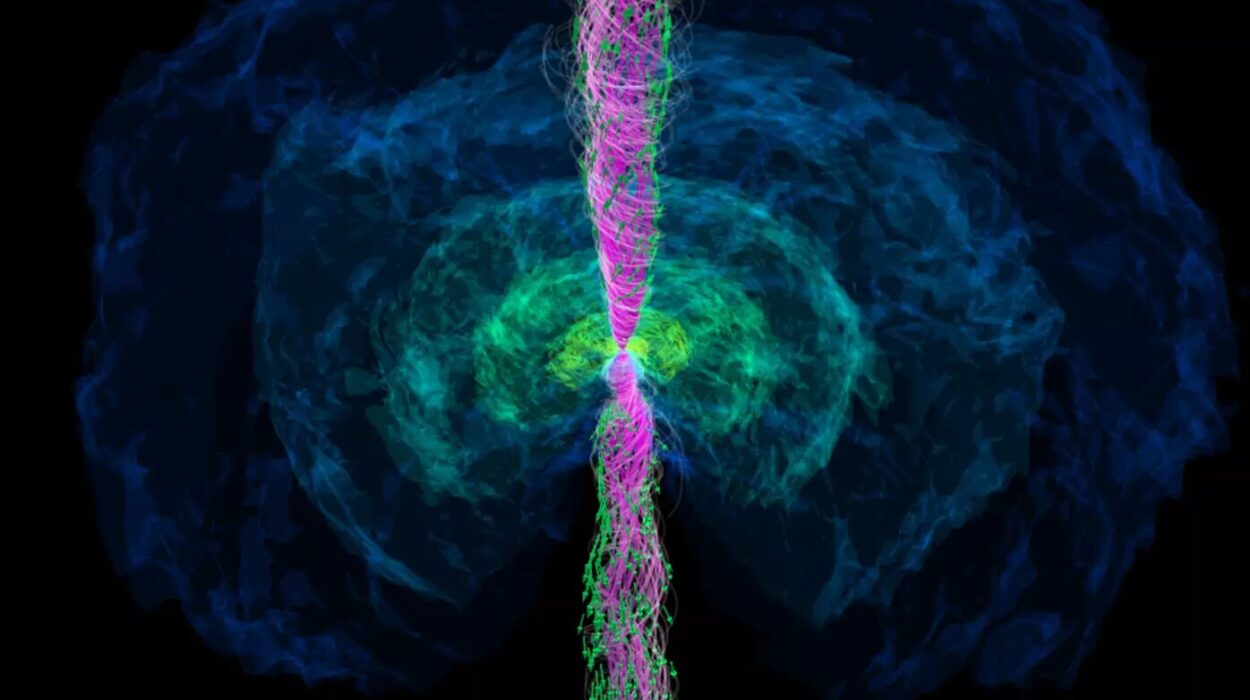
In stars of extraordinary mass, temperatures in the core can become so high that energy is converted into electron-positron pairs. This process reduces the radiation pressure supporting the star against gravity.
Without that support, the core becomes unstable, triggering a runaway thermonuclear explosion.
Unlike many other supernovae, which leave behind compact remnants, a pair-instability explosion is expected to consume the entire star. No neutron star or black hole should remain.
Theoretical models predict this fate for stars with initial masses of roughly 140 to 260 solar masses in low-metallicity environments. The modeled properties of SN 2023vbw appear to fall comfortably within that predicted range.
Why This Matters
Pair-instability supernovae have long been predicted but remain exceptionally difficult to identify with confidence. If SN 2023vbw truly belongs to this rare class, it would provide an important opportunity to study one of the most extreme stellar explosions known.
Because the object remains relatively nearby and bright, astronomers can continue observing it across multiple wavelengths to investigate its mass-loss history and the elements forged during the explosion.
The discovery could also be a preview of what future observatories will uncover. Researchers expect upcoming surveys conducted by the Vera Rubin Observatory and the Nancy Grace Roman Space Telescope to detect tens to hundreds of similar events.
Finding more examples would help astronomers understand how the universe’s most massive stars evolve, shed material, and ultimately meet their dramatic end—sometimes by destroying themselves completely.
Study Details
Daichi Hiramatsu et al, The pair-instability origin of supernova 2023vbw, arXiv (2026). DOI: 10.48550/arxiv.2605.16487