Astronomers have identified a giant stellar bar inside GN20, a massive galaxy seen just 1.5 billion years after the Big Bang, revealing a structure that many models suggested should not yet exist. The discovery, made with the James Webb Space Telescope, suggests that turbulent gas may have helped form and sustain the bar, potentially accelerating star formation and shaping the evolution of some of the universe’s earliest massive galaxies.
A galaxy from the dawn of cosmic history has delivered an unexpected surprise.
Using the James Webb Space Telescope (JWST), astronomers have discovered a large stellar bar stretching across the heart of GN20, a distant galaxy observed at a time when the universe was only about 1.5 billion years old. The finding challenges long-standing ideas about how quickly these structures can emerge and raises new questions about the processes that shaped some of the universe’s earliest giant galaxies.
The research, led by Leindert A. Boogaard of Leiden University, was submitted to the preprint server arXiv on May 14.
A Structure That Should Have Been Too Young to Exist
Stellar bars are elongated arrangements of stars that extend across the centers of galaxies. As they rotate, they act as cosmic channels, drawing gas toward the galactic core.
This inward flow of material can trigger bursts of star formation, help build dense central regions, and potentially feed supermassive black holes. Stellar bars are common in the modern universe, including in the Milky Way.
However, astronomers have generally believed that bar formation is a slow process that unfolds over billions of years. Early galaxies were also thought to contain large amounts of gas, a condition expected to suppress or delay the development of these structures.
That assumption was already being tested after JWST began detecting stellar bars within the first 2 billion years of cosmic history. The newly identified bar in GN20 adds one of the most striking examples yet.
Peering Through Dust to Reveal GN20’s Hidden Core
GN20 is a massive galaxy located at redshift 4, making it both extremely distant and difficult to study. The galaxy is heavily obscured by dust, which has long concealed its internal structure.
JWST’s Mid-Infrared Instrument and Near-Infrared Camera changed that picture.
By effectively seeing through the dust, the telescope allowed researchers to examine the galaxy’s inner regions in unprecedented detail. The team analyzed how the brightness of the galaxy changed and rotated from the center outward, a technique known as isophotal analysis.
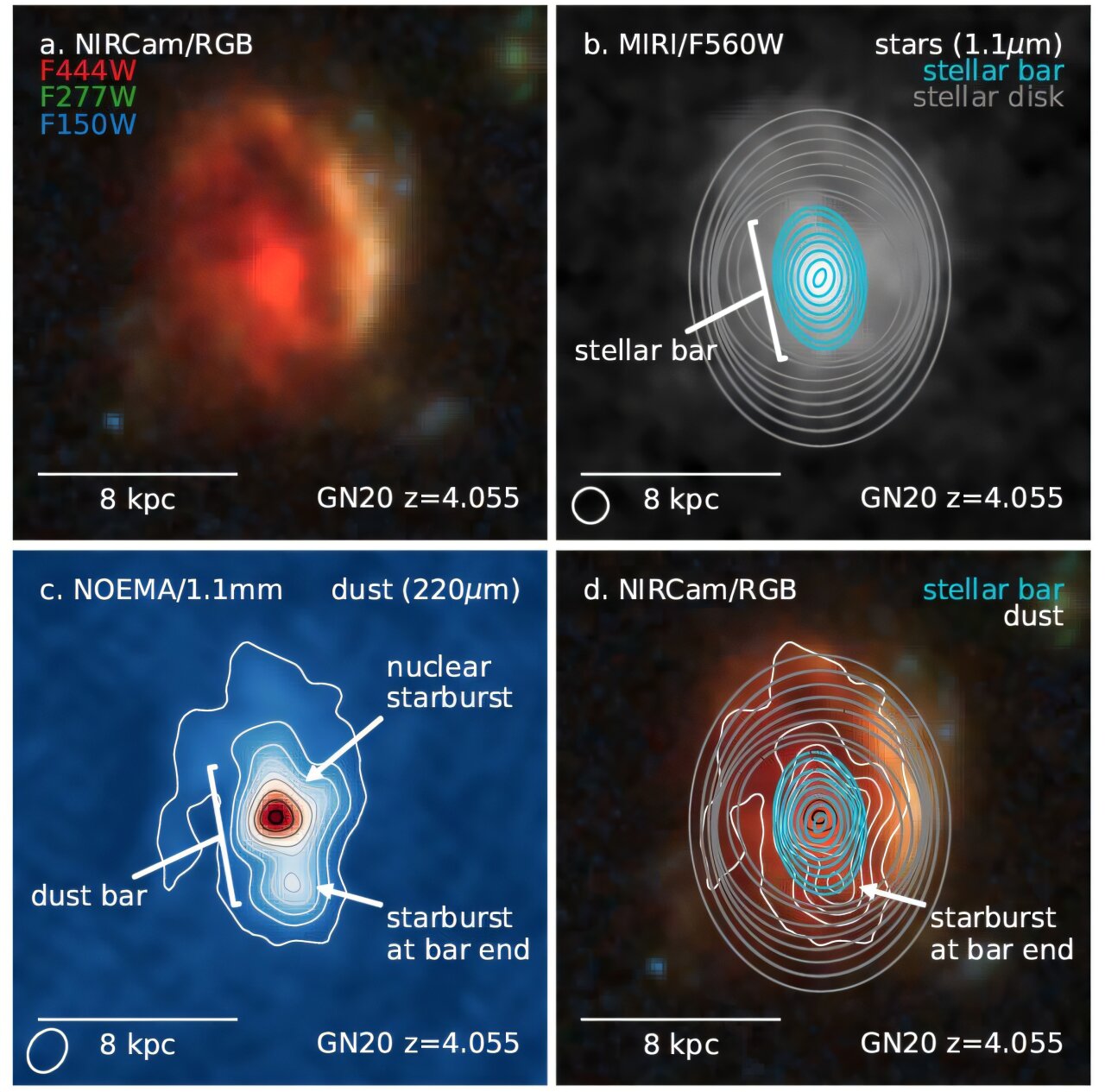
The results revealed a clear stellar bar measuring approximately seven kiloparsecs from end to end.
To verify the finding, the researchers applied an entirely separate mathematical analysis of the galaxy’s light distribution. That independent method produced the same conclusion. The detected structure also matched a bar-shaped feature previously identified in dust observations made by the NOrthern Extended Millimeter Array (NOEMA).
Together, the evidence strongly supports the presence of a genuine stellar bar.
Why the Discovery Is So Surprising
According to current theoretical expectations, the bar in GN20 faces three major obstacles.
First, bars that form under such conditions are expected to become so strong that they collapse under their own weight. Second, growing a structure to a length of seven kiloparsecs should normally require billions of years. Third, the galaxy’s high gas content should have delayed or prevented bar formation altogether.
Yet the observations indicate that the bar exists despite all three challenges.
The researchers argue that a single factor may explain this apparent contradiction: the presence of highly turbulent gas throughout the galaxy’s inner disk.
In their paper, the team writes that this turbulence, combined with the galaxy’s high gas fraction, appears capable of overcoming the barriers that standard models predict.
While some uncertainties remain, particularly regarding estimates of stellar mass in the dust-obscured central regions, the authors emphasize that these limitations do not alter the main conclusion. GN20 remains a gas-rich galaxy, and the stellar bar appears to be real.
A Powerful Engine for Star Formation
The observations also provide clues about how the bar is influencing the galaxy itself.
Researchers found evidence that intense star formation is concentrated in specific regions connected to the bar. On the southern side of the galaxy, where the bar meets the outer disk, gas appears to accumulate and ignite a hotspot of vigorous star formation.
Meanwhile, the bar is also funneling material toward the galaxy’s center.
This process is believed to be fueling a nuclear starburst and may also be feeding a central supermassive black hole. The mechanism could help explain GN20’s extraordinary star formation rate, which exceeds 1,000 solar masses per year.
According to the researchers, part of this remarkable activity is likely driven directly by the bar’s ability to transport gas and dust into the galaxy’s core, where conditions become favorable for rapid star formation and possible black hole growth.
A Potential Clue to the Fate of Massive Galaxies
The implications may extend far beyond a single galaxy.
If stellar bars can efficiently channel gas into galactic centers and rapidly consume the fuel needed for star formation, they could play a major role in determining how galaxies evolve.
Once a galaxy exhausts its supply of star-forming gas, the creation of new stars slows dramatically or stops altogether. Over time, the galaxy becomes quiet and inactive.
The researchers suggest that bar-driven activity in systems like GN20 may represent a missing piece of a larger puzzle. Such processes could help explain how some of the massive elliptical galaxies seen in the present-day universe became dormant so early in their histories.
Why This Matters
The discovery of a seven-kiloparsec stellar bar in a gas-rich galaxy just 1.5 billion years after the Big Bang challenges key assumptions about when and how these structures form. Rather than preventing bar growth, turbulent gas may have helped create one of the earliest known examples.
By revealing how bars can drive extreme star formation and potentially accelerate galaxy evolution, JWST is providing a new window into the forces that shaped the universe’s first massive galaxies. GN20 suggests that some galaxies may have matured far faster than astronomers once believed, forcing scientists to rethink the timeline of cosmic evolution.
Study Details
Leindert A. Boogaard et al, A stellar bar hidden in an extreme gas-rich disk galaxy at z=4.055, arXiv (2026). DOI: 10.48550/arxiv.2605.15273